Practise 20 questions on Forming expressions and using identities for Year 8 Maths. Write your answer and get it marked in seconds against the mark scheme, point by point, with the Study Helper on hand if you get stuck.
20 questions
1–5 marks each
Instant marking
No sign-up needed
20 questions, marked as you go
Sample questions with model answers
Here are 4 of the questions in this topic, each with a model answer, an explanation of why it earns the marks and the mark scheme.
Question 1
1 mark
Here is a statement.
\(6(x - 2) \equiv 6x - 12\)
What does the symbol \(\equiv\) tell you about the two sides?
Model answer
The symbol \(\equiv\) means 'is identically equal to'. The two sides are equal for every value of \(x\), so the statement is an identity.
Explanation
The symbol \(\equiv\) has three lines instead of two. It shows an identity: the two sides are equal whatever number \(x\) stands for. You can check by expanding: \(6(x - 2)\) is exactly \(6x - 12\). An ordinary equals sign is also used in equations, which are true only for some values.
Mark scheme
1 mark
The two sides are equal for every value of \(x\) / the two expressions are identical (equivalent) / the statement is an identity
Accept 'is identical to', 'is always equal to' or 'is equivalent to'. Do not accept 'equals' or 'is equal to' on its own, or 'is approximately equal to'. A correct answer with no working scores full marks.
Question 2
2 marks
Write the missing term in each identity.
Identity 1: \(\square(2x - 3) \equiv 10x - 15\)
Identity 2: \(3x(x - 2) \equiv 3x^2 - \square\)
Model answer
Identity 1: \(\square \times 2x = 10x\), so the missing term is 5. Check: \(5(2x - 3) = 10x - 15\) Identity 2: \(3x \times 2 = 6x\), so the missing term is \(6x\).
Explanation
In an identity both sides are the same expression written in different ways, so expand and match the terms. In identity 1, the number outside times \(2x\) gives \(10x\), so it is 5; check that \(5 \times -3 = -15\). In identity 2, the \(3x\) outside multiplies the 2 to give \(6x\). A common mistake is to write just 6 and forget the \(x\).
Mark scheme
1 mark
Identity 1: 5
Do not accept \(5x\) or 10.
1 mark
Identity 2: \(6x\)
Do not accept 6 on its own (the term is \(6x\)), 2 or \(6x^2\). Each identity is marked on its own. A correct answer with no working scores full marks.
Question 3
3 marks
Mia wants to know whether \(x(x + 2) = x^2 + 4\) is an identity. She puts \(x = 2\) into both sides. Both sides come to 8, so she says it is an identity.
Explain why Mia is wrong. Then write an expression, without brackets, that \(x(x + 2)\) is identical to.
Model answer
An identity must be true for every value of \(x\), not just one. When \(x = 1\): \(x(x + 2) = 1 \times 3 = 3\), but \(x^2 + 4 = 5\). The sides are different, so it is not an identity. \(x(x + 2) \equiv x^2 + 2x\)
Explanation
One value that works does not make a statement an identity: it must work for every value of \(x\). Mia happened to choose the one value where both sides agree, because \(x^2 + 2x\) and \(x^2 + 4\) are only equal when \(2x = 4\). Expanding is the reliable test: \(x(x + 2) \equiv x^2 + 2x\), so \(x(x + 2) = x^2 + 4\) is an equation with the solution \(x = 2\).
Mark scheme
1 mark
A relevant but incomplete reason, e.g. 'one value is not enough' or 'it has to work for every value of \(x\)'
'She is wrong' alone scores 0.
1 mark
A complete correct reason, e.g. another value gives different sides, such as \(x = 1\): \(1 \times 3 = 3\) but \(1 + 4 = 5\) / \(x(x + 2) = x^2 + 2x\), which only equals \(x^2 + 4\) when \(2x = 4\), so it is only true for \(x = 2\)
A complete correct reason on its own scores both marks.
1 mark
\(x^2 + 2x\)
Accept \(2x + x^2\), with the power typed any clear way. The expression scores this mark on its own; the first two marks need the explanation.
Question 4
4 marks
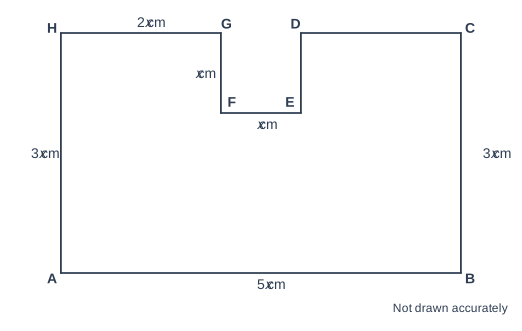
The diagram shows a shape made by cutting a square notch out of the top edge of a rectangle. Its corners are labelled A to H. All its sides meet at right angles.
Work out the lengths of CD and DE. Then write an expression for the perimeter of the shape and an expression for its area. Give each answer in its simplest form.
Model answer
\(CD = 5x - 2x - x = 2x\) \(DE = FG = x\) Perimeter \(= 5x + 3x + 2x + x + x + x + 2x + 3x = 18x\) cm Area \(= 5x \times 3x - x \times x = 15x^2 - x^2 = 14x^2\) cm²
Explanation
The top edges and the notch together make the same width as the bottom, so \(CD = 5x - 2x - x = 2x\); the two sides of the notch are equal, so \(DE = x\). The perimeter goes all the way round, including the three sides of the notch, so it is more than the perimeter of the rectangle. For the area, take the notch away from the whole rectangle: \(15x^2 - x^2 = 14x^2\). A common mistake is to forget the notch's sides in the perimeter.
Mark scheme
1 mark
\(CD = 2x\) and \(DE = x\); or the correct answers \(18x\) and \(14x^2\) with no working
Both needed.
1 mark
Perimeter \(= 18x\)
Ignore units. Follow through their CD and DE. Do not accept \(16x\) (the perimeter of the rectangle without the notch).
1 mark
A correct method for the area, e.g. \(5x \times 3x - x \times x\), or three rectangles such as \(2x \times 3x + x \times 2x + 2x \times 3x\)
1 mark
Area \(= 14x^2\)
Accept the power typed any clear way. Ignore units. Do not accept \(15x^2\) (the notch not taken away) or \(14x\). A correct answer with no working scores full marks.
Ready to try the rest? Every answer you write is marked against the mark scheme, so you can see exactly where the marks are.
Ctrl + Enter to check
Study HelperHints first, answers after you try
Stuck on this one? Ask for a hint and I’ll point you in the right direction, without giving the answer away. Once you’ve checked your answer, I’ll show you how the marks are awarded.