Level:
Correct: 0
Incorrect: 0
Marks: 0/0
Practice
Course:
Topics:
Year 8 Maths Smart practice A mixed round aimed at your weak spots
Unit 1
Number: accuracy, powers and standard form
Unit 2
Fractions, decimals and percentages
Unit 3
Algebraic expressions
Unit 4
Equations, inequalities and formulae
Unit 5
Sequences and graphs
Unit 6
Ratio, proportion and rates of change
Unit 7
Circles, area and volume
Unit 8
Angles and constructions
Unit 9
Transformations and symmetry
Unit 10
Probability
Unit 11
Statistics
Avg
score:
–
Topics
done:
0/50

Translations and combined transformations

Practise 20 questions on Translations and combined transformations for Year 8 Maths. Write your answer and get it marked in seconds against the mark scheme, point by point, with the Study Helper on hand if you get stuck.

  • 20 questions
  • 1–5 marks each
  • Instant marking
  • No sign-up needed
20 questions, marked as you go

Sample questions with model answers

Here are 4 of the questions in this topic, each with a model answer, an explanation of why it earns the marks and the mark scheme.

Question 1

1 mark

What does the translation \(\begin{pmatrix} -4 \\ 0 \end{pmatrix}\) do to a shape?

Choose your answer.

  • Moves it 4 squares left
  • Moves it 4 squares down
  • Moves it 4 squares right

Model answer

The top number is the move across: \(-4\) means 4 to the left.
The bottom number is 0, so there is no move up or down.
Moves it 4 squares left

Explanation

The top number of a column vector tells you how far to move across, and a negative number means to the left. The bottom number tells you how far to move up or down, and here it is 0, so the shape does not move up or down at all. A common mistake is to read the top number as the up-or-down move.

Mark scheme
  1. 1 mark

    Moves it 4 squares left

    Accept '4 left'. '4 squares down' scores 0 (reading the top number as the move up or down). '4 squares right' scores 0 (ignoring the minus sign).

Question 2

2 marks

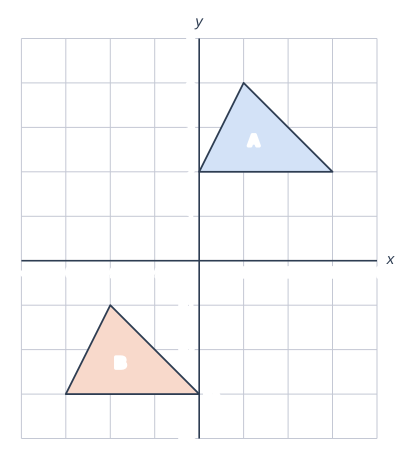
The diagram shows two triangles, A and B.
Triangle B is where triangle A ends up after a translation.

Write the column vector for the translation.

A coordinate grid with x from −4 to 4 and y from −4 to 5; each grid square is 1 unit across, and the axes cross at the origin O. Shape A is a shaded triangle with vertices (0, 2), (3, 2) and (1, 4). Shape B is a shaded triangle with vertices (−3, −3), (0, −3) and (−2, −1).

Model answer

The corner \((0, 2)\) of A moves to \((-3, -3)\) on B.
That is 3 to the left and 5 down.
\(\begin{pmatrix} -3 \\ -5 \end{pmatrix}\)

Explanation

Choose one corner of A and find the matching corner of B, then count the squares: across first, then up or down. Left and down are negative, so both numbers here are negative. Check with another corner: \((3, 2)\) moves to \((0, -3)\), which is also 3 left and 5 down. A common mistake is to count from a corner of A to a different corner of B.

Mark scheme
  1. 1 mark

    One number of the vector correct: \(-3\) on top or \(-5\) underneath; or the correct answer \(\begin{pmatrix} -3 \\ -5 \end{pmatrix}\) with no working

    May be seen in words, e.g. '3 left' or '5 down'.

  2. 1 mark

    \(\begin{pmatrix} -3 \\ -5 \end{pmatrix}\)

    Accept the vector typed in any clear way, with the across number first: a column vector from the maths keyboard, (-3, -5) or -3, -5 typed in a row, '-3 over -5' or (-3/-5), or in words, 3 left and 5 down. (3, 5) (from B to A) or (-5, -3) scores 0 for this mark. A correct answer with no working scores full marks.

Question 3

3 marks

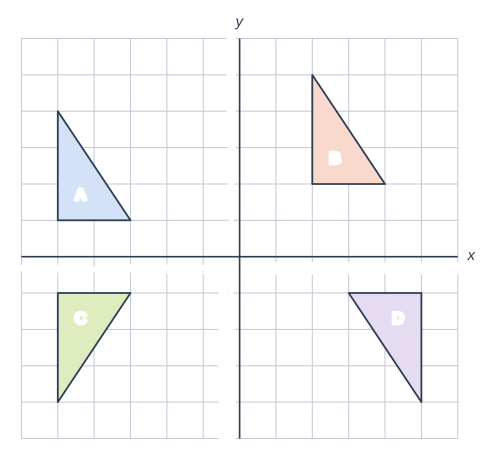
The diagram shows four triangles, A, B, C and D.

Write the type of single transformation that maps triangle A onto each of the other triangles: onto B, onto C and onto D.

A coordinate grid with x from −6 to 6 and y from −5 to 6; each grid square is 1 unit across, and the axes cross at the origin O. Shape A is a shaded triangle with vertices (−5, 1), (−3, 1) and (−5, 4). Shape B is a shaded triangle with vertices (2, 2), (4, 2) and (2, 5). Shape C is a shaded triangle with vertices (−5, −1), (−3, −1) and (−5, −4). Shape D is a shaded triangle with vertices (5, −1), (3, −1) and (5, −4).

Model answer

B faces the same way as A and has just moved: translation.
C is A flipped over the x-axis: reflection.
D is A turned upside down, a half turn about the origin: rotation.

Explanation

Ask two questions about each image. Is it flipped over, so it is a mirror image? Then it is a reflection. Is it turned round but not flipped? Then it is a rotation. Has it just slid, still facing the same way? Then it is a translation. A common mistake is to call D a reflection: it has been turned through \(180^\circ\), so it is upside down but it is not a mirror image of A.

Mark scheme
  1. 1 mark

    A onto B: translation

    Accept 'translated' or 'slide'. If a full description is given, ignore a wrong vector, mirror line or centre.

  2. 1 mark

    A onto C: reflection

    Accept 'reflected' or 'flip'.

  3. 1 mark

    A onto D: rotation

    Accept 'rotated', 'turn' or 'half turn'. Reflection scores 0 for this mark. A correct answer with no working scores full marks.

Question 4

4 marks

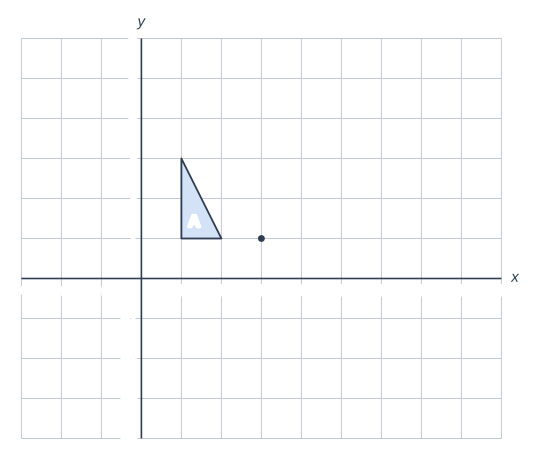
The diagram shows shape A and the point P.

Shape A is rotated \(180^\circ\) about the origin to give shape B.
Shape B is then rotated \(180^\circ\) about P to give shape C.

Describe fully the single transformation that maps shape A onto shape C.

A coordinate grid with x from −3 to 9 and y from −4 to 6; each grid square is 1 unit across, and the axes cross at the origin O. Shape A is a shaded triangle with vertices (1, 1), (2, 1) and (1, 3). Point P is marked with a dot at (3, 1).

Model answer

B (half turn about O): \((-1, -1)\), \((-2, -1)\), \((-1, -3)\)
C (half turn about P \((3, 1)\)): \((7, 3)\), \((8, 3)\), \((7, 5)\)
C faces the same way as A, and every corner has moved 6 right and 2 up.
Translation by \(\begin{pmatrix} 6 \\ 2 \end{pmatrix}\)

Explanation

Each half turn turns the shape upside down, so two half turns bring it back the right way up: C faces the same way as A, so the single transformation is a translation. Compare one corner of A with its image in C to find the vector: \((1, 1)\) goes to \((7, 3)\). Notice that the vector is double the move from the first centre, O, to the second centre, P. A common mistake is to describe the two rotations instead of one single transformation.

Mark scheme
  1. 1 mark

    B correct: \((-1, -1)\), \((-2, -1)\), \((-1, -3)\); or the correct description, a translation by \(\begin{pmatrix} 6 \\ 2 \end{pmatrix}\), with no working

    Brackets are not needed, but each corner must be written in the order (x, y). May be implied by a correct shape C.

  2. 1 mark

    C correct: \((7, 3)\), \((8, 3)\), \((7, 5)\)

    Follow through their shape B.

  3. 1 mark

    Translation

    Naming two transformations, or 'a rotation of 360 degrees', scores 0 for the last two marks.

  4. 1 mark

    by the vector \(\begin{pmatrix} 6 \\ 2 \end{pmatrix}\)

    Accept the vector typed in any clear way, with the across number first: a column vector from the maths keyboard, (6, 2) or 6, 2 typed in a row, '6 over 2' or (6/2), or in words, 6 right and 2 up. A correct description with no working scores full marks.

Ready to try the rest? Every answer you write is marked against the mark scheme, so you can see exactly where the marks are.

Topic notes

Translations and combined transformations

The big idea

A translation slides a shape without turning or flipping it: every point moves the same distance in the same direction. A column vector describes the slide exactly, in two numbers.

In Year 7 you described translations in words, such as "2 squares left and 5 squares up". The image of a translation is congruent to the object: the same size and shape, facing the same way.

Column vectors

In the column vector \(\begin{pmatrix} a \\ b \end{pmatrix}\), the top number is the move across (right is positive, left is negative). The bottom number is the move up or down (up is positive, down is negative).

  • 3 left and 4 up is \(\begin{pmatrix} -3 \\ 4 \end{pmatrix}\).
  • \(\begin{pmatrix} 2 \\ 0 \end{pmatrix}\) is 2 right, with no move up or down.

To translate a point, add the top number to the x-coordinate and the bottom number to the y-coordinate.

A knight's move

In chess, a knight moves 2 squares one way, then 1 square at right angles. A knight stands at \((4, 3)\) on a coordinate grid.

(a) Write the move "2 left and 1 up" as a column vector.

Left is negative and up is positive: \(\begin{pmatrix} -2 \\ 1 \end{pmatrix}\).

(b) Where does the knight land after the move \(\begin{pmatrix} 1 \\ -2 \end{pmatrix}\)?

Across: \(4 + 1 = 5\). Up or down: \(3 + (-2) = 1\). It lands on \((5, 1)\).

Finding the vector

Count from a corner of the object to the matching corner of the image: across first, then up or down. (Or subtract: image coordinates minus object coordinates.) Check with a second corner. To go back from the image to the object, change both signs.

Which transformation?

To find the single transformation that maps shape A onto shape B (moves it exactly onto B), compare the two shapes:

  • B is a mirror image of A, flipped over: a reflection. Give the mirror line.
  • B is turned round but not flipped: a rotation. Give the angle, direction and centre.
  • B faces the same way as A: a translation. Give the column vector.

All three give an image congruent to the object.

A stencil

Mia paints shape A with a stencil, then moves the stencil to paint B, C and D. Only once did she just slide it. Which shape was that? Write the slide as a column vector.

A coordinate grid with x from −5 to 5 and y from −5 to 6; each grid square is 1 unit across, and the axes cross at the origin O. Shape A is a shaded hexagon with vertices P(−4, 1), (−2, 1), (−2, 2), (−3, 2), (−3, 4) and (−4, 4). Shape B is a shaded hexagon with vertices P′(2, −4), (4, −4), (4, −3), (3, −3), (3, −1) and (2, −1). Shape C is a shaded hexagon with vertices (4, 1), (2, 1), (2, 2), (3, 2), (3, 4) and (4, 4). Shape D is a shaded hexagon with vertices (−1, −4), (−1, −2), (−2, −2), (−2, −3), (−4, −3) and (−4, −4).
Shape A and the shapes B, C and D painted with the same stencil. Corner P of A matches corner P′ of B.

C is a mirror image of A (the stencil was flipped), and D lies on its side (it was turned). B faces the same way as A, so B is the translation.

P\((-4, 1)\) moves to P′\((2, -4)\). Across: \(2 - (-4) = 6\), so 6 right. Up or down: \(-4 - 1 = -5\), so 5 down.

The vector is \(\begin{pmatrix} 6 \\ -5 \end{pmatrix}\).

Check: the top corner \((-4, 4)\) moves to \((2, -1)\), also 6 right and 5 down.

Stretch: combining two transformations

Do the transformations one at a time, corner by corner, then compare the first shape with the last one. Two translations add: \(\begin{pmatrix} 2 \\ 1 \end{pmatrix}\) then \(\begin{pmatrix} -5 \\ 3 \end{pmatrix}\) is the same as \(\begin{pmatrix} -3 \\ 4 \end{pmatrix}\).

Two mirrors

A mirror along \(x = 1\) turns A into B, and a second mirror along \(x = 4\) turns B into C. Which single transformation takes A straight to C?

A coordinate grid with x from −3 to 7 and y from 0 to 5; each grid square is 1 unit across, and the axes cross at the origin O. Shape A is a shaded triangle with vertices (−2, 1), (0, 1) and (−2, 4). Shape B is a shaded, dashed triangle with vertices (4, 1), (2, 1) and (4, 4). Shape C is a shaded triangle with vertices (4, 1), (6, 1) and (4, 4). The line labelled "x = 1" is a vertical straight line crossing the x-axis at (1, 0). The line labelled "x = 4" is a vertical straight line crossing the x-axis at (4, 0).
A reflected in x = 1 gives B (dashed). B reflected in x = 4 gives C.

Reflect in \(x = 1\): \((-2, 1)\) is 3 left of the line, so it goes 3 right of it, to \((4, 1)\). B's other corners are \((2, 1)\) and \((4, 4)\).

Reflect in \(x = 4\): \((4, 1)\) and \((4, 4)\) are on the line, so they stay put. \((2, 1)\) goes to \((6, 1)\).

The two flips cancel out, so C faces the same way as A: a translation. \((-2, 1)\) moves to \((4, 1)\), which is 6 right.

Translation by \(\begin{pmatrix} 6 \\ 0 \end{pmatrix}\): twice the gap between the mirror lines, in the direction from the first mirror to the second. (Reflecting in \(x = 4\) first would give 6 left.)

Remember

  • Top number: across (right is positive). Bottom number: up or down (up is positive).
  • Count from the object to the image, using matching corners.
  • Translations, reflections and rotations all give congruent images.

Common mistakes

  • Swapping the two numbers: the across move goes on top.
  • Leaving out the minus sign: left and down are negative.
  • Counting from the image back to the object, which gives both signs the wrong way round.
  • Counting from a corner of A to a different corner of B: use matching corners.
  • Describing two transformations when the question asks for a single one.

Top tip

Say "across, then up or down" as you write a vector. It is the same order as the coordinates \((x, y)\).

Study Helper Hints first, answers after you try

Stuck on this one? Ask for a hint and I’ll point you in the right direction, without giving the answer away. Once you’ve checked your answer, I’ll show you how the marks are awarded.