Level:
Correct: 0
Incorrect: 0
Marks: 0/0
Practice
Course:
Topics:
Year 8 Maths Smart practice A mixed round aimed at your weak spots
Unit 1
Number: accuracy, powers and standard form
Unit 2
Fractions, decimals and percentages
Unit 3
Algebraic expressions
Unit 4
Equations, inequalities and formulae
Unit 5
Sequences and graphs
Unit 6
Ratio, proportion and rates of change
Unit 7
Circles, area and volume
Unit 8
Angles and constructions
Unit 9
Transformations and symmetry
Unit 10
Probability
Unit 11
Statistics
Avg
score:
–
Topics
done:
0/50

Plotting straight-line graphs

Practise 25 questions on Plotting straight-line graphs for Year 8 Maths. Write your answer and get it marked in seconds against the mark scheme, point by point, with the Study Helper on hand if you get stuck.

  • 25 questions
  • 1–5 marks each
  • Instant marking
  • No sign-up needed
20 questions, marked as you go

Sample questions with model answers

Here are 4 of the questions in this topic, each with a model answer, an explanation of why it earns the marks and the mark scheme.

Question 1

1 mark

The point \((-2, k)\) lies on the line \(x + y = 6\).

Work out the value of \(k\).

Model answer

\(x = -2\), so \(-2 + k = 6\)
\(k = 6 + 2 = 8\)

Explanation

On the line \(x + y = 6\), the two coordinates always add up to 6. The x-coordinate is \(-2\), so the y-coordinate must be 8, because \(-2 + 8 = 6\). A common mistake is to work out \(6 - 2 = 4\), but \(-2 + 4\) is only 2.

Mark scheme
  1. 1 mark

    \(k = 8\)

    Accept 8. Do not accept 4 (\(6 - 2\)) or \(-8\). A correct answer with no working scores full marks.

Question 2

2 marks

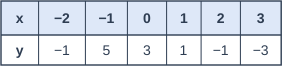
Ama makes a table of values for \(y = 3 - 2x\). One of her y-values is wrong.

Which y-value is wrong? What should it be?

Table with columns "x", "−2", "−1", "0", "1", "2", "3". x: y; −2: −1; −1: 5; 0: 3; 1: 1; 2: −1; 3: −3.

Model answer

\(x = -2\): \(y = 3 - 2 \times (-2) = 3 + 4 = 7\), not \(-1\)
The other values are right: \(5, 3, 1, -1, -3\).
The value for \(x = -2\) should be 7.

Explanation

Check each value with the rule. \(2 \times (-2) = -4\), and \(3 - (-4) = 7\). Ama worked out \(3 - 4 = -1\), losing the minus sign of \(-2\). The pattern helps too: the y-values should go down by 2 each time, so the first one must be 2 more than 5, which is 7.

Mark scheme
  1. 1 mark

    The y-value for \(x = -2\) (her \(-1\)) is wrong; or the correct answer (\(x = -2\) should give 7) with no working

    Accept 'the first one' or 'the -1 under -2'. Do not award for the \(-1\) under \(x = 2\), which is correct.

  2. 1 mark

    It should be 7

    From \(3 - 2 \times (-2) = 3 + 4\). Do not accept 1 or \(-7\). A correct answer with no working scores full marks.

Question 3

3 marks

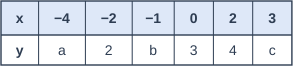
Here is a table of values for \(y = \dfrac{1}{2}x + 3\).

Work out the values of a, b and c.

Table with columns "x", "−4", "−2", "−1", "0", "2", "3". x: y; −4: a; −2: 2; −1: b; 0: 3; 2: 4; 3: c.

Model answer

\(x = -4\): \(a = -2 + 3 = 1\)
\(x = -1\): \(b = -0.5 + 3 = 2.5\)
\(x = 3\): \(c = 1.5 + 3 = 4.5\)

Explanation

\(\dfrac{1}{2}x\) means half of x. Half of \(-4\) is \(-2\), half of \(-1\) is \(-0.5\) and half of 3 is 1.5; then add 3 to each. The y-values go up by \(\dfrac{1}{2}\) every time x goes up by 1, which you can use to check: from \(x = 0\) (\(y = 3\)) back to \(x = -1\) is half a step down, 2.5. A common mistake is to work out \(-0.5 + 3\) as 3.5.

Mark scheme
  1. 1 mark

    \(a = 1\)

    From \(\dfrac{1}{2} \times (-4) + 3 = -2 + 3\). Do not accept 5 or \(-1\).

  2. 1 mark

    \(b = 2.5\)

    From \(-0.5 + 3\). Accept \(2\dfrac{1}{2}\) or 5/2. Do not accept 3.5.

  3. 1 mark

    \(c = 4.5\)

    From \(1.5 + 3\). Accept \(4\dfrac{1}{2}\) or 9/2. A correct answer with no working scores full marks.

Question 4

4 marks

A and B are two points on the line \(y = 2x - 3\).

A has x-coordinate \(-1\). B has y-coordinate 9.

Work out the coordinates of A and B.

Then work out the coordinates of the midpoint of AB.

Model answer

A: \(y = 2 \times (-1) - 3 = -5\), so A is \((-1, -5)\).
B: \(2x - 3 = 9\), \(2x = 12\), \(x = 6\), so B is \((6, 9)\).
Midpoint: \(\left(\dfrac{-1 + 6}{2}, \dfrac{-5 + 9}{2}\right) = (2.5, 2)\)

Explanation

For A you know x, so substitute it: \(2 \times (-1) - 3 = -5\). For B you know y, so solve \(2x - 3 = 9\) to get \(x = 6\). The midpoint is halfway along each coordinate: halfway between \(-1\) and 6 is 2.5, and halfway between \(-5\) and 9 is 2. The midpoint also lies on the line, as a check: \(2 \times 2.5 - 3 = 2\). A common mistake is to subtract the coordinates instead of adding them before halving.

Mark scheme
  1. 1 mark

    A is \((-1, -5)\); or the correct answers (A \((-1, -5)\), B \((6, 9)\), midpoint \((2.5, 2)\)) with no working

    Do not accept \((-1, -1)\) or \((-1, 5)\).

  2. 1 mark

    \(2x - 3 = 9\), or \(2x = 12\)

  3. 1 mark

    B is \((6, 9)\)

  4. 1 mark

    Midpoint \((2.5, 2)\)

    Follow through their A and B: \(\left(\dfrac{x_A + x_B}{2}, \dfrac{y_A + y_B}{2}\right)\). Accept \(\left(2\dfrac{1}{2}, 2\right)\). A correct answer with no working scores full marks.

Ready to try the rest? Every answer you write is marked against the mark scheme, so you can see exactly where the marks are.

Topic notes

Plotting straight-line graphs

The big idea

The equation of a straight line is a rule that the x- and y-coordinates of every point on the line obey. From the equation you can make a table of values, test whether a point is on the line, and work out which line on a grid is which.

In Year 7 you met lines parallel to the axes (going the same way as an axis, so they never meet it): \(y = 3\) is horizontal, parallel to the x-axis, and \(x = -2\) is vertical, parallel to the y-axis. The x-axis itself is \(y = 0\), and the y-axis is \(x = 0\).

Tables of values with negative numbers

Put each x-value into the rule, one at a time. Take care with negatives: \(-3 \times (-2) = 6\) and \(4 - (-3) = 7\). On a straight line the y-values change by the same amount each step, which gives you a check.

Complete a table of values for \(y = 1 - 3x\), for x from \(-2\) to 2.

\(x = -2\): \(y = 1 - 3 \times (-2) = 1 + 6 = 7\)

\(x = -1\): \(y = 1 - 3 \times (-1) = 1 + 3 = 4\)

\(x = 0\), 1 and 2: \(y = 1\), \(1 - 3 = -2\) and \(1 - 6 = -5\)

x−2−1012
y741−2−5

Check: the y-values go down by 3 each time.

An equation such as \(x + y = 4\) says the two coordinates add up to 4. So when \(x = -3\), \(y = 7\), because \(-3 + 7 = 4\).

Is a point on the line?

Put the point's x-coordinate (always first) and y-coordinate into the equation. If the equation is true, the point is on the line.

A game character runs along the line \(y = 2x + 3\). Which of the coins at \((-4, -5)\), \((1, 6)\), \((-1, 1)\) and \((3, 9)\) does it collect?

\((-4, -5)\): \(2 \times (-4) + 3 = -8 + 3 = -5\) ✓

\((1, 6)\): \(2 \times 1 + 3 = 5\), not 6 ✗

\((-1, 1)\): \(2 \times (-1) + 3 = -2 + 3 = 1\) ✓

\((3, 9)\): \(2 \times 3 + 3 = 9\) ✓

It collects the coins at \((-4, -5)\), \((-1, 1)\) and \((3, 9)\).

Reading a graph

  • To find y for a given x, start at x on the x-axis, go up or down to the line, then across to the y-axis.
  • To find x for a given y, start on the y-axis, go across to the line, then up or down.
  • Where two lines intersect (cross), the point lies on both lines, so its coordinates fit both equations.
A coordinate grid with x from −4 to 5 and y from −5 to 10; each grid square is 1 unit across, and the axes cross at the origin O. The line labelled "road: y = x + 4" is a straight line sloping upwards from left to right crossing the y-axis at (0, 4) and crossing the x-axis at (−4, 0). The line labelled "railway: y = 7 − 2x" is a straight line sloping downwards from left to right crossing the y-axis at (0, 7) and crossing the x-axis at (3.5, 0). The line labelled "road: y = x + 4" and the line labelled "railway: y = 7 − 2x" cross at (1, 5). A dot at (1, 5) is labelled "(1, 5)". A dashed straight line segment joins (−3, 0) to (−3, 1). A dashed straight line segment joins (−3, 1) to (0, 1).
The road y = x + 4 and the railway y = 7 − 2x meet at (1, 5). The dashed lines show the reading at x = −3.

On a map grid, a straight road follows \(y = x + 4\) and a railway follows \(y = 7 - 2x\). A bus stop on the road has x-coordinate \(-3\). Find its y-coordinate from the graph, and where the road crosses the railway.

From \(x = -3\), go up to the road and across: \(y = 1\). Check: \(-3 + 4 = 1\) ✓

The road crosses the railway at \((1, 5)\). Check it in both equations:

\(y = x + 4\): \(1 + 4 = 5\) ✓

\(y = 7 - 2x\): \(7 - 2 \times 1 = 5\) ✓

Matching equations to lines

  • Put \(x = 0\) into each equation to find where its line crosses the y-axis.
  • If y goes down as x goes up, as in \(y = 1 - 2x\), the line slopes down from left to right.
  • Two lines can cross the y-axis at the same point, so check a second point.
A coordinate grid with x from −3 to 3 and y from −5 to 7; each grid square is 1 unit across, and the axes cross at the origin O. Line P is a straight line sloping upwards from left to right crossing the y-axis at (0, −2) and crossing the x-axis at (2, 0). Line Q is a straight line sloping upwards from left to right crossing the y-axis at (0, 1) and crossing the x-axis at (−1/3, 0). Line R is a straight line sloping downwards from left to right crossing the y-axis at (0, 1) and crossing the x-axis at (0.5, 0). Line P and line Q cross at (−1.5, −3.5). Line P and line R cross at (1, −1). Line Q and line R cross at (0, 1).
Paths P, Q and R on the map grid of a park. The example below matches each one to its equation.

A map grid of a park shows three straight paths, P, Q and R. Their equations are \(y = 3x + 1\), \(y = 1 - 2x\) and \(y = x - 2\). Which path is which?

Put \(x = 0\) in each equation: the paths cross the y-axis at 1, 1 and \(-2\). Only P crosses at \(-2\), so P is \(y = x - 2\).

Q and R both cross at 1. R slopes down, so R is \(y = 1 - 2x\), and Q is \(y = 3x + 1\).

Check Q with \(x = 1\): \(y = 3 + 1 = 4\), and Q passes through \((1, 4)\) ✓

Remember

  • \(y = \) a number is horizontal; \(x = \) a number is vertical.
  • A point is on a line when its coordinates make the equation true.
  • The point where two lines meet fits both equations.
  • Write coordinates with x first: \((x, y)\).

Common mistakes

  • Losing a minus sign: for \(y = 4 - x\), when \(x = -3\), \(y = 4 + 3 = 7\), not 1.
  • For \(x + y = 5\), when \(x = -1\), y is 6, not 4.
  • Writing coordinates the wrong way round: 2 across and 7 up is \((2, 7)\), not \((7, 2)\).
  • Starting on the wrong axis: to find y from x, start on the x-axis.
  • Mixing up \(x = 4\) (vertical) and \(y = 4\) (horizontal).

Top tip

Read a crossing point from the grid, then check it in both equations. If one does not work, read the grid again.

Study Helper Hints first, answers after you try

Stuck on this one? Ask for a hint and I’ll point you in the right direction, without giving the answer away. Once you’ve checked your answer, I’ll show you how the marks are awarded.