Practise 21 questions on Probability from two-way tables and Venn diagrams for Year 8 Maths. Write your answer and get it marked in seconds against the mark scheme, point by point, with the Study Helper on hand if you get stuck.
21 questions
1–5 marks each
Instant marking
No sign-up needed
20 questions, marked as you go
Sample questions with model answers
Here are 4 of the questions in this topic, each with a model answer, an explanation of why it earns the marks and the mark scheme.
Question 1
1 mark
A and B are two sets.
Which of these is the set of members that are in A or B or both?
Choose your answer.
\(A \cap B\)
\(B'\)
\(A'\)
\(A \cup B\)
Model answer
'In A or B or both' is the union of A and B. \(A \cup B\)
Explanation
The union, \(A \cup B\), contains everything in A, everything in B, and everything in both: it is the whole of both circles. The intersection, \(A \cap B\), is only the overlap. One way to remember: \(\cup\) looks like a cup that holds everything from both sets. The dash in \(A'\) means 'not in A'.
Mark scheme
1 mark
\(A \cup B\)
Accept 'A ∪ B', 'A U B' typed with a letter U, or 'A union B'. \(A \cap B\) is wrong: it is the intersection, the members in both A and B (the two symbols are often mixed up). \(A'\) is wrong: it is the members not in A. \(B'\) is wrong: it is the members not in B.
Question 2
2 marks
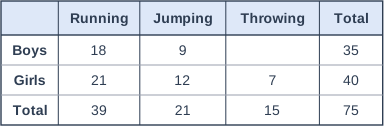
The two-way table shows the event that each pupil in a sports day team chose. One number is missing.
One of the pupils is chosen at random. Work out the probability that the pupil is a boy who chose throwing.
Model answer
Boys who chose throwing: 35 - 18 - 9 = 8 Check: 8 + 7 = 15 P = \(\dfrac{8}{75}\)
Explanation
First find the missing number. The boys' row adds up to 35, so 35 - 18 - 9 = 8 boys chose throwing; the throwing column checks this, because 8 + 7 = 15. The pupil is chosen from all 75 pupils, so the probability is \(\dfrac{8}{75}\). A common mistake is to divide by 35, the number of boys.
Mark scheme
1 mark
Boys who chose throwing = 8 (35 - 18 - 9, or 15 - 7); or the correct answer \(\dfrac{8}{75}\) with no working
1 mark
\(\dfrac{8}{75}\)
Follow through their number of boys who chose throwing over 75. Accept any equivalent fraction, 0.11 or better (0.106...) or 11% or better (10.7%). Do not accept \(\dfrac{8}{35}\) (out of the boys only) or \(\dfrac{8}{15}\). A probability written as '8 in 75', '8 out of 75' or 8 : 75 scores 0. A correct answer with no working scores full marks.
Question 3
3 marks
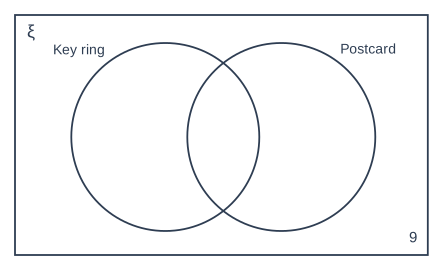
36 pupils went on a school trip. 20 pupils bought a key ring. 14 pupils bought a postcard. 9 pupils bought neither.
The Venn diagram shows the 9 pupils who bought neither.
One of the pupils is chosen at random. Work out the probability that the pupil bought a key ring but not a postcard.
Model answer
Bought at least one: 36 - 9 = 27 Both: 20 + 14 - 27 = 7 Key ring only: 20 - 7 = 13 P(key ring but not postcard) = \(\dfrac{13}{36}\)
Explanation
27 pupils are inside the circles. The two circles hold 20 + 14 = 34 pupils if you count them separately, which is 7 more than 27, so 7 pupils bought both. That leaves 20 - 7 = 13 with a key ring only. A common mistake is to use all 20 key-ring buyers: 'but not a postcard' leaves out the overlap.
Mark scheme
1 mark
36 - 9 = 27 pupils bought at least one; or the correct answer \(\dfrac{13}{36}\) with no working
1 mark
Both = 20 + 14 - 27 = 7, or key ring only = 27 - 14 = 13
1 mark
\(\dfrac{13}{36}\)
Follow through their number of pupils with a key ring only over 36. Accept any equivalent fraction, or 0.36 or better (0.361...) or 36% or better (36.1%). Do not accept \(\dfrac{20}{36}\) (all key rings) or \(\dfrac{7}{36}\). A probability written as '13 in 36', '13 out of 36' or 13 : 36 scores 0. A correct answer with no working scores full marks.
Question 4
4 marks
A school records how its pupils travel and what they have for lunch. One pupil is picked at random. A is the event 'the pupil walks to school'. B is the event 'the pupil has a packed lunch'.
\(B'\) means 'not B', so P(B) = 1 - 0.65 = 0.35. Draw a Venn diagram: put 0.2 in the overlap, then A only is 0.6 - 0.2 = 0.4 and B only is 0.35 - 0.2 = 0.15. \(A \cup B\) is everything inside the circles: 0.4 + 0.2 + 0.15 = 0.75. A common mistake is to use 0.65 as P(B).
Mark scheme
1 mark
P(B) = 0.35 (1 - 0.65); or the correct answer 0.75 with no working
1 mark
P(A only) = 0.4 (0.6 - 0.2)
1 mark
P(B only) = 0.15 (0.35 - 0.2)
Follow through their P(B) - 0.2. Another correct method also scores the second and third marks, e.g. 0.6 + 0.35 - 0.2.
1 mark
0.75
Accept \(\dfrac{3}{4}\) or 75%. Do not accept 0.95 (0.6 + 0.35, counting the overlap twice), 1.25 or 0.55. A probability written as '3 in 4', '3 out of 4' or 3 : 4 scores 0. A correct answer with no working scores full marks.
Ready to try the rest? Every answer you write is marked against the mark scheme, so you can see exactly where the marks are.
Ctrl + Enter to check
Study HelperHints first, answers after you try
Stuck on this one? Ask for a hint and I’ll point you in the right direction, without giving the answer away. Once you’ve checked your answer, I’ll show you how the marks are awarded.