Practise 20 questions on Surface area of cuboids and prisms for Year 8 Maths. Write your answer and get it marked in seconds against the mark scheme, point by point, with the Study Helper on hand if you get stuck.
20 questions
1–5 marks each
Instant marking
No sign-up needed
20 questions, marked as you go
Sample questions with model answers
Here are 4 of the questions in this topic, each with a model answer, an explanation of why it earns the marks and the mark scheme.
Question 1
1 mark
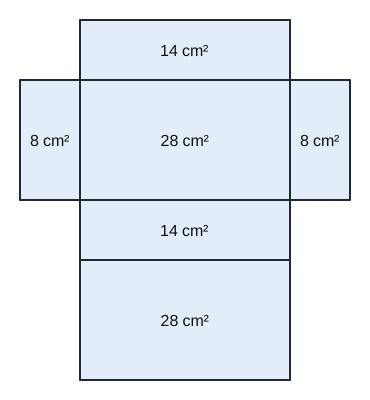
The diagram shows the net of a cuboid. The area of each face is written on it.
The net shows every face of the cuboid laid out flat, so the surface area is the total area of the net. Add all six faces: 14 + 28 + 14 + 28 + 8 + 8 = 100 cm². A common mistake is to add each different area only once and get 50 cm², forgetting that a cuboid has three pairs of matching faces.
Mark scheme
1 mark
100 (cm²)
14 + 28 + 14 + 28 + 8 + 8 = 100. Units not needed. Do not accept 50 (only three different faces added) or 28 (the largest face). A correct answer with no working scores full marks.
Question 2
2 marks
The surface area of a cube is 384 cm².
Work out the length of one edge of the cube.
Model answer
A cube has 6 equal faces. Area of one face = \(384 \div 6 = 64\) cm² \(8 \times 8 = 64\), so each edge is 8 cm.
Explanation
Work backwards. The 6 faces of a cube are equal squares, so one face has an area of \(384 \div 6 = 64\) cm². The side of a square with area 64 cm² is 8 cm, because \(8 \times 8 = 64\). A common mistake is to stop at 64, which is an area, not a length.
Mark scheme
1 mark
Area of one face \(384 \div 6 = 64\) (cm²); or the correct answer 8 cm with no working
1 mark
8 (cm)
Follow through: the square root of their face area, if it is a square number. Units not needed. Do not accept 64 (the area of a face) or 32 (\(384 \div 12\)). A correct answer with no working scores full marks.
Question 3
3 marks
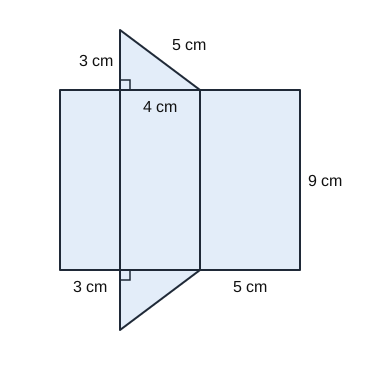
The diagram shows the net of a triangular prism. The two triangles are right-angled.
The net shows all five faces: two right-angled triangles and three rectangles. Each triangle has legs of 3 cm and 4 cm, so its area is \(\dfrac{1}{2} \times 4 \times 3 = 6\) cm². The rectangles are all 9 cm long and 3, 4 and 5 cm wide, giving 108 cm², so the total is 120 cm². A common mistake is to forget the second triangle.
Mark scheme
1 mark
Area of one triangle \(\dfrac{1}{2} \times 4 \times 3 = 6\) (cm²); or the correct answer 120 cm² with no working
Using the 5 cm side as the height of the triangle scores 0 for this mark.
1 mark
Areas of the three rectangles \(3 \times 9 = 27\), \(4 \times 9 = 36\) and \(5 \times 9 = 45\) (cm²), or their total 108 (cm²)
Also award for \(12 \times 9 = 108\) (the perimeter of the triangle × the length).
1 mark
120 (cm²)
From \(2 \times 6 + 27 + 36 + 45\). Follow through: their 2 triangles + their 3 rectangles, so 132 (triangles of 12 cm², the half forgotten) scores this mark but not the first. Units not needed. Do not accept 114 (only one triangle). A correct answer with no working scores full marks.
Question 4
4 marks
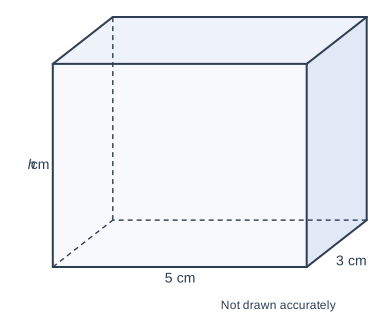
The cuboid in the diagram has a surface area of 94 cm².
Find the value of \(h\).
Model answer
Top and bottom: \(2 \times 5 \times 3 = 30\) cm² Front and back: \(2 \times 5 \times h = 10h\) Two ends: \(2 \times 3 \times h = 6h\) \(30 + 10h + 6h = 94\) \(16h = 64\) \(h = 4\) cm
Explanation
Write the surface area in terms of \(h\). The top and bottom make 30 cm², and the four side faces make \(10h + 6h = 16h\). So \(30 + 16h = 94\), which gives \(16h = 64\) and \(h = 4\). Check: \(2 \times 15 + 2 \times 20 + 2 \times 12 = 94\). A common mistake is to divide 94 by \(5 \times 3\), mixing up surface area and volume.
Mark scheme
1 mark
The top and bottom found, \(2 \times 5 \times 3 = 30\) (cm²), or the four side faces written as \(2 \times 5h + 2 \times 3h\) or \(16h\); or the correct answer 4 with no working
1 mark
\(30 + 16h = 94\), or the four side faces have a total area of \(94 - 30 = 64\) (cm²)
1 mark
\(16h = 64\) or \(64 \div 16\)
Follow through from their equation, or from their area of the four side faces divided by the perimeter of the base (16 cm).
1 mark
\(h = 4\) (cm)
Accept 4. Units not needed. Also award all four marks for a correct trial that checks \(h = 4\): \(2 \times 15 + 2 \times 20 + 2 \times 12 = 94\). A correct answer with no working scores full marks.
Ready to try the rest? Every answer you write is marked against the mark scheme, so you can see exactly where the marks are.
Ctrl + Enter to check
Study HelperHints first, answers after you try
Stuck on this one? Ask for a hint and I’ll point you in the right direction, without giving the answer away. Once you’ve checked your answer, I’ll show you how the marks are awarded.