Level:
Correct: 0
Incorrect: 0
Marks: 0/0
Practice
Course:
Topics:
Year 8 Maths Smart practice A mixed round aimed at your weak spots
Unit 1
Number: accuracy, powers and standard form
Unit 2
Fractions, decimals and percentages
Unit 3
Algebraic expressions
Unit 4
Equations, inequalities and formulae
Unit 5
Sequences and graphs
Unit 6
Ratio, proportion and rates of change
Unit 7
Circles, area and volume
Unit 8
Angles and constructions
Unit 9
Transformations and symmetry
Unit 10
Probability
Unit 11
Statistics
Avg
score:
–
Topics
done:
0/50

Interior and exterior angles of polygons

Practise 26 questions on Interior and exterior angles of polygons for Year 8 Maths. Write your answer and get it marked in seconds against the mark scheme, point by point, with the Study Helper on hand if you get stuck.

  • 26 questions
  • 1–5 marks each
  • Instant marking
  • No sign-up needed
20 questions, marked as you go

Sample questions with model answers

Here are 4 of the questions in this topic, each with a model answer, an explanation of why it earns the marks and the mark scheme.

Question 1

1 mark

Each interior angle of a regular polygon is \(170^\circ\).

What is the size of each exterior angle?

Model answer

\(180 - 170 = 10\)
Each exterior angle is \(10^\circ\).

Explanation

At every vertex the interior angle and the exterior angle lie on a straight line, so they add up to \(180^\circ\). Take 170 away from 180. A common mistake is to take it away from 360.

Mark scheme
  1. 1 mark

    \(10^\circ\)

    Accept 10. 190 (from \(360 - 170\)) scores 0. A correct answer with no working scores full marks.

Question 2

2 marks

A regular polygon has 40 sides.

Work out the size of each interior angle.

Model answer

Exterior angle \(= 360 \div 40 = 9^\circ\)
Interior angle \(= 180 - 9 = 171^\circ\)

Explanation

The quickest way is through the exterior angle: \(360 \div 40 = 9^\circ\). The interior and exterior angles at each vertex add up to \(180^\circ\), so each interior angle is \(171^\circ\). You could also find the angle sum, \(38 \times 180 = 6840^\circ\), and divide by 40, but that is much harder without a calculator. A common mistake is to stop at \(9^\circ\), which is the exterior angle.

Mark scheme
  1. 1 mark

    Exterior angle \(= 360 \div 40 = 9^\circ\), or \((40 - 2) \times 180 = 6840\) seen; or the correct answer \(171^\circ\) with no working

  2. 1 mark

    \(171^\circ\)

    Accept 171. 9 on its own scores the first mark only. A correct answer with no working scores full marks.

Question 3

3 marks

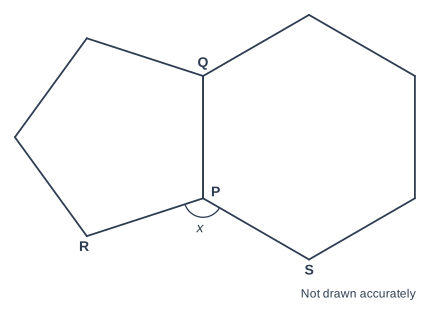
The diagram shows a regular hexagon and a regular pentagon.
They share the side PQ.

Work out the size of angle \(x\).

Geometry diagram, marked "Not drawn accurately". A regular hexagon with vertices Q, P, S and 3 unlabelled points in order. A regular pentagon with vertices R, P, Q and 2 unlabelled points in order. Angle RPS is marked x.

Model answer

Regular hexagon: exterior angle \(360 \div 6 = 60^\circ\), interior angle \(180 - 60 = 120^\circ\)
Regular pentagon: exterior angle \(360 \div 5 = 72^\circ\), interior angle \(180 - 72 = 108^\circ\)
Angles around P add up to \(360^\circ\).
\(x = 360 - 120 - 108 = 132^\circ\)

Explanation

Three angles meet at P: one from the hexagon, one from the pentagon and the angle \(x\) in the gap. Angles around a point add up to \(360^\circ\). Find each interior angle from its exterior angle (\(360 \div\) the number of sides), then subtract both from 360. A common mistake is to use the exterior angles, 60 and 72, instead of the interior angles.

Mark scheme
  1. 1 mark

    One interior angle found: \(120^\circ\) for the regular hexagon or \(108^\circ\) for the regular pentagon; or the correct answer \(132^\circ\) with no working

    120 may come from 720 ÷ 6 or 180 − 60; 108 from 540 ÷ 5 or 180 − 72.

  2. 1 mark

    Both angles, and \(360 - 120 - 108\) seen

    Follow through their interior angles.

  3. 1 mark

    \(x = 132^\circ\)

    Accept 132. 228 (the two interior angles added) scores 0 for this mark. A correct answer with no working scores full marks.

Question 4

4 marks

Each interior angle of a regular polygon is 11 times the size of each exterior angle.

Work out the number of sides of the polygon.
Then work out the sum of its interior angles.

Model answer

Interior + exterior \(= 180^\circ\), and interior \(= 11 \times\) exterior.
\(e + 11e = 180\)
\(12e = 180\), so \(e = 15^\circ\)
Number of sides \(= 360 \div 15 = 24\)
Sum of interior angles \(= (24 - 2) \times 180 = 22 \times 180 = 3960^\circ\)

Explanation

At each vertex the interior and exterior angles add up to \(180^\circ\). If the interior angle is 11 times the exterior angle, the two angles make 12 equal parts of 180, so the exterior angle is \(15^\circ\) and the interior angle is \(165^\circ\). Then \(360 \div 15\) gives the number of sides. Check the sum another way: \(24 \times 165 = 3960\). A common mistake is to work out \(180 \div 11\): the two angles together make 12 parts, not 11.

Mark scheme
  1. 1 mark

    \(e + 11e = 180\) or \(12e = 180\), where \(e\) is the exterior angle; or the correct answers 24 sides and \(3960^\circ\) with no working

    Or 180 ÷ 12 seen.

  2. 1 mark

    Exterior angle \(= 15^\circ\)

  3. 1 mark

    24 sides

    Follow through 360 ÷ their exterior angle.

  4. 1 mark

    Sum of the interior angles \(= 3960^\circ\)

    From \(22 \times 180\) or \(24 \times 165\). Follow through their number of sides. A correct answer with no working scores full marks.

Ready to try the rest? Every answer you write is marked against the mark scheme, so you can see exactly where the marks are.

Topic notes

Interior and exterior angles of polygons

The big idea

A polygon is a flat shape with straight sides. Its interior angles are inside it, and its exterior angles are the turns you make at the corners as you walk round it. Two totals unlock the angles of any polygon, and explain why only some tiles fit together.

From Year 7: split a polygon into triangles from one vertex (corner) to find its angle sum. A regular polygon has all its sides equal and all its angles equal.

The sum of the interior angles

From one vertex of a polygon with \(n\) sides, draw a diagonal to every other vertex except the two next to it. This splits the polygon into \(n - 2\) triangles, whose angles fill its interior angles exactly. So

\[ \text{angle sum} = (n - 2) \times 180^\circ \]

Every angle sum is in the 180 times table: 180°, 360°, 540° and so on.

Exterior angles

Carry one side of a polygon on past a vertex. The angle between this extension and the next side is an exterior angle.

A hexagon ABCDEF with each side extended past one end, so that there is an exterior angle at every vertex: 40° at A, 65° at B, 70° at C, 55° at D, 80° at E and 50° at F. The interior angle at B is marked 115°.
A hexagon with one side carried on at each vertex. The exterior angles add up to 40° + 65° + 70° + 55° + 80° + 50° = 360°. At B, the interior angle 115° and the exterior angle 65° add up to 180°.
  • The interior and exterior angles at a vertex make a straight line, so interior + exterior = 180°.
  • Walk once round any polygon, turning through each exterior angle, and you end up facing the way you started. That is one full turn, so the exterior angles of any polygon add up to 360°.

Regular polygons

In a regular polygon with \(n\) sides, the exterior angles are all equal, so:

  • each exterior angle = 360 ÷ \(n\)
  • each interior angle = 180 − the exterior angle
  • the number of sides = 360 ÷ the exterior angle.

So a regular polygon can only exist if 360 ÷ its exterior angle is a whole number.

Compare two gazebo floors

A small gazebo (a garden shelter) has a floor that is a regular polygon with interior angles of 144°. A large gazebo's floor is a regular polygon with twice as many sides. Find its interior angles.

Small floor: exterior angle \(= 180 - 144 = 36^\circ\), so it has \(360 \div 36 = 10\) sides.

Large floor: \(2 \times 10 = 20\) sides, so each exterior angle is \(360 \div 20 = 18^\circ\).

Each interior angle of the large floor is \(180 - 18 = 162^\circ\).

Missing angles in irregular polygons

Find the angle sum first. Then take away the angles you know, or, if the angles are written with a letter, make an equation and solve it.

Angles that go up in tens

In degrees, the angles of a hexagon are \(x\), \(x + 10\), \(x + 20\), \(x + 30\), \(x + 40\) and \(x + 50\). Find the smallest and the largest angle.

Angle sum: \((6 - 2) \times 180 = 720^\circ\)

Add the six angles: six lots of \(x\), and \(10 + 20 + 30 + 40 + 50 = 150\). So \(6x + 150 = 720\).

\(6x = 570\), so \(x = 95\)

The smallest angle is 95° and the largest is \(95 + 50 = 145^\circ\).

Check: \(95 + 105 + 115 + 125 + 135 + 145 = 720\)

Which regular polygons tessellate?

Shapes tessellate when copies fit together with no gaps and no overlaps. Where corners meet at a point, their angles must add up to exactly 360°, so the interior angle must divide exactly into 360.

Regular polygonInterior angleCopies at a pointTessellates?
Equilateral triangle60°6 × 60° = 360°Yes
Square90°4 × 90° = 360°Yes
Pentagon108°3 × 10⁸° = 324° (gap); 4 × 10⁸° = 432° (overlap)No
Hexagon120°3 × 120° = 360°Yes

With more than 6 sides, each exterior angle is less than 60°, so each interior angle is between 120° and 180°. Two of them make less than 360° and three make more, so they never fit.

Stretch: why the exterior angles add up to 360°

At each of the \(n\) vertices, interior + exterior = 180°, so all the angles together make \(n \times 180\). The interior angles use up \((n - 2) \times 180\), which is \(n \times 180 - 360\). That leaves exactly 360° for the exterior angles.

Remember

  • Angle sum of a polygon = \((n - 2) \times 180^\circ\).
  • The exterior angles of any polygon add up to 360°.
  • Interior angle + exterior angle = 180°.
  • Regular polygon: exterior angle = 360 ÷ \(n\), and \(n\) = 360 ÷ the exterior angle.
  • Of the regular polygons, only equilateral triangles, squares and hexagons tessellate.

Common mistakes

  • Multiplying the number of sides by 180°. The angle sum is \((n - 2) \times 180^\circ\).
  • Taking an angle from 360 to swap between interior and exterior. They add up to 180°.
  • Dividing 360 by the interior angle to find the number of sides. Use the exterior angle.
  • Stopping at the exterior angle, or at \(x\), when you need an interior angle.
  • Testing tessellation with exterior angles. The angles that meet at a point are interior angles.

Top tip

For a regular polygon, work through the exterior angle. It is much quicker than using the angle sum.

Study Helper Hints first, answers after you try

Stuck on this one? Ask for a hint and I’ll point you in the right direction, without giving the answer away. Once you’ve checked your answer, I’ll show you how the marks are awarded.