Level:
Correct: 0
Incorrect: 0
Marks: 0/0
Practice
Course:
Topics:
Year 8 Maths Smart practice A mixed round aimed at your weak spots
Unit 1
Number: accuracy, powers and standard form
Unit 2
Fractions, decimals and percentages
Unit 3
Algebraic expressions
Unit 4
Equations, inequalities and formulae
Unit 5
Sequences and graphs
Unit 6
Ratio, proportion and rates of change
Unit 7
Circles, area and volume
Unit 8
Angles and constructions
Unit 9
Transformations and symmetry
Unit 10
Probability
Unit 11
Statistics
Avg
score:
–
Topics
done:
0/50

Direct proportion

Practise 25 questions on Direct proportion for Year 8 Maths. Write your answer and get it marked in seconds against the mark scheme, point by point, with the Study Helper on hand if you get stuck.

  • 25 questions
  • 1–5 marks each
  • Instant marking
  • No sign-up needed
20 questions, marked as you go

Sample questions with model answers

Here are 4 of the questions in this topic, each with a model answer, an explanation of why it earns the marks and the mark scheme.

Question 1

1 mark

A recipe for 8 people uses 1.2 kg of potatoes.

How much potato is needed for 6 people?

Model answer

1.2 kg = 1200 g
1 person: \(1200 \div 8 = 150\) g
6 people: \(6 \times 150 = 900\) g = 0.9 kg

Explanation

Changing 1.2 kg into 1200 g gives whole numbers to work with. One person needs \(1200 \div 8 = 150\) g, so 6 people need \(6 \times 150 = 900\) g, which is 0.9 kg. You could also see that 6 people is \(\dfrac{3}{4}\) of 8 people, and \(\dfrac{3}{4}\) of 1.2 kg is 0.9 kg. A common mistake is to take away a fixed amount because there are 2 fewer people.

Mark scheme
  1. 1 mark

    0.9 kg (900 g)

    Accept 0.9 kg or 900 g; a number with no unit scores only if it is clearly in kg (0.9) or g (900). Do not accept 1 kg or 1000 g (subtracting 0.2 kg because there are 2 fewer people) or 1.6 kg (from 1.2 kg divided by 6 and multiplied by 8). A correct answer with no working scores full marks.

Question 2

2 marks

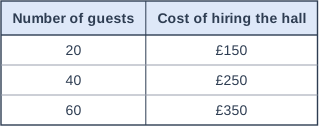
The table shows the cost of hiring a hall for a party with different numbers of guests.

Jamal says the cost is directly proportional to the number of guests.

Is Jamal right? Explain how you know.

Table with columns "Number of guests", "Cost of hiring the hall". Number of guests: 20; Cost of hiring the hall: £150 | Number of guests: 40; Cost of hiring the hall: £250 | Number of guests: 60; Cost of hiring the hall: £350.

Model answer

No. 40 guests is double 20 guests, but \(2 \times 150 = 300\), and 40 guests cost £250, not £300.
So the cost is not directly proportional to the number of guests.

Explanation

If the cost were directly proportional, doubling the number of guests would double the cost. Here 20 guests cost £150 but 40 guests cost only £250. The cost goes up by £100 for every 20 guests, which means there is a fixed charge of £50 as well as £5 for each guest, so the cost does not start from 0. A common mistake is to say yes because the cost goes up as the number of guests goes up.

Mark scheme
  1. 1 mark

    No, with a relevant but incomplete reason, e.g. "the cost for each guest changes" with no values, or "the cost does not double" with no values

    "No" alone scores 0. "No, because the cost goes up" scores 0.

  2. 1 mark

    A complete correct reason: 40 guests is double 20 guests, but £250 is not double £150 (it would be £300) / the cost for each guest is £7.50, £6.25 and about £5.83, which are not the same / the cost goes up by £100 for every 20 guests, so 0 guests would cost £50, not £0

    A complete correct reason on its own scores both marks.

Question 3

3 marks

A car uses 12 litres of petrol to travel 150 km. The amount of petrol used is directly proportional to the distance travelled.

How far can the car travel on 20 litres of petrol? How much petrol does the car need to travel 400 km?

Model answer

12 litres for 150 km, so 4 litres for 50 km.
20 litres = \(5 \times 4\) litres, so \(5 \times 50 = 250\) km
400 km = \(8 \times 50\) km, so \(8 \times 4 = 32\) litres

Explanation

Find a small pair that is easy to scale: dividing 12 litres and 150 km by 3 gives 4 litres for 50 km. Then 20 litres is 5 times 4 litres, so the car goes 250 km, and 400 km is 8 times 50 km, so it needs 32 litres. You could also use 1 litre for 12.5 km. A common mistake is to scale only one of the two quantities.

Mark scheme
  1. 1 mark

    A correct rate or pair, e.g. 1 litre for 12.5 km, or 4 litres for 50 km, or 8 litres for 100 km; or the correct answers 250 km and 32 litres with no working

    Implied by either correct answer.

  2. 1 mark

    250 km

    Do not accept 158 km (adding 8).

  3. 1 mark

    32 litres

    The two answers are marked separately. Units are not needed if each answer is clearly matched to its question. A correct answer with no working scores full marks.

Question 4

4 marks

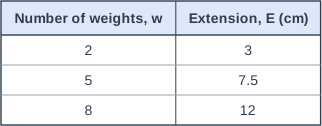
In a science lesson, Amara hangs identical weights on a spring and measures how far the spring stretches. The table shows her results.

The extension, \(E\) cm, is directly proportional to the number of weights, \(w\).

Write a formula for \(E\) in terms of \(w\). Then work out the extension with 11 weights, and the number of weights that gives an extension of 21 cm.

Table with columns "Number of weights, w", "Extension, E (cm)". Number of weights, w: 2; Extension, E (cm): 3 | Number of weights, w: 5; Extension, E (cm): 7.5 | Number of weights, w: 8; Extension, E (cm): 12.

Model answer

\(E \div w = 3 \div 2 = 1.5\) (and \(7.5 \div 5 = 1.5\), \(12 \div 8 = 1.5\))
\(E = 1.5w\)
\(w = 11\): \(E = 1.5 \times 11 = 16.5\) cm
\(E = 21\): \(21 = 1.5w\), so \(w = 21 \div 1.5 = 14\) weights

Explanation

When \(E\) is directly proportional to \(w\), \(E = kw\), where \(k\) is the constant of proportionality. Here \(3 \div 2 = 1.5\), and the other pairs give 1.5 too, so \(E = 1.5w\): each weight stretches the spring by 1.5 cm. Then substitute: 11 weights give 16.5 cm, and for 21 cm you solve \(1.5w = 21\) to get 14 weights. A common mistake is to write the formula the wrong way round, as \(w = 1.5E\).

Mark scheme
  1. 1 mark

    Finds the constant, \(3 \div 2 = 1.5\) (or \(7.5 \div 5\) or \(12 \div 8\)); or the correct answers \(E = 1.5w\), 16.5 cm and 14 weights with no working

    Implied by a correct formula.

  2. 1 mark

    \(E = 1.5w\)

    Accept \(E = 1.5 \times w\), \(E = \dfrac{3w}{2}\) or E = 1.5w typed any clear way. Do not accept \(w = 1.5E\) or "1.5w" with no "E =".

  3. 1 mark

    16.5 cm

    The unit is not needed. Follow through from their formula.

  4. 1 mark

    14 weights

    Follow through from their formula. A correct answer with no working scores full marks.

Ready to try the rest? Every answer you write is marked against the mark scheme, so you can see exactly where the marks are.

Topic notes

Direct proportion

The big idea

Two quantities are in direct proportion when they always change by the same multiplier: double one and the other doubles, and when one is zero, so is the other. Direct proportion helps you scale recipes, change money and find the best buy.

Remember from Year 7: the unitary method means finding the value of one first. If 4 pens cost £3, one pen costs 75p, so 7 pens cost £5.25.

Is it direct proportion?

  • In words: each item costs the same, or something happens at a steady rate, and none of one means none of the other.
  • In a table: divide one quantity by the other for every pair. Direct proportion gives the same answer every time.
  • On a graph: the points lie on a straight line through the origin, the point (0, 0).

Two quantities are not in direct proportion when there is a fixed charge to start with, or when doubling one does not double the other. A straight line is not enough: it must pass through the origin too.

A graph of Cost (£) (vertical axis, 0 to 40, marked every 5) against Time (hours) (horizontal axis, 0 to 6, marked every 1), on a grid. The graph labelled "Plan P: £5 an hour" is a straight line joining (0, 0) and (6, 30). The graph labelled "Plan Q: £10 + £5 an hour" is a straight line joining (0, 10) and (6, 40).
Two ways to pay for kayak hire. Plan P is a straight line through the origin, so its cost is directly proportional to the time. Plan Q is a straight line that starts at £10, so it is not: 1 hour costs £15, but 2 hours cost £20, not £30.

Unitary method and multipliers

  • Unitary method: find the value of one, then multiply.
  • Multiplier: new amount ÷ old amount tells you what to multiply the other quantity by.
  • If neither is easy, go through a handy amount in between.

Whatever you do to one quantity, do to the other. Never add the same amount to both.

A school pays £27 for 45 exercise books. How much would 75 of the same books cost?

Unitary method: one book costs \(2700 \div 45 = 60\)p, so 75 books cost \(75 \times 60 = 4500\)p = £45.

Or go through 15 books, because 45 and 75 are both multiples of 15. 15 books cost \(27 \div 3 = 9\) pounds, and 75 books are 5 lots of 15: \(5 \times 9 = 45\) pounds.

Recipes, exchange rates and best buys

  • Recipes: multiply every ingredient by the same multiplier: for 10 people instead of 4, multiply by \(10 \div 4 = 2.5\). When you buy whole packs, round up. When you work out how many people you can feed, round down; the first ingredient to run out decides.
  • Exchange rates: an exchange rate such as £1 = 1.25 euros tells you what £1 is worth in another currency (a country's money). Pounds into euros: multiply by the rate. Euros into pounds: divide.
  • Best buys: compare the cost of the same amount, such as the price of 1 kg.

Trainers cost £72 in a UK shop and 85 euros in a shop in Spain. £1 is worth 1.25 euros. Where are the trainers cheaper, and by how much?

Change the UK price into euros by multiplying by the rate. A quarter of 72 is 18, so

\(72 \times 1.25 = 72 + 18 = 90\) euros.

85 euros is less than 90 euros, so the trainers are cheaper in Spain, by 5 euros.

In pounds: \(5 \div 1.25 = 4\), so they are £4 cheaper.

Stretch: the constant of proportionality

When \(y\) is directly proportional to \(x\), then \(y = kx\). The number \(k\) is the constant of proportionality: it is \(y \div x\) for any pair, the amount of \(y\) for each 1 of \(x\).

The table shows the area, \(A\) m², that \(n\) litres of Brand X paint cover. Write a formula for \(A\) in terms of \(n\). Brand Y paint covers \(A = 11.5n\). Which brand covers more with each litre?

Paint, \(n\) (litres)247
Area, \(A\) (m²)244884

\(24 \div 2 = 12\), \(48 \div 4 = 12\) and \(84 \div 7 = 12\), so \(k = 12\) and \(A = 12n\).

\(k\) is the area for each litre: 12 m² for Brand X and 11.5 m² for Brand Y, so Brand X covers more.

Check with 6 litres: X covers \(12 \times 6 = 72\) m² and Y covers \(11.5 \times 6 = 69\) m².

Remember

  • Direct proportion: double one quantity and the other doubles; zero gives zero.
  • In a table, one quantity ÷ the other is the same for every pair.
  • On a graph: a straight line through the origin.
  • Pounds into another currency: multiply by the rate. Back into pounds: divide.

Common mistakes

  • Adding instead of multiplying: if 3 kg cost £6, then 6 kg cost £12, not £9.
  • Saying "direct proportion" just because both quantities go up.
  • Thinking every straight-line graph shows direct proportion. It must pass through (0, 0).
  • Multiplying by the rate when changing back into pounds: at £1 = 1.25 euros, 90 euros is £72, not £112.50.
  • Mixing units: change 1.2 kg into 1200 g before comparing it with 300 g.

Top tip

Write the two quantities in two labelled columns, and do the same to both columns. Then ask: should my answer be bigger or smaller than what I started with?

Study Helper Hints first, answers after you try

Stuck on this one? Ask for a hint and I’ll point you in the right direction, without giving the answer away. Once you’ve checked your answer, I’ll show you how the marks are awarded.