Practise 21 questions on Sample spaces and combined events for Year 8 Maths. Write your answer and get it marked in seconds against the mark scheme, point by point, with the Study Helper on hand if you get stuck.
21 questions
1–5 marks each
Instant marking
No sign-up needed
20 questions, marked as you go
Sample questions with model answers
Here are 4 of the questions in this topic, each with a model answer, an explanation of why it earns the marks and the mark scheme.
Question 1
1 mark
Mo rolls two fair dice, each numbered 1 to 6.
What is the probability that both dice show a number greater than 4?
Choose your answer.
\(\dfrac{1}{9}\)
\(\dfrac{1}{3}\)
\(\dfrac{2}{3}\)
\(\dfrac{1}{18}\)
Model answer
There are 36 outcomes. Numbers greater than 4: 5 and 6 Both greater than 4: (5, 5), (5, 6), (6, 5), (6, 6), so 4 outcomes P = \(\dfrac{4}{36} = \dfrac{1}{9}\)
Explanation
Think of the 6 by 6 sample space: it has 36 equally likely outcomes. Both dice are greater than 4 only in the rows for 5 and 6 and the columns for 5 and 6, which is a block of \(2 \times 2 = 4\) outcomes. So the probability is \(\dfrac{4}{36} = \dfrac{1}{9}\). A common mistake is to forget 5 and 6, and 6 and 5, and count only the doubles.
Mark scheme
1 mark
\(\dfrac{1}{9}\)
Accept 1/9 typed, \(\dfrac{4}{36}\), or 0.11 or better (0.111...). \(\dfrac{1}{3}\) is wrong: it is the probability for one dice (5 or 6), as if 'both' did not make it less likely. \(\dfrac{2}{3}\) is wrong: it adds \(\dfrac{1}{3} + \dfrac{1}{3}\). \(\dfrac{1}{18}\) is wrong: it counts only the doubles 5 and 5, and 6 and 6. A probability written as '1 in 9', '4 out of 36' or 1 : 9 scores 0.
Question 2
2 marks
Sam rolls two fair dice, each numbered 1 to 6, and adds the scores.
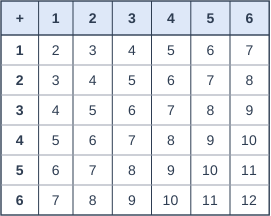
The table shows every possible total. The numbers down the side are for the first dice and the numbers across the top are for the second dice.
Work out the probability that the total is a multiple of 3.
Model answer
Multiples of 3 that can be totals: 3, 6, 9, 12 Total of 3: 2 outcomes; 6: 5 outcomes; 9: 4 outcomes; 12: 1 outcome 2 + 5 + 4 + 1 = 12 P(multiple of 3) = \(\dfrac{12}{36} = \dfrac{1}{3}\)
Explanation
The totals go from 2 to 12, and the multiples of 3 in that range are 3, 6, 9 and 12. Count every cell in the table that shows one of them: 2 + 5 + 4 + 1 = 12 cells out of 36. A common mistake is to count each total once and say \(\dfrac{4}{11}\), but the totals are not equally likely: the 36 cells are.
Mark scheme
1 mark
Totals of 3, 6, 9 and 12 identified, or 12 outcomes counted (2 + 5 + 4 + 1); or the correct answer \(\dfrac{1}{3}\) with no working
Leaving out 12, or one of the other multiples of 3, scores 0 for this mark.
1 mark
\(\dfrac{12}{36}\) or \(\dfrac{1}{3}\)
Accept any equivalent fraction, or 0.33 or better (0.333...) or 33% or better (33.3%). Do not accept \(\dfrac{4}{11}\) (4 of the 11 different totals) or \(\dfrac{11}{36}\). A probability written as '12 in 36', '12 out of 36' or 12 : 36 scores 0. A correct answer with no working scores full marks.
Question 3
3 marks
Amir is finding the probability of a total of 8 when two fair dice, each numbered 1 to 6, are rolled.
He says, 'There are three ways to get a total of 8: 2 and 6, 3 and 5, and 4 and 4. So the probability of a total of 8 is \(\dfrac{3}{36}\).'
Is Amir right? Explain how you know. Then work out the correct probability of a total of 8.
Model answer
No. The two dice are different, so 2 and 6 is not the same outcome as 6 and 2. Total of 8: (2, 6), (6, 2), (3, 5), (5, 3), (4, 4) That is 5 outcomes, so P(total of 8) = \(\dfrac{5}{36}\)
Explanation
In a sample space for two dice, a 2 on the first dice with a 6 on the second is a different cell from a 6 on the first dice with a 2 on the second. So 2 and 6 counts twice, and so does 3 and 5, but 4 and 4 is only one cell. That makes 5 outcomes out of 36. A common mistake is to forget that the order of the two dice matters.
Mark scheme
1 mark
No, with a relevant but incomplete reason, e.g. 'he has missed some ways' or 'the order matters'
'No' on its own scores 0.
1 mark
A complete correct reason: 2 and 6 can happen two ways (2 on the first dice and 6 on the second, or 6 on the first and 2 on the second), and so can 3 and 5; only 4 and 4 is one way
A complete correct reason on its own scores the first two marks. The third mark needs the correct probability.
1 mark
\(\dfrac{5}{36}\)
Accept any equivalent fraction, or 0.14 or better (0.138...) or 14% or better (13.9%). A probability written as '5 in 36', '5 out of 36' or 5 : 36 scores 0. The answer \(\dfrac{5}{36}\) with no reason scores this mark only; the first two marks need the reason.
Question 4
4 marks
On an activity day, every pupil does one morning activity and one afternoon activity.
Morning: climbing, archery, cooking or drama Afternoon: kayaking, football or art
Work out how many different pairs of activities a pupil could do.
Ali's two activities are chosen at random. Work out the probability that Ali does climbing in the morning and does not do kayaking in the afternoon.
Model answer
Pairs: \(4 \times 3 = 12\) Climbing and not kayaking: climbing and football, climbing and art (2 pairs) P = \(\dfrac{2}{12} = \dfrac{1}{6}\)
Explanation
Each of the 4 morning activities can go with each of the 3 afternoon activities, so there are \(4 \times 3 = 12\) pairs: this is the product rule for counting. If the pair is chosen at random, all 12 are equally likely. Only 2 of them have climbing without kayaking. A common mistake is to add 4 and 3 instead of multiplying.
Mark scheme
1 mark
\(4 \times 3\), or a complete systematic list or table; or the correct answers 12 and \(\dfrac{1}{6}\) with no working
1 mark
12 pairs
Do not accept 7 (adding 4 + 3).
1 mark
2 pairs counted (climbing and football, climbing and art)
1 mark
\(\dfrac{2}{12}\) or \(\dfrac{1}{6}\)
Follow through 2 over their number of pairs. Accept any equivalent fraction, or 0.17 or better (0.166...) or 17% or better (16.7%). Do not accept \(\dfrac{1}{12}\) or \(\dfrac{3}{12}\). A probability written as '2 in 12', '2 out of 12' or 2 : 12 scores 0. A correct answer with no working scores full marks.
Ready to try the rest? Every answer you write is marked against the mark scheme, so you can see exactly where the marks are.
Ctrl + Enter to check
Study HelperHints first, answers after you try
Stuck on this one? Ask for a hint and I’ll point you in the right direction, without giving the answer away. Once you’ve checked your answer, I’ll show you how the marks are awarded.