The big idea
A compound unit is made from two units, like km/h for speed. It tells you how much of one thing there is for each one of another: g/cm³ means grams in each cubic centimetre, and £ per hour means pounds for each hour. "Per" means "for each", and it tells you which way to divide.
Density
Mass is how heavy something is (g, kg). Volume is how much space it takes up (cm³, m³). Density is the mass of each cm³ (or each m³) of a material:
density = mass ÷ volume, so mass = density × volume and volume = mass ÷ density.
- g/cm³ means grams per cubic centimetre; kg/m³ means kilograms per cubic metre.
- Every piece of a material has the same density, big or small. Iron's density is about 7.9 g/cm³, so 1 cm³ of iron has a mass of 7.9 g and 10 cm³ has a mass of 79 g.
- Water has a density of about 1 g/cm³. Things with a smaller density than water float in it.
- For a cuboid, find the volume first: length × width × height.
A small bar of pure gold has a mass of 386 g. The density of gold is 19.3 g/cm³. Work out the volume of the bar.
Volume = mass ÷ density = \(386 \div 19.3\)
Multiply both numbers by 10 to clear the decimal: \(3860 \div 193 = 20\), because \(193 \times 20 = 3860\).
The volume is 20 cm³.
Check the units: grams ÷ grams per cm³ gives cm³.
Rates
A rate tells you how much of something there is for each unit of something else, often time: litres per minute, pages per hour, pay per hour. Rates work just like speed:
- rate = amount ÷ time
- amount = rate × time
- time = amount ÷ rate
The time must be in the unit the rate uses: for pay per hour, change minutes into hours.
Asha works at a garden centre and is paid £10.80 per hour. On Saturday she works for 3 hours 20 minutes. How much does she earn?
20 minutes is \(\dfrac{1}{3}\) of an hour, so she works \(3\dfrac{1}{3}\) hours.
Pay for 3 hours: \(3 \times 10.80 = 32.40\) pounds.
Pay for \(\dfrac{1}{3}\) of an hour: \(10.80 \div 3 = 3.60\) pounds.
Total: £32.40 + £3.60 = £36.00.
Unit pricing and best value
A unit price is the cost of one unit, such as the price in pence per gram: price in pence ÷ mass in grams. To find the best value, compare unit prices. The lowest price for each gram is the best value.
You may use a calculator for this one. A 375 g box of cereal costs £2.49. A 600 g box of the same cereal costs £3.89. Which box is better value?
Work out the pence per gram for each box:
- 375 g box: \(249 \div 375 = 0.664\)p per gram
- 600 g box: \(389 \div 600 = 0.648...\)p per gram
The 600 g box costs less for each gram, so it is better value.
Choosing the operation
Not sure whether to multiply or divide? Say the unit in words: "grams per cm³" means grams ÷ cm³. Then check the unit of your answer: litres ÷ litres per minute gives minutes. If the unit makes no sense, you have used the wrong operation.
Stretch: population density
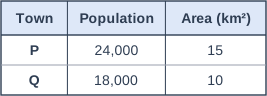
Population density is the number of people for each km² of land: number of people ÷ area. It tells you how crowded a place is. An island with 2,700 people and an area of 45 km² has \(2700 \div 45 = 60\) people per km². A place with more people is not always more crowded: it might also be much bigger.
Remember
- density = mass ÷ volume; mass = density × volume; volume = mass ÷ density.
- "Per" means "for each": g/cm³ is grams ÷ cm³.
- Rates work like speed: amount = rate × time.
- Best value: the lowest price for each gram (or each ml).
Common mistakes
- Dividing the wrong way: 40 g with a volume of 50 cm³ has a density of \(40 \div 50 = 0.8\) g/cm³, not \(50 \div 40 = 1.25\).
- Adding the lengths of a cuboid instead of multiplying them to find its volume.
- Mixing up pence per gram with pence per 100 g: 0.5p per gram is 50p per 100 g.
- Comparing amounts in different units, like 4500 g with 5 kg. Change one of them first.
Top tip
Write the unit next to every number as you work. If the answer's unit matches what the question asks for (cm³, minutes, pounds), you have almost certainly used the right operation.