Practise 12 exam-style questions on Vaccination for AQA GCSE Combined Science (Biology Paper 1). Write your answer as you would in the exam and get it marked in seconds against the mark scheme, point by point, with the Study Helper on hand if you get stuck.
12 questions
1–6 marks each
Instant marking
No sign-up needed
12 questions, marked as you go
Sample questions with model answers
Here are 4 of the questions in this topic, each with a model answer, an explanation of why it earns the marks and the mark scheme an examiner would use.
Question 1
1 mark
Which type of blood cell produces antibodies?
Model answer
White blood cells.
Explanation
White blood cells defend the body by phagocytosis, by producing antibodies and by producing antitoxins. Vaccination works by stimulating white blood cells to produce antibodies.
Mark scheme
1 mark
white blood cells
allow lymphocytes; do not accept red blood cells or platelets
Question 2
2 marks
A child has been vaccinated against measles.
Explain why this vaccination does not protect the child against influenza.
Model answer
Antibodies are specific: each type only works against one pathogen. The measles vaccine stimulated the child's white blood cells to produce antibodies against the measles virus only. The influenza virus is a different pathogen, so the white blood cells would not respond quickly to it.
Explanation
Because antibodies are specific, a vaccine only protects against the pathogen it contains. That is why there are separate vaccines for different diseases.
Mark scheme
1 mark
antibodies are specific to one type of pathogen
allow each pathogen needs a different antibody
1 mark
the measles vaccine only stimulates the production of antibodies against the measles virus, not the influenza virus
allow the white blood cells have not met the influenza virus
Question 3
3 marks
A student said: "A vaccine works by giving you the antibodies against a disease."
Explain why the student is wrong.
Model answer
A vaccine does not contain antibodies. It contains a small amount of a dead or inactive form of the pathogen. This stimulates the person's own white blood cells to produce antibodies against it. If the same pathogen enters the body later, the white blood cells respond quickly and produce the correct antibodies, which prevents infection.
Explanation
This is a common misconception. The vaccine provides the pathogen in a harmless form; the body's white blood cells do the work of making antibodies, which is why the protection is long-lasting.
Mark scheme
1 mark
a vaccine contains a dead or inactive form of the pathogen, not antibodies
1 mark
it stimulates the person's own white blood cells to produce antibodies
1 mark
if the same pathogen enters later, the white blood cells quickly produce the correct antibodies
allow the protection lasts because the white blood cells respond quickly next time
Question 4
4 marks
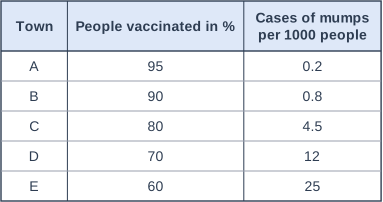
During an outbreak of mumps, a viral disease, health officials recorded the percentage of people vaccinated against mumps in five towns and the number of cases in each town. The table shows the results.
Describe and explain the relationship shown by the data.
Suggest why there were still some cases in town A.
Model answer
The higher the percentage of people vaccinated, the lower the number of cases. In town A, where 95% were vaccinated, there were only 0.2 cases per 1000 people, but in town E, where 60% were vaccinated, there were 25 cases per 1000 people. When most people are immune, the virus cannot be passed from person to person easily, so it spreads less. There were still a few cases in town A because 5% of people were not vaccinated, and they could catch mumps from an infected person, for example a visitor from another town.
Explanation
The data show the effect of immunising a large proportion of the population: the cases fall steeply as vaccination rises. A small number of cases can still occur among people who are not immune.
Mark scheme
1 mark
the higher the percentage vaccinated, the fewer cases per 1000 people
allow negative correlation; max 4
1 mark
data, e.g. 95% vaccinated gave 0.2 cases per 1000 but 60% vaccinated gave 25 cases per 1000
1 mark
when more people are immune, the virus cannot be passed on as easily, so the spread is reduced
1 mark
town A: some people were not vaccinated (5%) and could catch it from visitors / infected people
allow the vaccine does not work in every person
Ready to try the rest? Every answer you write is marked against the mark scheme, so you can see exactly where the marks are.
Ctrl + Enter to check
Study HelperHints first, answers after you try
Stuck on this one? Ask for a hint and I’ll point you in the right direction, without giving the answer away. Once you’ve checked your answer, I’ll show you how the marks are awarded.