Level:
Correct: 0
Incorrect: 0
Marks: 0/0

Uses of glucose from photosynthesis

Practise 10 exam-style questions on Uses of glucose from photosynthesis for AQA GCSE Combined Science (Biology Paper 1). Write your answer as you would in the exam and get it marked in seconds against the mark scheme, point by point, with the Study Helper on hand if you get stuck.

  • 10 questions
  • 1–6 marks each
  • Instant marking
  • No sign-up needed
10 questions, marked as you go

Sample questions with model answers

Here are 4 of the questions in this topic, each with a model answer, an explanation of why it earns the marks and the mark scheme an examiner would use.

Question 1

2 marks

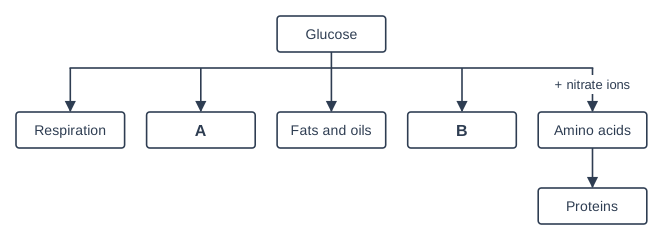
The flow chart shows some of the ways a plant uses the glucose made in photosynthesis.

Substance A is an insoluble storage substance. Substance B strengthens the cell walls.

Name substances A and B.

Flow chart of 7 boxes joined by arrows, read from top to bottom. The first box is "Glucose". From "Glucose", 5 arrows branch out side by side: the 1st from the left arrow leads to "Respiration"; the 2nd from the left arrow leads to box A; the 3rd from the left arrow leads to "Fats and oils"; the 4th from the left arrow leads to box B; the 5th from the left arrow, labelled "+ nitrate ions", leads to "Amino acids", which leads to "Proteins".

Model answer

A is starch. B is cellulose.

Explanation

Plants convert glucose into insoluble starch for storage and use it to make cellulose, which strengthens cell walls. Glycogen is the storage carbohydrate in animals, not plants.

Mark scheme
  1. 1 mark

    A: starch

    do not accept glycogen

  2. 1 mark

    B: cellulose

    do not accept cellulase

Question 2

2 marks

Plants use some of the glucose they make to produce cellulose.

Explain why plants need cellulose.

Model answer

Cellulose is used to make cell walls and it strengthens them. This means the cells keep their shape and do not burst when they take in water, which helps to support the plant.

Explanation

Producing cellulose to strengthen the cell wall is one of the uses of glucose. Strong cell walls let plant cells become firm with water, which supports stems and leaves.

Mark scheme
  1. 1 mark

    cellulose strengthens the cell wall

    allow cell walls are made of cellulose

  2. 1 mark

    so the cells keep their shape / do not burst when they take in water / the plant is supported

Question 3

3 marks

In one week a plant produced 120 g of glucose by photosynthesis. It used 40% of the glucose for respiration and converted 35% into starch. The rest was used to make other substances.

Calculate the mass of glucose converted into starch and the mass used to make other substances.

Model answer

Glucose converted into starch = 120 × 0.35 = 42 g
Glucose used for respiration = 120 × 0.40 = 48 g
Glucose used for other substances = 120 − 48 − 42 = 30 g

Explanation

To find a percentage of a mass, multiply by the percentage as a decimal. The remaining 25% would be used, for example, to make cellulose, fats and oils, and amino acids.

Mark scheme
  1. 1 mark

    starch: 120 × 0.35 = 42 (g)

  2. 1 mark

    respiration: 120 × 0.40 = 48 (g)

    allow 100 − 40 − 35 = 25% used for other substances

  3. 1 mark

    other substances: 120 − 48 − 42 = 30 (g)

    allow 120 × 0.25 = 30; allow ecf

Question 4

4 marks

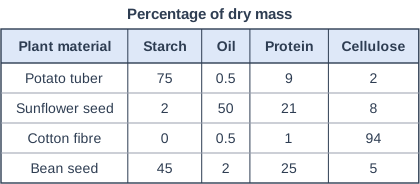
The table shows the percentages of starch, oil, protein and cellulose in the dry mass of four plant materials.

Use the table and your knowledge of how plants use glucose to explain the differences between the four materials.

Percentage of dry mass. Table with columns "Plant material", "Starch", "Oil", "Protein", "Cellulose". Plant material: Potato tuber; Starch: 75; Oil: 0.5; Protein: 9; Cellulose: 2 | Plant material: Sunflower seed; Starch: 2; Oil: 50; Protein: 21; Cellulose: 8 | Plant material: Cotton fibre; Starch: 0; Oil: 0.5; Protein: 1; Cellulose: 94 | Plant material: Bean seed; Starch: 45; Oil: 2; Protein: 25; Cellulose: 5.

Model answer

All of these substances are made from glucose produced by photosynthesis. Potato tubers are storage organs that store glucose as insoluble starch, which makes up 75% of their dry mass. Sunflower seeds store glucose as oil (50%). Cotton fibres are made of cell walls, so they are 94% cellulose, which the plant makes from glucose to strengthen cell walls. Bean seeds contain a lot of protein (25%), made from amino acids that the plant produced from glucose and nitrate ions.

Explanation

Different parts of plants use glucose in different ways: as starch or oil for storage, as cellulose for cell walls and, with nitrate ions, to make amino acids for proteins. The composition of each material reflects its function.

Mark scheme
  1. 1 mark

    potato tubers store glucose as starch (75%)

    max 4

  2. 1 mark

    sunflower seeds store glucose as oil (50%)

  3. 1 mark

    cotton fibres are made of cell walls, so are mostly cellulose (94%), which strengthens cell walls

  4. 1 mark

    bean seeds have a lot of protein (25%), made from amino acids produced from glucose and nitrate ions

    allow sunflower seeds for protein (21%)

  5. 1 mark

    all are made from glucose produced by photosynthesis

Ready to try the rest? Every answer you write is marked against the mark scheme, so you can see exactly where the marks are.

Revision notes

Uses of glucose from photosynthesis

The big idea

Photosynthesis makes glucose, and almost everything a plant is made of, or does, starts with it. Glucose is used for respiration, turned into storage substances, built into cell walls and used to make proteins. To make proteins the plant also needs nitrate ions from the soil.

Five uses of glucose

Flow chart of 7 boxes joined by arrows, read from top to bottom. The first box is "Glucose from photosynthesis" (shaded). From "Glucose from photosynthesis", 5 arrows branch out side by side: the 1st from the left arrow leads to "Respiration"; the 2nd from the left arrow leads to "Starch for storage"; the 3rd from the left arrow leads to "Fats or oils for storage"; the 4th from the left arrow leads to "Cellulose for cell walls"; the 5th from the left arrow, labelled "+ nitrate ions", leads to "Amino acids", which leads to "Proteins".
The glucose made in photosynthesis has five main uses.
  1. Respiration releases energy for living processes, such as building large molecules, active transport and growth. Plants respire all the time, day and night.
  2. Starch is made for storage. It is insoluble, unlike glucose.
  3. Fats or oils are made for storage, especially in seeds such as sunflower seeds.
  4. Cellulose is made to strengthen the cell wall.
  5. Amino acids are made for protein synthesis; amino acids are joined together to make proteins such as enzymes.

Storing glucose

Why convert glucose to starch? Glucose dissolves, so storing lots of it would make the cell contents very concentrated, and water would move in by osmosis. Starch is insoluble, so it does not affect osmosis. Its molecules are also too large to leave the cell, and a lot can be packed into a small space.

  • Leaves build up starch during the day, when glucose is made faster than it is used, and break it down at night, when there is no photosynthesis.
  • Storage organs such as potato tubers are underground and cannot photosynthesise. Sugars are carried to them in the phloem and converted to starch there.
  • Seeds store starch or oil. Oil holds about twice as much energy per gram as starch, so an oily seed can be lighter.

Stores are used when the plant cannot photosynthesise. A germinating seed or a new shoot in spring converts its store back to glucose, which it uses for respiration and to build new cells until its leaves can photosynthesise. That is why the dry mass of seedlings falls for the first few days and then rises once their leaves are making more glucose than they use.

Making proteins needs nitrate ions

Glucose contains only carbon, hydrogen and oxygen, but amino acids also contain nitrogen. Plants get it by absorbing nitrate ions from the soil through their root hair cells, by active transport, which uses energy from respiration (another use of glucose). Glucose and nitrate ions together make amino acids, which are built into proteins.

Without enough nitrate, a plant cannot make enough protein for new cells and enzymes, so it grows poorly. This is why farmers add nitrate fertiliser, but beyond a certain amount extra fertiliser costs more without increasing the yield.

Using a pie chart of glucose use

A plant makes 4.0 g of glucose in a day. It uses 35% for respiration, 25% for starch, 15% for cellulose, 10% for oil and the rest for amino acids. Calculate the mass used to make amino acids.

Percentage for amino acids: \(100 - (35 + 25 + 15 + 10) = 15\%\)

Mass: \(\dfrac{15}{100} \times 4.0 = 0.60\text{ g}\)

Remember

  • Glucose is used for respiration, starch, fats or oils, cellulose and amino acids.
  • Starch is stored because it is insoluble and does not affect osmosis.
  • Cellulose strengthens plant cell walls.
  • Proteins need glucose and nitrate ions from the soil.

Common mistakes

  • Writing "glycogen" for the plant storage substance. Plants store starch; glycogen is stored by animals.
  • Confusing cellulose (in the cell wall) with cellulase, or the cell wall with the cell membrane.
  • Writing "nitrogen" or "nitrite" for what the roots absorb. Plants absorb nitrate ions.
  • Writing "used for energy". Say "used in respiration to release energy".
  • Saying sugars travel to the roots in the xylem. They travel in the phloem.

Exam tip

A 6-mark "uses of glucose" question needs at least four uses, each with a reason: "converted to starch for storage, because starch is insoluble so it does not affect osmosis". A bare list of five uses will not reach the top level.

Study Helper Hints first, answers after you try

Stuck on this one? Ask for a hint and I’ll point you in the right direction, without giving the answer away. Once you’ve checked your answer, I’ll show you how the marks are awarded.