Practise 15 exam-style questions on Rate of photosynthesis for AQA GCSE Combined Science (Biology Paper 1). Write your answer as you would in the exam and get it marked in seconds against the mark scheme, point by point, with the Study Helper on hand if you get stuck.
15 questions
1–6 marks each
Instant marking
No sign-up needed
15 questions, marked as you go
Sample questions with model answers
Here are 4 of the questions in this topic, each with a model answer, an explanation of why it earns the marks and the mark scheme an examiner would use.
Question 1
1 mark
Light intensity and temperature both affect the rate of photosynthesis.
Give one other factor that affects the rate of photosynthesis.
Model answer
The concentration of carbon dioxide.
Explanation
The four factors in the specification are temperature, light intensity, carbon dioxide concentration and the amount of chlorophyll. Any of them can limit the rate of photosynthesis.
Mark scheme
1 mark
carbon dioxide concentration
allow amount of chlorophyll; ignore water; do not accept oxygen concentration
Question 2
2 marks
A piece of pondweed produced 18 cm³ of oxygen in 6 minutes.
Calculate the mean rate of oxygen production in cm³ per hour.
Model answer
Rate = 18 ÷ 6 = 3 cm³ per minute Rate per hour = 3 × 60 = 180 cm³ per hour
Explanation
Rate = amount of product ÷ time. Check the unit the question asks for: there are 60 minutes in an hour, so multiply the rate per minute by 60.
Mark scheme
1 mark
18 ÷ 6 = 3 (cm³ per minute)
an answer of 180 (cm³ per hour) scores 2 marks
1 mark
3 × 60 = 180 (cm³ per hour)
allow ecf
Question 3
3 marks
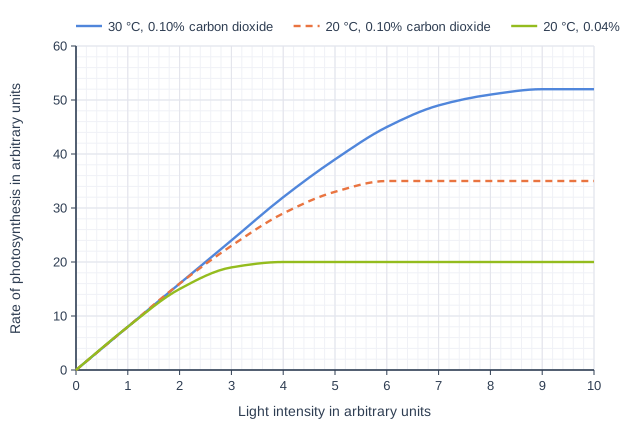
The graph shows the rate of photosynthesis of a plant at different light intensities under three sets of conditions.
What is limiting the rate of photosynthesis at 20 °C and 0.10% carbon dioxide when the light intensity is 9 units? Explain how the graph shows this.
Model answer
Temperature is the limiting factor. At 9 units the 20 °C, 0.10% line is flat at 35 units, so increasing light intensity has no further effect. The 30 °C, 0.10% line has the same carbon dioxide concentration but is much higher (about 52 units), so raising the temperature increases the rate.
Explanation
To find the limiting factor, compare two curves that differ in only one factor. The 20 °C and 30 °C curves at 0.10% carbon dioxide differ only in temperature, so temperature must be what limits the lower one when it has levelled off.
Mark scheme
1 mark
temperature
1 mark
increasing light intensity has no effect at this point / the line is flat, so light is not limiting
1 mark
increasing the temperature to 30 °C at the same carbon dioxide concentration increases the rate (from 35 to about 52 units)
allow carbon dioxide is not limiting because it is already at 0.10% and only temperature differs between the top two curves
Question 4
6 marks
A student wants to investigate the effect of light intensity on the rate of photosynthesis of pondweed.
Plan a method the student could use.
Model answer
Put a piece of pondweed into a boiling tube of water containing a little sodium hydrogencarbonate, so that carbon dioxide is not limiting. Darken the room and place a lamp 10 cm from the pondweed, measuring the distance with a metre rule. Leave the pondweed for 5 minutes to adjust, then count the number of oxygen bubbles released in one minute. Repeat with the lamp at 20, 30, 40 and 50 cm. Keep the temperature constant by standing the boiling tube in a beaker of water, or by using an LED lamp, which gives off little heat. Use the same piece of pondweed throughout. Repeat the count three times at each distance and calculate the mean number of bubbles per minute.
Explanation
Light intensity is changed by moving the lamp. The rate is measured by the oxygen given off, either by counting bubbles or, more accurately, by collecting the gas and measuring its volume. Temperature and carbon dioxide concentration are control variables because they also affect the rate.
Mark scheme
1 mark
put a piece of pondweed in a boiling tube of water (containing sodium hydrogencarbonate to supply carbon dioxide)
Level of response question: credit a coherent, logically linked answer; max 6
1 mark
place a lamp at a measured distance, e.g. 10 cm, from the pondweed (using a metre rule)
1 mark
leave the pondweed for a few minutes to adjust before measuring
1 mark
count the number of bubbles of gas (oxygen) produced in one minute / collect the gas in a measuring cylinder or gas syringe for a set time
1 mark
repeat with the lamp at different distances, e.g. 20, 30, 40 and 50 cm
at least three distances
1 mark
keep the temperature constant, e.g. with a water bath / a heat shield / an LED lamp
1 mark
use the same piece of pondweed and the same concentration of sodium hydrogencarbonate / work in a darkened room
1 mark
repeat each distance and calculate a mean rate
Ready to try the rest? Every answer you write is marked against the mark scheme, so you can see exactly where the marks are.
Ctrl + Enter to check
Study HelperHints first, answers after you try
Stuck on this one? Ask for a hint and I’ll point you in the right direction, without giving the answer away. Once you’ve checked your answer, I’ll show you how the marks are awarded.