Level:
Correct: 0
Incorrect: 0
Marks: 0/0

Metabolism

Practise 13 exam-style questions on Metabolism for AQA GCSE Combined Science (Biology Paper 1). Write your answer as you would in the exam and get it marked in seconds against the mark scheme, point by point, with the Study Helper on hand if you get stuck.

  • 13 questions
  • 1–6 marks each
  • Instant marking
  • No sign-up needed
13 questions, marked as you go

Sample questions with model answers

Here are 4 of the questions in this topic, each with a model answer, an explanation of why it earns the marks and the mark scheme an examiner would use.

Question 1

1 mark

What substance is formed when excess proteins are broken down in the body?

Model answer

Urea.

Explanation

The body cannot store excess proteins, so they are broken down to form urea, which is excreted. Do not confuse urea (the substance) with urine (the liquid that contains it).

Mark scheme
  1. 1 mark

    urea

    do not accept urine; do not accept amino acids

Question 2

2 marks

Lipase enzymes break down lipids in food into fatty acids and glycerol.

Explain how the body uses the fatty acids and glycerol after they are absorbed.

Model answer

Cells join one glycerol molecule to three fatty acid molecules to synthesise new lipids, for example to store energy or to build cell membranes. Fatty acids and glycerol can also be used in respiration to transfer energy.

Explanation

Large molecules in food are broken down into small ones during digestion so they can be absorbed, then rebuilt into the body's own large molecules. This synthesis is part of metabolism and needs energy from respiration.

Mark scheme
  1. 1 mark

    they are used to synthesise new lipids / one glycerol and three fatty acids are joined to form a lipid

    allow lipids for energy stores or cell membranes

  2. 1 mark

    they can be used in respiration to transfer energy

Question 3

3 marks

Explain the importance of amino acids in the human body. Include how they are obtained from food.

Model answer

Proteins in food are digested by protease enzymes into amino acids, which are absorbed into the blood. Cells use the amino acids to synthesise new proteins, such as enzymes and the proteins needed for growth and repair. Any excess protein is broken down to form urea, which is excreted.

Explanation

Amino acids link the breakdown of proteins (digestion) with their synthesis in cells. Because the body cannot store them, excess amino acids are broken down to urea.

Mark scheme
  1. 1 mark

    proteins in food are broken down / digested into amino acids (by proteases)

    max 3

  2. 1 mark

    amino acids are absorbed (into the blood) and used to synthesise new proteins

  3. 1 mark

    e.g. enzymes / proteins for growth and repair

    any one correct use of the proteins

  4. 1 mark

    excess amino acids / proteins are broken down to form urea

Question 4

4 marks

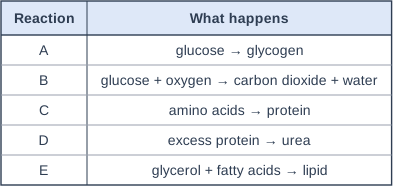
The table shows five reactions that are part of metabolism.

Identify the two reactions that break molecules down.

Explain why the other three reactions need energy transferred by respiration.

Table with columns "Reaction", "What happens". Reaction: A; What happens: glucose → glycogen | Reaction: B; What happens: glucose + oxygen → carbon dioxide + water | Reaction: C; What happens: amino acids → protein | Reaction: D; What happens: excess protein → urea | Reaction: E; What happens: glycerol + fatty acids → lipid.

Model answer

The breakdown reactions are B (respiration) and D (the breakdown of excess protein to urea).
Reactions A, C and E all build larger molecules from smaller ones: glycogen from glucose, proteins from amino acids and lipids from glycerol and fatty acids. Synthesising larger molecules requires energy, which is transferred by respiration.

Explanation

Metabolism includes synthesis reactions, which build up molecules and need energy, and breakdown reactions such as respiration, which transfers the energy. All of them are controlled by enzymes.

Mark scheme
  1. 1 mark

    B (respiration)

    if more than two letters are given, deduct one mark for each wrong letter

  2. 1 mark

    D (breakdown of excess protein to urea)

  3. 1 mark

    A, C and E synthesise larger molecules from smaller molecules

    allow they are synthesis reactions

  4. 1 mark

    building larger molecules requires energy, which is supplied by respiration

Ready to try the rest? Every answer you write is marked against the mark scheme, so you can see exactly where the marks are.

Revision notes

Metabolism

The big idea

Metabolism is the sum of all the reactions in a cell or the body. Some reactions build large molecules from small ones; others break large molecules down. They are all controlled by enzymes, and the energy for building new molecules comes from respiration. This topic links ideas from digestion, photosynthesis and respiration into one picture.

Building and breaking down large molecules

Carbohydrates, proteins and lipids are large molecules built from smaller ones. The small molecules are the key: digestion releases them, and cells use them to build what they need.

Large moleculeBuilt fromBroken down byExamples and uses
CarbohydratesGlucose (sugars)Carbohydrases, such as amylaseStarch: store in plants. Glycogen: store in animals' liver and muscle cells. Cellulose: strengthens plant cell walls
ProteinsAmino acidsProteasesEnzymes, muscle, antibodies
Lipids (fats and oils)One glycerol and three fatty acidsLipasesEnergy stores, for example in seeds or in animals that hibernate

Starch and glycogen are insoluble, so they can be stored without affecting osmosis, and they can be broken back down into glucose for respiration when needed.

The metabolic processes you need to know

Metabolism includes:

  1. the conversion of glucose to starch, glycogen and cellulose;
  2. the formation of a lipid molecule from one molecule of glycerol and three molecules of fatty acids;
  3. the use of glucose and nitrate ions to form amino acids, which are then used to synthesise proteins (in plants);
  4. respiration, which transfers the energy needed for the other reactions;
  5. the breakdown of excess proteins to form urea for excretion.

Plants and animals get amino acids differently. Plants make their own from glucose (from photosynthesis) and nitrate ions (from the soil). Animals cannot do this, so they eat protein and digest it into amino acids.

Flow chart of 5 boxes joined by arrows, read from top to bottom. The first box is "Protein in food", which leads (along an arrow labelled "digested by protease") to "Amino acids absorbed into blood". From "Amino acids absorbed into blood", 2 arrows branch out side by side: the left arrow, labelled "needed", leads to "New proteins built in cells"; the right arrow, labelled "not needed", leads to "Excess broken down to urea", which leads to "Urea excreted in urine".
Amino acids cannot be stored, so any not needed for new proteins are broken down to urea.

The excess amino acids are broken down in the liver to form urea, which is carried in the blood to the kidneys and excreted in urine.

Why enzymes and energy matter

Without enzymes, these reactions would be far too slow at body temperature to keep an organism alive. Each enzyme is specific: its active site fits only one substrate, so a process with several steps needs a different enzyme for each step.

Building large molecules needs energy, which is transferred by respiration. This is why respiration continues even when you are asleep: your cells keep making proteins for growth and repair, and your body keeps warm and your heart keeps beating. Cells that make lots of protein, such as the pancreas cells that make digestive enzymes, have many ribosomes (where proteins are made) and many mitochondria (to release the energy).

Stores are broken down when energy is needed: muscles convert glycogen to glucose during exercise, a hibernating bear breaks down its fat into glycerol and fatty acids to respire, and a germinating seed uses its stored lipid before it can photosynthesise.

Counting molecules in standard form

A fat-storage cell under a seal's skin makes \(5.0 \times 10^{5}\) lipid molecules. How many fatty acid molecules and glycerol molecules are needed?

Each lipid needs three fatty acids: \(3 \times 5.0 \times 10^{5} = 15 \times 10^{5} = 1.5 \times 10^{6}\) fatty acids

Each lipid needs one glycerol: \(5.0 \times 10^{5}\) glycerol molecules

Remember

  • Metabolism = the sum of all the reactions in a cell or the body.
  • Glucose \(\rightarrow\) starch, glycogen and cellulose.
  • One glycerol + three fatty acids \(\rightarrow\) one lipid.
  • Glucose + nitrate ions \(\rightarrow\) amino acids \(\rightarrow\) proteins.
  • Excess proteins \(\rightarrow\) urea, excreted.

Common mistakes

  • Writing "glucagon" for the animal storage carbohydrate. It is glycogen.
  • Writing "urine" for the waste made from excess protein. It is urea; urine is the liquid that carries it out.
  • Writing "fatty acids" without the number. A lipid is one glycerol and three fatty acids.
  • Describing metabolism as "how fast you burn food". It is the sum of all the reactions in a cell or the body.
  • Calling diffusion a metabolic reaction. Diffusion is a physical process, not a chemical reaction.

Exam tip

In 6-mark questions about sugars, amino acids, fatty acids and glycerol, cover both directions for each type of molecule: how the large molecule is synthesised from the small ones, and how it is broken down (and by which enzyme). Finish with the fate of each: glucose respired, excess amino acids made into urea.

Study Helper Hints first, answers after you try

Stuck on this one? Ask for a hint and I’ll point you in the right direction, without giving the answer away. Once you’ve checked your answer, I’ll show you how the marks are awarded.