Level:
Correct: 0
Incorrect: 0
Marks: 0/0

Communicable (infectious) diseases

Practise 12 exam-style questions on Communicable (infectious) diseases for AQA GCSE Combined Science (Biology Paper 1). Write your answer as you would in the exam and get it marked in seconds against the mark scheme, point by point, with the Study Helper on hand if you get stuck.

  • 12 questions
  • 1–6 marks each
  • Instant marking
  • No sign-up needed
12 questions, marked as you go

Sample questions with model answers

Here are 4 of the questions in this topic, each with a model answer, an explanation of why it earns the marks and the mark scheme an examiner would use.

Question 1

2 marks

Pathogens may infect plants or animals.

Name the four types of pathogen.

Model answer

Viruses, bacteria, protists and fungi.

Explanation

All four types of microorganism include pathogens: for example, measles (virus), Salmonella food poisoning (bacterium), malaria (protist) and rose black spot (fungus). Each type can infect plants or animals.

Mark scheme
  1. 1 mark

    any two correct from: viruses, bacteria, protists, fungi

    2 marks for all four; 1 mark for two or three; allow singular forms

  2. 1 mark

    all four correct: viruses, bacteria, protists and fungi

    ignore named examples, e.g. Salmonella, if the type is also given

Question 2

2 marks

Ebola is a viral disease spread by direct contact with the blood and other body fluids of an infected person.

Explain why patients with Ebola are kept isolated in a separate ward.

Model answer

Isolating patients stops healthy people from coming into direct contact with them or their body fluids, so the virus cannot be passed on to others.

Explanation

Isolating infected individuals is one of the main ways of reducing the spread of a communicable disease. It is especially important for a disease spread by direct contact, because the only route of spread is close contact with the patient.

Mark scheme
  1. 1 mark

    it prevents (direct) contact between the patient and healthy people

    allow fewer people touch the patient or their body fluids

  2. 1 mark

    so the virus cannot be passed on / the spread is reduced

Question 3

3 marks

Brown rust is a fungal disease of wheat plants. The fungus produces spores that are carried by the wind and by splashes of rain.

Explain how the disease spreads through a field of wheat and suggest two ways a farmer could reduce the spread.

Model answer

Spores produced on infected plants are carried by the wind or splashed by rain onto nearby healthy plants, where they grow and infect them. The farmer could remove and destroy the infected plants, and spray the crop with a fungicide.

Explanation

Fungal plant diseases spread by spores in the air and water. Removing infected plants takes away the source of spores, and fungicides kill the fungus. Antibiotics are no use: they only kill bacteria.

Mark scheme
  1. 1 mark

    spores from infected plants are blown / splashed onto nearby healthy plants (and infect them)

    max 3 overall

  2. 1 mark

    remove and destroy infected plants / leaves

    any two from the remaining points for 1 mark each; allow burn infected plants

  3. 1 mark

    spray the crop with a fungicide

    do not accept antibiotics or pesticide on its own

  4. 1 mark

    plant the wheat further apart

  5. 1 mark

    grow a variety of wheat that is resistant to brown rust

Question 4

4 marks

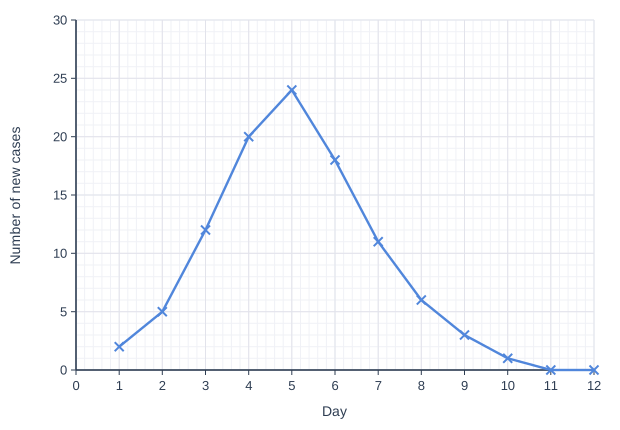
There was an outbreak of a disease caused by norovirus on a cruise ship. The graph shows the number of new cases on each day.

At the start of day 4, the crew began isolating passengers who were ill and disinfecting surfaces in public areas. A crew member said that these measures stopped the outbreak.

Evaluate this claim. Use data from the graph in your answer.

Line graph of number of new cases (y-axis, 0 to 30) against day (x-axis, 0 to 12). The line joins the points (1, 2), (2, 5), (3, 12), (4, 20), (5, 24), (6, 18), (7, 11), (8, 6), (9, 3), (10, 1), (11, 0), (12, 0).

Model answer

The number of new cases rose until day 5 (24 cases), a day after the measures began, but this could be people who had already been infected before day 4. After day 5 new cases fell steadily and there were none by day 11, which fits with isolation and disinfection reducing the spread of the virus. However, there is nothing to compare with, such as a ship that did not use these measures, so we cannot be sure that the outbreak would not have ended anyway, for example because many of the people at risk had already caught it. The data support the claim but do not prove it.

Explanation

When evaluating, look at what the data show before and after the change, then consider other explanations. Without a control, a fall in cases after an intervention does not prove the intervention caused it.

Mark scheme
  1. 1 mark

    new cases kept rising until day 5 / for a day after the measures started

    max 4; max 3 if no data from the graph are used

  2. 1 mark

    this could be people who were already infected before day 4 / it takes time for symptoms to appear

  3. 1 mark

    new cases then fell, from 24 on day 5 to 0 by day 11

    allow fell to zero after day 10

  4. 1 mark

    the fall is consistent with the measures reducing spread by direct contact

  5. 1 mark

    but there is no comparison / control (no ship without the measures), so the outbreak might have ended anyway

  6. 1 mark

    e.g. because most people who could catch it had already been infected

Ready to try the rest? Every answer you write is marked against the mark scheme, so you can see exactly where the marks are.

Revision notes

Communicable (infectious) diseases

The big idea

A communicable (infectious) disease can be passed from one person, animal or plant to another. It is caused by a pathogen: a microorganism that causes infectious disease. Once you know how a pathogen spreads, you can work out how to stop it, and linking the two is what most exam questions on this topic test.

The four types of pathogen

Pathogens may be viruses, bacteria, protists or fungi. They can infect animals or plants. Not every microorganism is a pathogen: many bacteria and fungi are harmless or useful.

Type of pathogenKey factsExamples
BacteriaVery small cells that reproduce rapidly inside the body; some produce poisons (toxins)Salmonella food poisoning, gonorrhoea
VirusesMuch smaller than bacteria; live and reproduce only inside cellsMeasles, HIV, tobacco mosaic virus
ProtistsMostly single-celled organisms with a nucleus; some are carried by an animalMalaria
FungiMany spread by tiny spores, carried in air or waterRose black spot, athlete's foot

How bacteria and viruses make us ill

Both bacteria and viruses may reproduce rapidly inside the body, so a few pathogens soon become millions. The way they cause damage is different:

  • Bacteria may produce toxins that damage tissues and make us feel ill (for example fever, vomiting or diarrhoea).
  • Viruses get inside the body's cells and use them to make many copies of themselves. This damages the cells: often the cell bursts, releasing new viruses that infect more cells.

Each time a bacterium divides, the number doubles. Symptoms start once there are enough bacteria, or enough toxin, to damage tissues.

Working out bacterial growth

A person swallows 20 bacteria in contaminated water. In the gut the bacteria divide once every 20 minutes. How many bacteria are there after 3 hours, assuming none die? Give your answer in standard form.

Number of divisions: \(\dfrac{3 \times 60}{20} = 9\)

Each division doubles the number: \(20 \times 2^9 = 20 \times 512 = 10\,240\)

In standard form: \(1.024 \times 10^4\) bacteria

How pathogens are spread

Pathogens can be spread by direct contact, by water or by air.

RouteHow the pathogen reaches a new hostExamples
Direct contactTouching an infected person, animal or plant, or a contaminated surface, towel or tool; sexual contactAthlete's foot, tobacco mosaic virus, gonorrhoea
WaterDrinking water contaminated with sewage; rain splashing spores from leaf to leafCholera, rose black spot
AirDroplets from coughs and sneezes are breathed in; spores are blown by the windMeasles, flu, fungal spores

Some pathogens reach new hosts in other ways. Salmonella bacteria are eaten in food. Others are carried by a vector: an animal (often an insect) that carries a pathogen from one host to another, such as the mosquito that spreads malaria.

Reducing or preventing the spread

Every method works by breaking the route the pathogen uses to reach a new host.

MethodHow it reduces spread
Hygiene: washing hands, disinfecting surfaces and tools, catching sneezes in a tissue, cooking food thoroughlyKills or removes pathogens before they reach a new host
Isolating infected people (or removing and destroying infected plants)Other individuals do not come into contact with the source of the pathogen
Clean drinking water and sewage treatmentPathogens in faeces cannot get into water that people drink
Destroying or controlling vectors (insecticides, removing breeding sites, nets)Fewer vectors to carry the pathogen between hosts
VaccinationVaccinated people do not become infected, so they cannot pass the pathogen on
For crops: cleaning tools, spacing plants, chemicals such as fungicides, resistant varietiesStops pathogens passing from plant to plant, or stops plants becoming infected

Linking control to the route of spread

A fungus infects strawberry plants. Its spores are splashed from plant to plant by rain and are carried on the gloves of fruit pickers. Suggest two ways to reduce the spread, and explain each.

  1. Remove and destroy (burn) infected plants. This removes the source of the spores, so fewer spores are produced to splash onto healthy plants.
  2. Pickers change or disinfect their gloves between rows. This kills or removes spores on the gloves, so they are not carried to healthy plants by direct contact.

Remember

  • The four types of pathogen: viruses, bacteria, protists and fungi.
  • The three main routes: direct contact, water and air.
  • Bacteria may produce toxins that damage tissues; viruses live and reproduce inside cells, damaging them.
  • To control a disease, break the route it spreads by.

Common mistakes

  • Defining a pathogen as "something that causes disease". Say a microorganism that causes infectious disease.
  • Saying viruses produce toxins or "divide". Toxins come from bacteria; viruses reproduce inside cells and damage them.
  • Listing control methods without explaining them. Link each method to the route it blocks.
  • In growth calculations, multiplying by the number of divisions (20 \(\times\) 9) instead of doubling each time (20 \(\times 2^9\)).

Exam tip

Questions often describe an unfamiliar disease. Use the clues: a pathogen in faeces spreads in water, one in the nose and throat spreads in droplets, and one on the skin spreads by touch. For a 6-mark answer on spread and control, give several routes, match a control method to each, and use examples from both plants and animals if the question asks for them.

Study Helper Hints first, answers after you try

Stuck on this one? Ask for a hint and I’ll point you in the right direction, without giving the answer away. Once you’ve checked your answer, I’ll show you how the marks are awarded.