The big idea
Bacteria cause disease by reproducing rapidly inside the body and releasing toxins that damage tissues. You need to know two bacterial diseases: Salmonella food poisoning and gonorrhoea. Because they are caused by bacteria, both can be treated with antibiotics, but bacteria that are resistant to antibiotics are a growing problem.
Salmonella food poisoning
- Spread: by bacteria ingested in food, or on food prepared in unhygienic conditions. Raw chicken and eggs often carry Salmonella. The bacteria survive if food is undercooked, and they spread to other food on hands, chopping boards, knives and worktops.
- Symptoms: fever, abdominal cramps, vomiting and diarrhoea. These are caused by the bacteria and the toxins they secrete.
- Symptoms often start 12 to 72 hours after eating, because the bacteria need time to reproduce and make enough toxin.
- Control: in the UK, poultry are vaccinated against Salmonella, so chicken meat and eggs are much less likely to carry it. Good food hygiene also stops the bacteria reaching the gut.
| Food hygiene step | Why it helps |
|---|
| Cook meat and eggs thoroughly, right to the middle | Heat kills the bacteria |
| Wash hands after touching raw meat | Stops bacteria being carried to other food |
| Use separate boards and knives for raw meat; clean worktops | Stops cross-contamination of food that will not be cooked |
| Keep raw meat in the fridge | Cold slows down the bacteria's reproduction (it does not kill them) |
People in the UK still get Salmonella food poisoning, from imported food, other animals and foods, poor kitchen hygiene and travel abroad.
Gonorrhoea
- A sexually transmitted disease (STD) caused by a bacterium.
- Symptoms: a thick yellow or green discharge from the vagina or penis and pain on urinating. Some infected people have no symptoms, so they pass it on without knowing.
- Spread: by sexual contact. It is not spread in food, water or droplets.
- Treatment: it was easily treated with the antibiotic penicillin until many resistant strains appeared. Doctors now use other antibiotics, and may test which antibiotic kills the strain a patient has.
- Control: treatment with antibiotics, and using a barrier method of contraception such as a condom, which stops the bacteria passing between partners. Testing and treating the sexual partners of infected people also helps. The contraceptive pill gives no protection.
Resistant strains became common because a mutation made some bacteria resistant. Penicillin killed the bacteria that were not resistant, but the resistant ones survived, reproduced and were passed on by sexual contact. It is the bacteria that become resistant, not the patient.
The two diseases compared
| Salmonella food poisoning | Gonorrhoea |
|---|
| Spread | Eating bacteria in food, or food prepared in unhygienic conditions | Sexual contact |
| Symptoms | Fever, abdominal cramps, vomiting, diarrhoea | Thick yellow or green discharge, pain on urinating |
| Control | Vaccinating poultry; food hygiene and thorough cooking | Antibiotics; condoms |
Finding the source of an outbreak
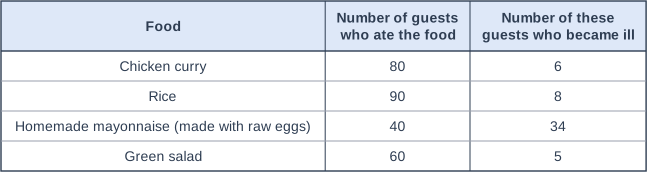
After a school barbecue, some pupils had Salmonella food poisoning. Which food most likely caused it?
| Food | Pupils who ate it | Pupils who became ill |
|---|
| Burgers | 80 | 12 |
| Chicken wings | 50 | 30 |
| Potato salad | 60 | 9 |
Different numbers of pupils ate each food, so compare percentages, not raw numbers.
Burgers: \(\dfrac{12}{80} \times 100 = 15\%\). Chicken wings: \(\dfrac{30}{50} \times 100 = 60\%\). Potato salad: \(\dfrac{9}{60} \times 100 = 15\%\).
The chicken wings are the most likely source: 60% of those who ate them became ill. Chicken can carry Salmonella, and if the wings were undercooked the bacteria were not killed.
Remember
- Salmonella: spread in food; fever, abdominal cramps, vomiting and diarrhoea, caused by the bacteria and the toxins they secrete.
- UK poultry are vaccinated against Salmonella.
- Gonorrhoea: an STD; thick yellow or green discharge and pain on urinating.
- Gonorrhoea is controlled with antibiotics and condoms; many strains are now resistant to penicillin.
Common mistakes
- Saying the patient becomes resistant or immune to an antibiotic. The bacteria become resistant.
- Saying the contraceptive pill stops gonorrhoea. Only a barrier method such as a condom does.
- Saying a fridge kills bacteria. It slows their reproduction, so food must still be cooked properly.
- Saying Salmonella bacteria make antitoxins. Bacteria secrete toxins; white blood cells make antitoxins.
- Mixing up the symptoms. Salmonella: fever, abdominal cramps, vomiting and diarrhoea. Gonorrhoea: thick yellow or green discharge and pain on urinating.
Exam tip
"Compare" questions want linked points, not two separate descriptions. Go feature by feature (spread, symptoms, control) and use "whereas": "Salmonella is spread by eating contaminated food, whereas gonorrhoea is spread by sexual contact."