Practise 13 exam-style questions on Antibiotics and painkillers for AQA GCSE Combined Science (Biology Paper 1). Write your answer as you would in the exam and get it marked in seconds against the mark scheme, point by point, with the Study Helper on hand if you get stuck.
13 questions
1–6 marks each
Instant marking
No sign-up needed
13 questions, marked as you go
Sample questions with model answers
Here are 4 of the questions in this topic, each with a model answer, an explanation of why it earns the marks and the mark scheme an examiner would use.
Question 1
1 mark
Which one of these diseases can be cured with antibiotics?
measles HIV gonorrhoea tobacco mosaic virus disease
Model answer
Gonorrhoea.
Explanation
Gonorrhoea is caused by a bacterium, so antibiotics can kill it (although many strains are now resistant to penicillin). Measles, HIV and TMV are caused by viruses, which antibiotics cannot kill.
Mark scheme
1 mark
gonorrhoea
do not accept more than one answer
Question 2
2 marks
A doctor sends a sample from a patient's infected wound to a laboratory to find out which type of bacterium is causing the infection before choosing an antibiotic.
Explain why.
Model answer
Different antibiotics kill different bacteria, so specific bacteria need to be treated with specific antibiotics. Knowing which bacterium is causing the infection lets the doctor choose an antibiotic that will actually kill it and cure the infection.
Explanation
It is important that specific bacteria are treated by specific antibiotics. Using the wrong antibiotic would not cure the infection and would add to the problem of antibiotic resistance.
Mark scheme
1 mark
each antibiotic only kills certain types of bacteria / specific bacteria should be treated by specific antibiotics
1 mark
so the doctor can choose an antibiotic that will kill this bacterium and cure the infection
allow so the antibiotic is effective; allow avoids using an antibiotic that does not work
Question 3
3 marks
A patient has a very sore throat and a fever. Tests show that the infection is caused by a bacterium. The doctor prescribes an antibiotic and advises the patient to take paracetamol, a painkiller.
Explain the role of each medicine in the patient's treatment.
Model answer
The antibiotic kills the bacteria that are causing the throat infection, so it cures the disease. Paracetamol is a painkiller: it relieves the symptoms, such as the sore throat and fever, so the patient feels better, but it does not kill the bacteria.
Explanation
Medicines can treat the cause of a disease (antibiotics kill bacteria) or its symptoms (painkillers). Often both are used together, as here.
Mark scheme
1 mark
the antibiotic kills the bacteria (causing the infection)
1 mark
so it cures the infection
allow removes the cause of the disease
1 mark
paracetamol relieves the symptoms (pain / fever) but does not kill the bacteria
both parts needed
Question 4
4 marks
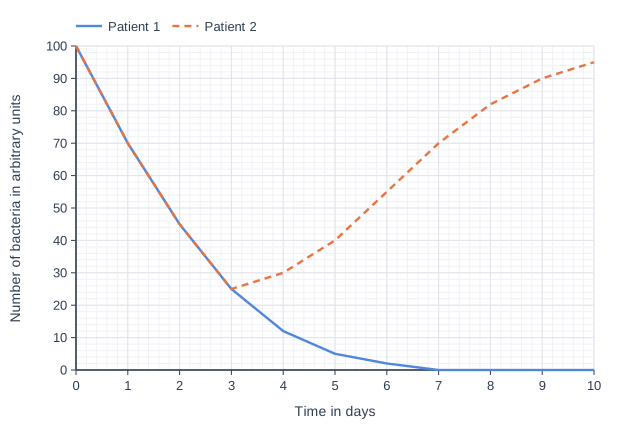
Two patients with the same bacterial infection were prescribed a 7-day course of an antibiotic. Patient 1 took the whole course. Patient 2 felt better and stopped taking the antibiotic after 3 days. The graph shows the number of bacteria in a sample from each patient.
Describe and explain the differences between the results for the two patients.
Model answer
For the first 3 days the number of bacteria fell in both patients, from 100 to 25, because the antibiotic was killing them. Patient 1 kept taking the antibiotic and the number of bacteria fell to zero by day 7, so the infection was cured. Patient 2 stopped on day 3, when some bacteria were still alive. These bacteria reproduced, so the number rose again to 95 by day 10 and the infection came back. Patient 2 felt better because there were fewer bacteria, but they had not all been killed.
Explanation
Antibiotics cure bacterial disease by killing the infective bacteria, but only if all of them are killed. Stopping a course early leaves survivors that can multiply, and any that survive are more likely to be resistant.
Mark scheme
1 mark
for both patients the number of bacteria fell for the first 3 days because the antibiotic killed the bacteria
max 4
1 mark
in patient 1 the number of bacteria fell to zero (by day 7) / all the bacteria were killed
1 mark
in patient 2 the number of bacteria increased again after day 3 (to 95 by day 10)
1 mark
because not all the bacteria had been killed when patient 2 stopped, so the remaining bacteria reproduced
1 mark
patient 2 felt better because the number of bacteria had fallen, but the infection was not cured / will return
allow surviving bacteria could be resistant
Ready to try the rest? Every answer you write is marked against the mark scheme, so you can see exactly where the marks are.
Ctrl + Enter to check
Study HelperHints first, answers after you try
Stuck on this one? Ask for a hint and I’ll point you in the right direction, without giving the answer away. Once you’ve checked your answer, I’ll show you how the marks are awarded.