Practise 9 exam-style questions on Chromosomes for AQA GCSE Combined Science (Biology Paper 1). Write your answer as you would in the exam and get it marked in seconds against the mark scheme, point by point, with the Study Helper on hand if you get stuck.
9 questions
1–4 marks each
Instant marking
No sign-up needed
9 questions, marked as you go
Sample questions with model answers
Here are 4 of the questions in this topic, each with a model answer, an explanation of why it earns the marks and the mark scheme an examiner would use.
Question 1
1 mark
What substance are chromosomes made of?
Model answer
DNA.
Explanation
Each chromosome is made of a very long molecule of DNA. Genes are short sections of that DNA, so each chromosome carries a large number of genes.
Mark scheme
1 mark
DNA
allow deoxyribonucleic acid; ignore protein
Question 2
2 marks
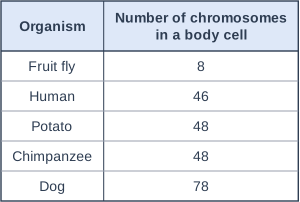
The table shows the number of chromosomes in a body cell of five different organisms.
Every number in the table is even. Explain why. State how many pairs of chromosomes there are in a body cell of a dog.
Model answer
In body cells the chromosomes are normally found in pairs, so the total number of chromosomes is always even. A dog body cell has 78 ÷ 2 = 39 pairs of chromosomes.
Explanation
Body cells contain two of each type of chromosome, one of each pair having come from each parent, so dividing the number of chromosomes by two gives the number of pairs.
Mark scheme
1 mark
chromosomes in body cells are (normally) found in pairs
1 mark
39 (pairs)
Question 3
3 marks
A teacher uses an analogy to describe a cell. The nucleus is a library of recipe books. Each book is a chromosome and each recipe in a book is a gene. Before the cell divides, every book is photocopied.
Use the analogy to explain why the genetic material must be copied before a cell divides.
Model answer
Each new cell needs a complete set of chromosomes, so that it has every gene (every recipe) it needs. If the chromosomes were not copied first, the books would have to be shared out, and each new cell would be missing some chromosomes and therefore many genes. Copying every chromosome produces two identical sets, so each new cell receives one complete set and the two cells are genetically identical.
Explanation
Analogies help explain unfamiliar processes: here, photocopying the library stands for the DNA replicating to form two copies of each chromosome before the cell divides.
Mark scheme
1 mark
each new cell needs a complete set of chromosomes / genes
allow a full set of recipe books / all the recipes
1 mark
if it were not copied, each new cell would get only some of the chromosomes / would be missing genes
allow half the books / missing recipes
1 mark
copying gives two identical sets, one for each new cell
allow so the two new cells are genetically identical
Question 4
4 marks
A student uses pipe cleaners to model a body cell that has four chromosomes, in two pairs. One pair is made of long pipe cleaners and the other pair of short pipe cleaners.
Describe how the student could use the pipe cleaners to model how this cell divides to form two genetically identical cells.
Model answer
First the student adds an identical copy of each chromosome, using another long pipe cleaner for each long one and another short one for each short one, so there are eight pipe cleaners: two copies of each chromosome. Then she separates the copies, moving one copy of each chromosome to each end of the cell. Each end now has four pipe cleaners, two long and two short, so each new cell has the same two pairs of chromosomes as the original cell and the two new cells are identical.
Explanation
A model like this shows why the genetic material must be doubled before it is divided: each new cell ends up with exactly the same chromosomes as the parent cell, in pairs.
Mark scheme
1 mark
make an exact copy of each of the four pipe cleaners / chromosomes
allow use four more pipe cleaners of the same lengths; max 4
1 mark
so there are now eight pipe cleaners / two copies of each chromosome
1 mark
separate them so that one copy of each chromosome moves to each end / into each group
allow pull the copies apart into two groups
1 mark
each group / new cell has four chromosomes: two long and two short / two pairs
1 mark
the two groups are identical to each other and to the original cell
Ready to try the rest? Every answer you write is marked against the mark scheme, so you can see exactly where the marks are.
Ctrl + Enter to check
Study HelperHints first, answers after you try
Stuck on this one? Ask for a hint and I’ll point you in the right direction, without giving the answer away. Once you’ve checked your answer, I’ll show you how the marks are awarded.