Level:
Correct: 0
Incorrect: 0
Marks: 0/0

Photosynthetic reaction

Practise 10 exam-style questions on Photosynthetic reaction for AQA GCSE Combined Science (Biology Paper 1). Write your answer as you would in the exam and get it marked in seconds against the mark scheme, point by point, with the Study Helper on hand if you get stuck.

  • 10 questions
  • 1–5 marks each
  • Instant marking
  • No sign-up needed
10 questions, marked as you go

Sample questions with model answers

Here are 4 of the questions in this topic, each with a model answer, an explanation of why it earns the marks and the mark scheme an examiner would use.

Question 1

1 mark

The formulae of four substances involved in photosynthesis are:

CO₂
H₂O
O₂
C₆H₁₂O₆

Which formula represents glucose?

Model answer

C₆H₁₂O₆

Explanation

Glucose is C₆H₁₂O₆: 6 carbon atoms, 12 hydrogen atoms and 6 oxygen atoms. CO₂ is carbon dioxide, H₂O is water and O₂ is oxygen.

Mark scheme
  1. 1 mark

    C₆H₁₂O₆

    allow the formula typed with ordinary numbers instead of subscripts

Question 2

2 marks

Explain why photosynthesis can only take place when light is available.

Model answer

Photosynthesis is an endothermic reaction, so it needs energy to be taken in. This energy is transferred from the environment to the chloroplasts by light, so without light the reaction cannot happen.

Explanation

Endothermic reactions take in energy from their surroundings. In photosynthesis that energy arrives as light, which is absorbed by chlorophyll in the chloroplasts.

Mark scheme
  1. 1 mark

    photosynthesis is an endothermic reaction / needs a supply of energy

  2. 1 mark

    the energy is transferred from the environment to the chloroplasts by light

    allow light provides the energy; do not accept light 'makes' energy

Question 3

3 marks

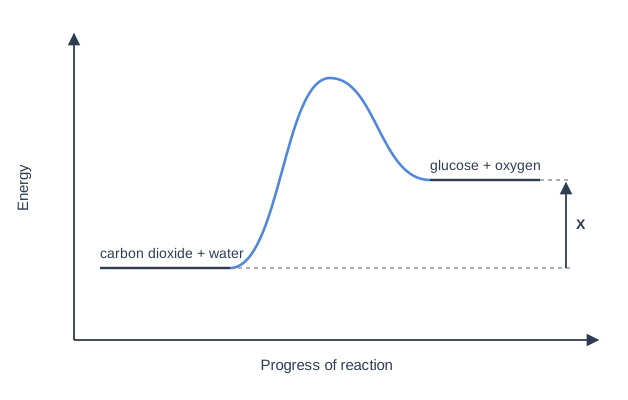
The diagram shows the energy change during photosynthesis.

Explain what the diagram shows about photosynthesis and where the energy shown by arrow X comes from.

Reaction profile (energy against progress of reaction). The reactants (carbon dioxide + water) are lower in energy than the products (glucose + oxygen); the curve rises to a peak between them. An arrow labelled X goes from the reactants' level up to the products' level.

Model answer

The diagram shows that the products, glucose and oxygen, have more energy than the reactants, carbon dioxide and water. This means energy is taken in during the reaction, so photosynthesis is endothermic. The energy shown by X is transferred from the environment to the chloroplasts by light.

Explanation

On a reaction profile, an endothermic reaction has products higher in energy than reactants. Some of the energy transferred by light is stored in glucose, which is why glucose can later be used in respiration to transfer energy.

Mark scheme
  1. 1 mark

    the products (glucose and oxygen) have more energy than the reactants (carbon dioxide and water)

    allow the energy level of the products is higher

  2. 1 mark

    so energy is taken in / photosynthesis is endothermic

  3. 1 mark

    the energy (X) is transferred from the environment to the chloroplasts by light

    allow from sunlight / light absorbed by chlorophyll

Question 4

4 marks

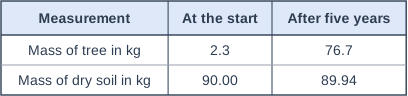
A scientist planted a young willow tree in a pot of dry soil. For five years he added only water. The table shows his measurements.

Calculate the increase in mass of the tree and the decrease in mass of the soil.

Use your knowledge of photosynthesis to explain where most of the extra mass of the tree came from.

Table with columns "Measurement", "At the start", "After five years". Measurement: Mass of tree in kg; At the start: 2.3; After five years: 76.7 | Measurement: Mass of dry soil in kg; At the start: 90.00; After five years: 89.94.

Model answer

Increase in mass of tree = 76.7 − 2.3 = 74.4 kg
Decrease in mass of soil = 90.00 − 89.94 = 0.06 kg
The soil lost only 0.06 kg, so almost none of the tree's extra mass came from the soil. The tree made glucose by photosynthesis, using carbon dioxide from the air and the water that was added. It used the glucose to make new substances, such as cellulose for cell walls, which built up the mass of the tree. The small loss from the soil was mineral ions taken up by the roots.

Explanation

Plants do not get their food from the soil: they make it by photosynthesis from carbon dioxide and water. Most of the dry mass of a plant comes from carbon dioxide in the air.

Mark scheme
  1. 1 mark

    increase in mass of tree = 76.7 − 2.3 = 74.4 (kg)

  2. 1 mark

    decrease in mass of soil = 90.00 − 89.94 = 0.06 (kg), so the extra mass did not come from the soil

    both the value and the conclusion needed

  3. 1 mark

    the tree made glucose by photosynthesis from carbon dioxide (from the air) and water

  4. 1 mark

    the glucose was used to build new material (e.g. cellulose) for growth

    allow the small loss from the soil was mineral ions

Ready to try the rest? Every answer you write is marked against the mark scheme, so you can see exactly where the marks are.

Revision notes

Photosynthetic reaction

The big idea

Plants make their own food. In photosynthesis, plants and algae use energy transferred by light to turn carbon dioxide and water into glucose, giving off oxygen. Almost every food chain depends on this reaction, and it also puts the oxygen we breathe into the air.

The equation

\[\text{carbon dioxide} + \text{water} \xrightarrow{\text{light}} \text{glucose} + \text{oxygen}\]
SubstanceSymbolRole
Carbon dioxideCO\(_2\)Reactant, from the air
WaterH\(_2\)OReactant, from the soil
GlucoseC\(_6\)H\(_{12}\)O\(_6\)Product, used by the plant
OxygenO\(_2\)Product, released into the air or used in respiration

You need to recognise these symbols. Light is written above the arrow, not as a reactant, because it is not a substance: it is how the energy for the reaction is transferred.

Photosynthesis is an endothermic reaction: energy is transferred from the environment to the chloroplasts by light. That energy is stored in the glucose. Respiration is the opposite: it is exothermic and releases the stored energy.

Where it happens and how the raw materials arrive

Diagram of a palisade cell (template palisade_cell). A palisade cell (from a leaf): cell wall, cell membrane, cytoplasm, many chloroplasts (15) packed round the edge for photosynthesis, a large permanent vacuole in the centre and the nucleus on the right-hand side. The label "chloroplast" points to a chloroplast (one of the 15 drawn); the label "cell wall" points to the cell wall; the label "vacuole" points to the permanent vacuole; the label "nucleus" points to the nucleus.
A palisade cell is packed with chloroplasts, where photosynthesis takes place.
  • Photosynthesis takes place in chloroplasts, which contain the green pigment chlorophyll. Chlorophyll absorbs light. Most chloroplasts are in the palisade mesophyll cells near the top of the leaf.
  • Carbon dioxide diffuses from the air into the leaf through the stomata, then through the air spaces to the cells.
  • Water is absorbed from the soil by the roots (by osmosis) and carried to the leaves in the xylem.
  • Oxygen diffuses out through the stomata.

Plants do not get food from the soil: the roots take in only water and mineral ions, which provide no energy. Most of a plant's mass is built from glucose, made from carbon dioxide and water.

Photosynthesis and respiration together

Plants respire all the time, day and night. What you measure depends on which process is faster:

  • Bright light: photosynthesis is faster than respiration, so the plant takes in carbon dioxide and gives out oxygen overall.
  • Dim light: the two rates can be equal, so there is no overall change in either gas.
  • Dark: only respiration happens, so the plant takes in oxygen and gives out carbon dioxide.

Hydrogencarbonate indicator shows the carbon dioxide level: red at the level in normal air, yellow when there is more carbon dioxide, and purple when there is less.

Showing that photosynthesis has happened

Glucose made in a leaf is turned into starch, so a leaf that has photosynthesised contains starch. To test a leaf: dip it in boiling water to kill the cells, warm it in ethanol in a hot water bath to remove the chlorophyll (no flames: ethanol is flammable), rinse it, then add iodine. Blue-black shows starch.

First keep the plant in the dark for about 48 hours to destarch it, so any starch found must have been made during the experiment. Then:

  • a variegated leaf (green and white) has starch only in the green parts, so chlorophyll is needed;
  • a leaf partly covered with foil has no starch under the foil, so light is needed;
  • a plant sealed with sodium hydroxide (which absorbs carbon dioxide) makes no starch, so carbon dioxide is needed.

Pondweed, snails and indicator

Four sealed tubes of red hydrogencarbonate indicator are left for a day. Explain each result.

  1. Snail only, in light: yellow. The snail respires and adds carbon dioxide.
  2. Pondweed only, in light: purple. Photosynthesis is faster than respiration, so carbon dioxide is used up.
  3. Snail and pondweed, in light: red. Carbon dioxide taken in by photosynthesis balances what both organisms give out.
  4. Snail and pondweed, in the dark: yellow. No photosynthesis, but both organisms respire.

Common mistakes

  • Writing "sugar" or "starch" in the equation. The product is glucose.
  • Mixing up chloroplast (the structure) and chlorophyll (the green pigment inside it that absorbs light).
  • Saying plants respire only in the dark. Plants respire all the time.
  • Saying an endothermic reaction gives out energy. It takes in energy from the surroundings.
  • Saying plants get their food from the soil. They make glucose by photosynthesis.

Exam tip

In 6-mark questions on photosynthesis, follow the raw materials in (carbon dioxide through the stomata, water up the xylem), name the site (chloroplasts and chlorophyll), give the equation and say that the reaction is endothermic, with energy transferred by light.

Study Helper Hints first, answers after you try

Stuck on this one? Ask for a hint and I’ll point you in the right direction, without giving the answer away. Once you’ve checked your answer, I’ll show you how the marks are awarded.