Level:
Correct: 0
Incorrect: 0
Marks: 0/0

Cell differentiation

Practise 11 exam-style questions on Cell differentiation for AQA GCSE Combined Science (Biology Paper 1). Write your answer as you would in the exam and get it marked in seconds against the mark scheme, point by point, with the Study Helper on hand if you get stuck.

  • 11 questions
  • 1–6 marks each
  • Instant marking
  • No sign-up needed
11 questions, marked as you go

Sample questions with model answers

Here are 4 of the questions in this topic, each with a model answer, an explanation of why it earns the marks and the mark scheme an examiner would use.

Question 1

2 marks

Explain why cell differentiation is important in a multicellular organism.

Model answer

Differentiation produces many different types of specialised cell, each adapted to carry out a particular function. These cells form tissues, organs and organ systems, so the organism as a whole can carry out all its life processes efficiently.

Explanation

A multicellular organism cannot work with only one kind of cell: it needs, for example, cells to carry oxygen, cells to contract and cells to carry impulses. Differentiation provides these different cell types.

Mark scheme
  1. 1 mark

    it produces different types of specialised cell

  2. 1 mark

    which carry out different functions / form tissues and organs, so the organism can carry out all its life processes (efficiently)

    allow division of labour between cells

Question 2

2 marks

As a red blood cell develops in the bone marrow, it loses its nucleus.

Suggest how losing the nucleus helps the red blood cell to carry out its function.

Model answer

Without a nucleus there is more space inside the red blood cell for haemoglobin, so the cell can carry more oxygen.

Explanation

Differentiation can involve losing structures as well as gaining them. Red blood cells carry oxygen bound to haemoglobin, so having no nucleus means more room for haemoglobin.

Mark scheme
  1. 1 mark

    more space / room for haemoglobin

  2. 1 mark

    so it can carry more oxygen

Question 3

3 marks

An adult human has about 2.5 × 10¹³ red blood cells. Each red blood cell lasts about 120 days before it is destroyed and replaced.

Calculate the number of new red blood cells that must be produced each second to replace them.
Give your answer in standard form to 2 significant figures.

Model answer

Time = 120 × 24 × 60 × 60 = 10 368 000 s
Number per second = 2.5 × 10¹³ ÷ 10 368 000 = 2 411 265...
= 2.4 × 10⁶ red blood cells per second

Explanation

In a mature animal, most cell division is for replacing cells that are lost or worn out, and the scale of replacement is huge. Convert days to seconds in steps (days → hours → minutes → seconds) before dividing, and round only at the end.

Mark scheme
  1. 1 mark

    120 days = 120 × 24 × 60 × 60 = 10 368 000 s

    allow 1.0368 × 10⁷ s; an answer of 2.4 × 10⁶ scores 3 marks

  2. 1 mark

    2.5 × 10¹³ ÷ 10 368 000 = 2 411 265

    allow ecf from an incorrect number of seconds

  3. 1 mark

    2.4 × 10⁶

    allow ecf; must be standard form to 2 significant figures

Question 4

4 marks

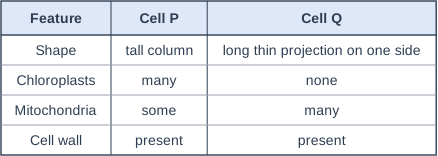
The table gives information about two specialised plant cells, P and Q.

Identify cell P and cell Q.
For each cell, explain how one feature in the table relates to its function.

Table with columns "Feature", "Cell P", "Cell Q". Feature: Shape; Cell P: tall column; Cell Q: long thin projection on one side | Feature: Chloroplasts; Cell P: many; Cell Q: none | Feature: Mitochondria; Cell P: some; Cell Q: many | Feature: Cell wall; Cell P: present; Cell Q: present.

Model answer

Cell P is a palisade cell. It has many chloroplasts, which absorb light for photosynthesis.
Cell Q is a root hair cell. Its long, thin projection gives it a large surface area, so it can absorb water and mineral ions from the soil quickly.

Explanation

As a cell differentiates it acquires the sub-cellular structures it needs. Cells that photosynthesise gain many chloroplasts, while root hair cells grow a projection to increase surface area and have no chloroplasts because they receive no light.

Mark scheme
  1. 1 mark

    P is a palisade cell

    allow a (photosynthesising) leaf cell

  2. 1 mark

    it has many chloroplasts to absorb light for photosynthesis

  3. 1 mark

    Q is a root hair cell

  4. 1 mark

    the long thin projection gives a large surface area for absorbing water / mineral ions

    allow no chloroplasts because it is underground / gets no light; allow many mitochondria to release energy for active transport

Ready to try the rest? Every answer you write is marked against the mark scheme, so you can see exactly where the marks are.

Revision notes

Cell differentiation

The big idea

Every plant and animal starts life as a single cell. That cell divides again and again, and the new cells then differentiate: they change into different types of specialised cell. Differentiation is important because it lets cells share out the jobs of the body, each type adapted to one function, forming tissues, organs and organ systems.

What happens when a cell differentiates

Differentiation is the process by which a cell becomes specialised to carry out a particular function. As a cell differentiates, it acquires different sub-cellular structures that enable it to carry out that function. Once it has them, it has become a specialised cell. For example:

  • a cell becoming a muscle cell gains protein fibres that can contract and many mitochondria;
  • a cell becoming a nerve cell grows a long axon and branched dendrites;
  • a cell becoming a red blood cell fills with haemoglobin and loses its nucleus;
  • a cell becoming a root hair cell grows a long root hair;
  • a cell becoming xylem thickens its walls with lignin and then dies, leaving a hollow tube.
Flow chart of 5 boxes joined by arrows, read from top to bottom. The first box is "Fertilised egg (one cell)", which leads (along an arrow labelled "cell division") to "Many unspecialised cells". From "Many unspecialised cells", 3 arrows branch out side by side: the left arrow, labelled "differentiation", leads to "Muscle cell" (shaded); the middle arrow, labelled "differentiation", leads to "Nerve cell" (shaded); the right arrow, labelled "differentiation", leads to "Red blood cell" (shaded).
Cell division makes more cells; differentiation makes them different.

Do not mix up the two processes. Cell division makes more cells. Differentiation makes cells different from each other.

Differentiation in animals and plants

AnimalsPlants
When cells differentiateMost types of animal cell differentiate at an early stage of developmentMany types of plant cell keep the ability to differentiate throughout life
Cell division in the mature organismMainly restricted to repair and replacementCarries on for growth, especially at the tips of shoots and roots
What this meansGrowth stops; lost limbs cannot regrow; some damage, such as to nerve cells, is permanentPlants keep growing all their lives, can regrow parts that are eaten, and new plants can grow from cuttings

Why each pattern is useful:

  • Animals: differentiating early means an embryo quickly forms working tissues and organs, such as a heart to pump blood, which it needs to survive and grow.
  • Plants: a plant cannot move away from animals that eat it or from damage, so being able to make new specialised cells all its life lets it replace lost leaves and roots and grow towards light and water.

Note the words "most" and "many". Adult animals keep a few unspecialised cells, and not every plant cell can differentiate: a dead xylem cell has no nucleus or cytoplasm, so it never can.

Repair and replacement in adult animals

In a mature animal, cells divide mainly to repair damage (such as healing a cut) and to replace cells that wear out (such as skin cells, cells lining the gut and red blood cells). The new cells are usually the same type as the cells they replace, so this is cell division, not a change into new types of cell.

Using data on differentiation

A scientist counted the number of different cell types in a fish embryo. At 10 hours after fertilisation there were 4 cell types. At 25 hours there were 34. Calculate the mean rate of increase in the number of cell types.

Change in number of cell types: \(34 - 4 = 30\)

Time taken: \(25 - 10 = 15\) hours

\(\text{mean rate} = \dfrac{30}{15} = 2\) cell types per hour

Explanation: the cells of the embryo are differentiating into more and more types of specialised cell, early in development, as most animal cells do.

Remember

  • Differentiation is the process by which a cell becomes specialised for a particular function.
  • A differentiating cell acquires the sub-cellular structures it needs for its function.
  • Most animal cells differentiate at an early stage; many plant cells can differentiate throughout life.
  • In mature animals, cell division is mainly for repair and replacement.

Common mistakes

  • Saying differentiation is the same as cell division or mitosis. Division makes more cells; differentiation makes them specialised.
  • Writing "all plant cells can differentiate throughout life". Use "many": dead xylem cells cannot.
  • Saying cells in adult animals divide mainly for growth. The specification says repair and replacement.
  • Thinking an organ that regrows by cell division, such as healing skin, shows adult cells changing type. The cells just make more of the same type.

Exam tip

"Compare" questions need a point about animals AND a point about plants. Learn the specification's exact phrases: "most types of animal cell differentiate at an early stage" and "many types of plant cell retain the ability to differentiate throughout life".

Study Helper Hints first, answers after you try

Stuck on this one? Ask for a hint and I’ll point you in the right direction, without giving the answer away. Once you’ve checked your answer, I’ll show you how the marks are awarded.