Practise 14 exam-style questions on Mitosis and the cell cycle for AQA GCSE Combined Science (Biology Paper 1). Write your answer as you would in the exam and get it marked in seconds against the mark scheme, point by point, with the Study Helper on hand if you get stuck.
14 questions
1–6 marks each
Instant marking
No sign-up needed
14 questions, marked as you go
Sample questions with model answers
Here are 4 of the questions in this topic, each with a model answer, an explanation of why it earns the marks and the mark scheme an examiner would use.
Question 1
2 marks
The flow chart shows the three stages of the cell cycle.
Describe what happens in stage B.
Model answer
Stage B is mitosis. One set of chromosomes is pulled to each end of the cell, and then the nucleus divides.
Explanation
In mitosis, the two copies of each chromosome made in the first stage are separated, so each end of the cell gets a full set. The cytoplasm and cell membrane only divide afterwards, in the final stage.
Mark scheme
1 mark
one set of chromosomes is pulled to each end of the cell
allow the copies of each chromosome are separated / pulled apart to opposite ends
1 mark
the nucleus divides
do not accept the cell divides
Question 2
2 marks
A body cell of a goat contains 60 chromosomes. The cell divides by mitosis.
State how many chromosomes there are in each of the new cells. Explain your answer.
Model answer
Each new cell contains 60 chromosomes. Before mitosis the DNA replicates to form two copies of each chromosome; then one set of chromosomes is pulled to each end of the cell, so each new cell receives a full set of 60.
Explanation
Mitosis keeps the chromosome number the same. A common mistake is to halve the number (30): the chromosomes are copied first, so halving the doubled genetic material gives back the original number.
Mark scheme
1 mark
60
1 mark
the DNA replicates / chromosomes are copied, then one copy of each chromosome goes to each new cell
allow genetic material is doubled and then divided equally
Question 3
3 marks
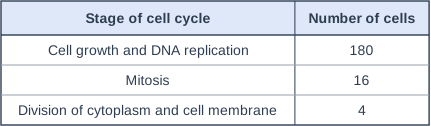
Scientists observed 200 cells from a tissue in which the cell cycle takes 24 hours. The table shows the number of cells they saw in each stage.
The proportion of cells in a stage is the same as the proportion of the cell cycle spent in that stage.
Calculate the time each cell spends in mitosis. Give your answer in minutes.
Model answer
Fraction of cells in mitosis = 16 ÷ 200 = 0.08 Time in mitosis = 0.08 × 24 = 1.92 hours 1.92 × 60 = 115 minutes (115.2)
Explanation
Because most of the cells are in the first stage, most of the cycle is spent growing and replicating DNA; mitosis is quick. Convert hours to minutes by multiplying by 60 at the end.
Mark scheme
1 mark
16 ÷ 200 = 0.08
allow 8%; an answer of 115 (minutes) scores 3 marks
1 mark
0.08 × 24 = 1.92 (hours)
allow ecf
1 mark
1.92 × 60 = 115 (minutes)
allow 115.2; allow ecf from an incorrect time in hours
Question 4
4 marks
Hydra is a small animal that lives in ponds. It can reproduce by growing a bud on the side of its body. The bud grows by mitosis until it is a small hydra, which then breaks off.
Explain why the new hydra is genetically identical to its parent.
Model answer
The bud is made entirely from the parent's cells dividing by mitosis. Before each division the DNA replicates, making two identical copies of each chromosome. During mitosis one set of chromosomes is pulled to each end, so each new cell receives an identical copy of every chromosome. Every cell in the new hydra therefore has exactly the same genetic material as the parent.
Explanation
Mitosis always produces genetically identical cells because DNA is copied exactly and shared equally. No cells from another individual are involved, so no new combination of genes is formed.
Mark scheme
1 mark
all the cells of the bud are produced by mitosis (from the parent's cells)
1 mark
before each division the DNA replicates / two copies of each chromosome are made
1 mark
one set of chromosomes goes to each new cell / each new cell gets a copy of every chromosome
1 mark
so every cell has the same genetic material as the parent cell / no new genetic material is added
allow no mixing of genes from another parent
Ready to try the rest? Every answer you write is marked against the mark scheme, so you can see exactly where the marks are.
Ctrl + Enter to check
Study HelperHints first, answers after you try
Stuck on this one? Ask for a hint and I’ll point you in the right direction, without giving the answer away. Once you’ve checked your answer, I’ll show you how the marks are awarded.