Level:
Correct: 0
Incorrect: 0
Marks: 0/0

Response to exercise

Practise 14 exam-style questions on Response to exercise for AQA GCSE Combined Science (Biology Paper 1). Write your answer as you would in the exam and get it marked in seconds against the mark scheme, point by point, with the Study Helper on hand if you get stuck.

  • 14 questions
  • 1–6 marks each
  • Instant marking
  • No sign-up needed
14 questions, marked as you go

Sample questions with model answers

Here are 4 of the questions in this topic, each with a model answer, an explanation of why it earns the marks and the mark scheme an examiner would use.

Question 1

1 mark

After exercise, lactic acid is transported in the blood to an organ where it is converted back into glucose.

Name this organ.

Model answer

The liver.

Explanation

Blood flowing through the muscles carries lactic acid to the liver, where it is converted back into glucose. This needs extra oxygen, which is part of the oxygen debt.

Mark scheme
  1. 1 mark

    liver

    do not accept kidneys or heart

Question 2

3 marks

Explain why a person's heart rate increases when they exercise.

Model answer

During exercise the muscles contract more, so they need more energy. Their cells respire faster to transfer this energy. The heart beats faster to pump more oxygenated blood to the muscles, supplying the extra oxygen and glucose needed for respiration and removing the extra carbon dioxide.

Explanation

During exercise the body reacts to the increased demand for energy. Heart rate, breathing rate and breath volume all increase so that the muscles are supplied with more oxygenated blood.

Mark scheme
  1. 1 mark

    the muscles need more energy (for contraction)

  2. 1 mark

    so the muscle cells respire faster

    allow more respiration

  3. 1 mark

    the heart pumps more (oxygenated) blood to the muscles, supplying more oxygen and glucose / removing more carbon dioxide

    need oxygen or glucose for the mark

Question 3

3 marks

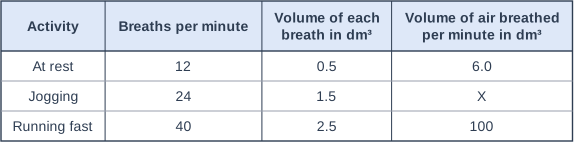
The table shows a student's breathing at rest and while jogging.

Calculate the volume of air breathed per minute while jogging, X.

Calculate how many times greater this is than the volume breathed per minute at rest.

Table with columns "Activity", "Breaths per minute", "Volume of each breath in dm³", "Volume of air breathed per minute in dm³". Activity: At rest; Breaths per minute: 12; Volume of each breath in dm³: 0.5; Volume of air breathed per minute in dm³: 6.0 | Activity: Jogging; Breaths per minute: 24; Volume of each breath in dm³: 1.5; Volume of air breathed per minute in dm³: X | Activity: Running fast; Breaths per minute: 40; Volume of each breath in dm³: 2.5; Volume of air breathed per minute in dm³: 100.

Model answer

Volume per minute = breathing rate × volume of each breath
X = 24 × 1.5 = 36 dm³
36 ÷ 6.0 = 6 times greater than at rest

Explanation

Both the breathing rate and the volume of each breath increase during exercise, and the total volume of air breathed per minute is their product. This brings more oxygen into the blood for the muscles.

Mark scheme
  1. 1 mark

    X = 24 × 1.5

    an answer of 36 (dm³) scores 2 marks

  2. 1 mark

    X = 36 (dm³)

  3. 1 mark

    36 ÷ 6.0 = 6 (times)

    allow ecf

Question 4

6 marks

Plan an investigation to find out how the length of time a person exercises affects their heart rate.

Model answer

The person sits quietly for 5 minutes, then measures their resting heart rate by counting the pulse at the wrist for 15 seconds and multiplying by 4. They then do step-ups onto a 20 cm step in time with a metronome for 1 minute and measure their heart rate immediately afterwards in the same way. They rest until the heart rate returns to the resting value, then repeat with 2, 3 and 4 minutes of exercise. The step height, stepping rate and person stay the same throughout. Each exercise time is repeated three times and a mean heart rate is calculated. The person stops at once if they feel unwell.

Explanation

A good plan states the independent variable (exercise time), how the dependent variable is measured (pulse counted over a set time), the control variables (type and intensity of exercise, same person) and repeats. Letting the heart rate return to resting between trials stops one trial affecting the next.

Mark scheme
  1. 1 mark

    measure the resting heart rate (pulse) by counting beats at the wrist or neck for 1 minute (or for 15 s and multiplying by 4)

    Level of response question: credit a coherent, logically linked answer; max 6. Allow a heart rate monitor

  2. 1 mark

    the person sits still for a few minutes before measuring the resting rate

  3. 1 mark

    do a set exercise, e.g. step-ups at a set rate, for different times, e.g. 1, 2, 3 and 4 minutes

    at least three times

  4. 1 mark

    measure the heart rate immediately after each exercise period

  5. 1 mark

    let the heart rate return to the resting rate before the next exercise period

  6. 1 mark

    control variables: same type and intensity of exercise, e.g. same step height and stepping rate; same person

    at least one named

  7. 1 mark

    repeat each time period (or test several people) and calculate means

  8. 1 mark

    safety: stop if the person feels unwell / check they are healthy enough to exercise

Ready to try the rest? Every answer you write is marked against the mark scheme, so you can see exactly where the marks are.

Revision notes

Response to exercise

The big idea

During exercise your muscles contract harder and more often, so they need much more energy. That energy comes from respiration, so the muscles need more oxygen and glucose, and they must get rid of more carbon dioxide. The body responds by speeding up the heart and breathing. If the oxygen supply still cannot keep up, the muscles respire anaerobically as well, which has costs during and after the exercise.

What changes during exercise

  • Heart rate increases, so more blood is pumped to the muscles each minute.
  • Breathing rate and breath volume both increase, so more oxygen is taken into the lungs and more carbon dioxide is breathed out.
  • The arteries supplying the working muscles widen, so more blood flows through them.

All of these supply the muscles with more oxygenated blood, giving the oxygen and glucose needed for a faster rate of aerobic respiration, and removing carbon dioxide more quickly.

Line graph of heart rate in beats per minute (y-axis, 40 to 180) against time in minutes (x-axis, 0 to 20). The line joins the points (0, 65), (1, 65), (2, 65), (3, 65), (4, 110), (5, 135), (6, 148), (7, 155), (8, 158), (9, 160), (10, 130), (11, 108), (12, 92), (13, 80), (14, 72), (15, 67), (16, 65), (18, 65), (20, 65).
One person's heart rate before, during (3 to 9 minutes) and after exercise: it stays raised for several minutes after the exercise ends.

When there is not enough oxygen

In vigorous exercise, especially at the start or in a sprint, the heart and lungs cannot deliver oxygen to the muscles fast enough. The muscles then also respire anaerobically:

\[\text{glucose} \rightarrow \text{lactic acid}\]

This is the incomplete oxidation of glucose: it releases much less energy than aerobic respiration, and lactic acid builds up in the muscles. This creates an oxygen debt. During long periods of vigorous activity the muscles become fatigued and stop contracting efficiently.

After exercise, heart rate and breathing take a while to return to normal. Fitter people have a lower resting heart rate and return to it sooner after exercise.

Higher tier only

Repaying the oxygen debt. Blood flowing through the muscles transports the lactic acid to the liver, where it is converted back into glucose.

The oxygen debt is the amount of extra oxygen the body needs after exercise to react with the accumulated lactic acid and remove it from the cells. This is why your breathing and heart rate stay high after a hard race: the extra oxygen is used to deal with the lactic acid, and they return to normal only when the oxygen debt has been repaid.

Investigating exercise

To measure the effect of exercise on pulse rate: find the resting pulse first, then exercise at a controlled intensity (for example step-ups in time with a metronome), and count the pulse immediately afterwards, because it starts to fall as soon as exercise stops. Counting for a full minute is more accurate than counting for 15 seconds and multiplying by 4. Rest until the pulse is back to resting before the next trial, repeat, and leave out any anomalous result when calculating a mean.

Percentage increase in heart rate

From the graph, the resting heart rate is 65 beats per minute and the maximum is 160. Calculate the percentage increase.

Increase: \(160 - 65 = 95\)

\(\dfrac{95}{65} \times 100 = 146\%\) (to 3 significant figures)

Volume of air breathed per minute

At rest a person takes 14 breaths per minute of 0.5 dm³ each. During exercise they take 28 breaths per minute of 2.5 dm³ each. How many times more air do they breathe in per minute?

At rest: \(14 \times 0.5 = 7\text{ dm}^3\) per minute. Exercise: \(28 \times 2.5 = 70\text{ dm}^3\) per minute.

\(70 \div 7 = 10\) times more

Common mistakes

  • Saying we breathe faster "to make more energy". Breathing takes in oxygen; respiration in the muscle cells releases the energy.
  • Giving ethanol or carbon dioxide as the product of anaerobic respiration in muscles. It is lactic acid only.
  • Writing "more blood goes to the muscles" and stopping. Say the blood brings more oxygen and glucose for respiration.
  • Reading a recovery time from the start of the graph. Measure it from the end of the exercise.
  • Saying anaerobic respiration releases no energy. It releases much less energy than aerobic respiration.

Exam tip

For "describe and explain" questions on heart rate graphs, split your answer into before, during and after the exercise, quote a value for each stage, and give a reason for each change.

Study Helper Hints first, answers after you try

Stuck on this one? Ask for a hint and I’ll point you in the right direction, without giving the answer away. Once you’ve checked your answer, I’ll show you how the marks are awarded.