Coronary heart disease: a non-communicable disease
Practise 16 exam-style questions on Coronary heart disease: a non-communicable disease for AQA GCSE Combined Science (Biology Paper 1). Write your answer as you would in the exam and get it marked in seconds against the mark scheme, point by point, with the Study Helper on hand if you get stuck.
16 questions
1–6 marks each
Instant marking
No sign-up needed
16 questions, marked as you go
Sample questions with model answers
Here are 4 of the questions in this topic, each with a model answer, an explanation of why it earns the marks and the mark scheme an examiner would use.
Question 1
2 marks
Statins are drugs that are widely used by people at risk of coronary heart disease.
Explain how statins reduce the risk of coronary heart disease.
Model answer
Statins reduce the level of cholesterol in the blood. This slows down the rate at which fatty material builds up inside the coronary arteries, so they are less likely to become narrowed.
Explanation
Statins do not remove fatty material that is already there; they slow down further build-up. They must usually be taken every day for the rest of the person's life.
Mark scheme
1 mark
statins reduce the level of cholesterol in the blood
1 mark
which slows down the rate at which fatty material is deposited in the arteries
allow so the coronary arteries are less likely to become narrowed
Question 2
2 marks
Patients who receive a donor heart must take drugs for the rest of their lives.
Explain why.
Model answer
The cells of the donor heart are genetically different from the patient's own cells and have different proteins on their surface, so the patient's immune system recognises the heart as foreign and could attack and reject it. The patient must take immunosuppressant drugs for life to suppress the immune system and prevent rejection.
Explanation
Rejection is a major risk of any transplant from a donor. The drugs that prevent it also make the patient more likely to catch infections.
Mark scheme
1 mark
the donor heart is genetically different / is recognised as foreign by the immune system / could be rejected
allow different antigens; allow white blood cells attack the donor heart
1 mark
the drugs suppress the immune system to prevent rejection
allow immunosuppressants
Question 3
3 marks
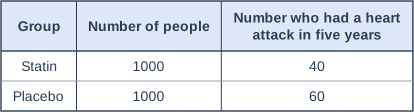
In a five-year trial, scientists gave one group of 1000 people a statin and another group of 1000 people a placebo (a tablet with no drug). The table shows the number of people in each group who had a heart attack.
Calculate the percentage reduction in heart attacks in the statin group compared with the placebo group. What does this suggest about statins?
Model answer
Reduction = 60 − 40 = 20 heart attacks Percentage reduction = (20 ÷ 60) × 100 = 33% Statins reduced the number of heart attacks by about a third, so they lower the risk, but some people taking statins still had heart attacks, so they do not remove the risk completely.
Explanation
Percentage reduction is calculated using the original (placebo) value as the denominator. The placebo group allows a fair comparison, because both groups took a tablet.
Mark scheme
1 mark
(60 − 40) ÷ 60 × 100
allow 20 ÷ 60 × 100; an answer of 33 (%) scores the first 2 marks
1 mark
33 (%)
allow 33.3%
1 mark
statins reduce the risk of a heart attack but do not prevent all heart attacks
allow statins reduce the risk by about a third
Question 4
6 marks
A patient has coronary heart disease. Doctors could treat the patient by fitting a stent or by prescribing statins.
Evaluate these two treatments.
Model answer
A stent holds the narrowed coronary artery open, so blood flow to the heart muscle improves straight away, and one procedure can last for many years. However, it needs an operation, which carries risks such as infection, bleeding or a blood clot, and it only treats the part of the artery where it is placed; the artery can narrow again. Statins reduce blood cholesterol and slow the build-up of fatty material in all the arteries, and they are tablets, so no surgery is needed. However, they must be taken every day for life, they can have side effects such as muscle pain or liver problems, and they act slowly, so they do not unblock an artery that is already badly narrowed. Overall, a stent is better for a patient whose artery is already severely narrowed, but most patients would also be prescribed statins to slow further build-up.
Explanation
An evaluation should give advantages and disadvantages of both options and finish with a conclusion supported by the points made. Consider speed of effect, risks, side effects, and whether the treatment deals with the cause or only one blockage.
Mark scheme
1 mark
stents keep the coronary artery open, so blood flow to the heart muscle improves immediately
Level of response question: credit a coherent, logically linked answer; max 6. An answer that gives no conclusion scores max 5.
1 mark
stents last a long time / one procedure
1 mark
fitting a stent needs an operation, with risks such as infection, bleeding or blood clots / heart attack during the procedure
1 mark
the artery may narrow again / a stent only treats one part of the artery
1 mark
statins reduce blood cholesterol, slowing the build-up of fatty material in all arteries
1 mark
statins are tablets, so no surgery is needed
1 mark
statins must be taken every day for life / have side effects, e.g. muscle pain or liver problems
allow patients may forget to take them
1 mark
statins act slowly and do not remove fatty material already present / do not unblock an artery
1 mark
a justified conclusion, e.g. a stent for a badly narrowed artery, together with statins to slow further build-up
Ready to try the rest? Every answer you write is marked against the mark scheme, so you can see exactly where the marks are.
Ctrl + Enter to check
Study HelperHints first, answers after you try
Stuck on this one? Ask for a hint and I’ll point you in the right direction, without giving the answer away. Once you’ve checked your answer, I’ll show you how the marks are awarded.