Practise 16 exam-style questions on Aerobic and anaerobic respiration for AQA GCSE Combined Science (Biology Paper 1). Write your answer as you would in the exam and get it marked in seconds against the mark scheme, point by point, with the Study Helper on hand if you get stuck.
16 questions
1–6 marks each
Instant marking
No sign-up needed
16 questions, marked as you go
Sample questions with model answers
Here are 4 of the questions in this topic, each with a model answer, an explanation of why it earns the marks and the mark scheme an examiner would use.
Question 1
2 marks
Write the word equation for aerobic respiration.
Model answer
glucose + oxygen → carbon dioxide + water
Explanation
Aerobic respiration uses oxygen to oxidise glucose completely to carbon dioxide and water. It is the reverse of the overall photosynthesis equation. Energy is transferred, but it is not a substance, so it is not strictly a product.
Mark scheme
1 mark
reactants: glucose + oxygen
reactants and products must be on the correct sides of the arrow; allow formulae if correct
1 mark
products: carbon dioxide + water
ignore 'energy' as a product
Question 2
2 marks
Respiration is continuously occurring in all living cells.
Explain why cells need to respire all the time.
Model answer
Respiration transfers the energy that cells need for all their living processes, such as building larger molecules like proteins and active transport. These processes happen all the time, so cells need a continuous supply of energy and must respire continuously.
Explanation
Energy cannot be stored in large amounts ready to use, so cells keep respiring. If respiration stops, for example because of a lack of oxygen and glucose, cells soon die.
Mark scheme
1 mark
cells need a constant supply of energy for living processes
allow respiration supplies all the energy needed for living processes
1 mark
e.g. building larger molecules / movement / keeping warm / active transport
any one correct example
Question 3
3 marks
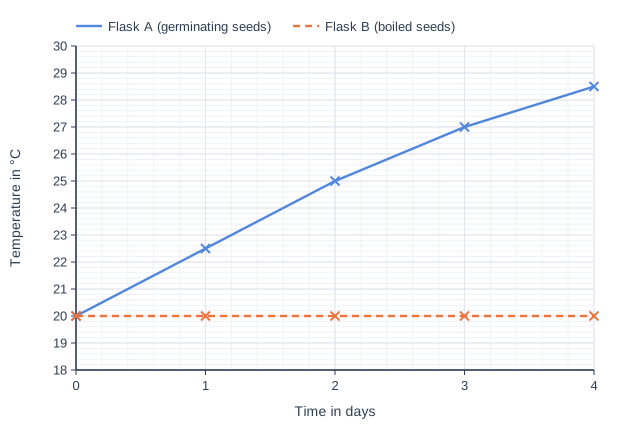
A student put germinating pea seeds into vacuum flask A and the same mass of boiled (dead) pea seeds into vacuum flask B. Both sets of seeds had been rinsed in disinfectant. She measured the temperature inside each flask every day. The graph shows the results.
Explain the difference between the results for the two flasks.
Model answer
The temperature in flask A rose from 20 °C to 28.5 °C over 4 days, but in flask B it stayed at 20 °C. The germinating seeds in flask A were alive and respiring. Respiration is exothermic, so it transferred energy to the surroundings, warming the flask. The boiled seeds in flask B were dead, so they did not respire and no energy was released.
Explanation
Respiration occurs continuously in living cells and is exothermic. Flask B is the control; rinsing the seeds in disinfectant kills microorganisms, so any temperature rise must be due to the seeds' own respiration.
Mark scheme
1 mark
the temperature in flask A rose (from 20 °C to 28.5 °C) but stayed at 20 °C in flask B
1 mark
the germinating seeds were respiring, and respiration is exothermic / transfers energy to the surroundings (as heat)
1 mark
the boiled seeds were dead / their enzymes were denatured, so they did not respire
Question 4
5 marks
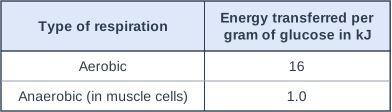
The table shows the energy transferred when 1 g of glucose is used in aerobic respiration and in anaerobic respiration in muscle cells.
During a race, a runner's leg muscles need 48 kJ of energy.
Calculate the mass of glucose needed to transfer 48 kJ by aerobic respiration and by anaerobic respiration.
Explain why anaerobic respiration transfers much less energy.
Model answer
Aerobic: mass of glucose = 48 ÷ 16 = 3 g Anaerobic: mass of glucose = 48 ÷ 1.0 = 48 g So 16 times as much glucose is needed to transfer the same energy anaerobically. In anaerobic respiration the oxidation of glucose is incomplete: it is broken down only to lactic acid, which still contains a lot of chemical energy, instead of being fully oxidised to carbon dioxide and water.
Explanation
Mass needed = energy needed ÷ energy per gram. Because the oxidation of glucose is incomplete in anaerobic respiration, much less energy is transferred from each gram, so muscles use up their glucose far faster.
Mark scheme
1 mark
aerobic: 48 ÷ 16 = 3 (g)
1 mark
anaerobic: 48 ÷ 1.0 = 48 (g)
1 mark
so 16 times as much glucose is needed for anaerobic respiration
allow ecf; allow a correct comparison in words
1 mark
the oxidation of glucose is incomplete in anaerobic respiration
1 mark
lactic acid still contains a lot of chemical energy / is not broken down fully to carbon dioxide and water
Ready to try the rest? Every answer you write is marked against the mark scheme, so you can see exactly where the marks are.
Ctrl + Enter to check
Study HelperHints first, answers after you try
Stuck on this one? Ask for a hint and I’ll point you in the right direction, without giving the answer away. Once you’ve checked your answer, I’ll show you how the marks are awarded.