Level:
Correct: 0
Incorrect: 0
Marks: 0/0

Human defence systems

Practise 10 exam-style questions on Human defence systems for AQA GCSE Combined Science (Biology Paper 1). Write your answer as you would in the exam and get it marked in seconds against the mark scheme, point by point, with the Study Helper on hand if you get stuck.

  • 10 questions
  • 1–6 marks each
  • Instant marking
  • No sign-up needed
10 questions, marked as you go

Sample questions with model answers

Here are 4 of the questions in this topic, each with a model answer, an explanation of why it earns the marks and the mark scheme an examiner would use.

Question 1

2 marks

Explain how the skin helps to defend the body against pathogens.

Model answer

Unbroken skin is a barrier that pathogens cannot get through. If the skin is cut, the blood clots and a scab forms, sealing the wound so that pathogens cannot get in.

Explanation

The skin is part of the body's non-specific defences: it stops all types of pathogen entering, rather than targeting one particular pathogen. Most pathogens enter through breaks in the skin or through openings such as the nose and mouth.

Mark scheme
  1. 1 mark

    it is a (physical) barrier that stops pathogens getting into the body

    max 2

  2. 1 mark

    it produces antimicrobial secretions that kill pathogens

    allow oils / chemicals that kill microorganisms

  3. 1 mark

    if the skin is cut, the blood clots / a scab forms, which seals the wound so pathogens cannot enter

Question 2

2 marks

Some bacteria release toxins into the blood.

Explain how white blood cells protect the body against these toxins.

Model answer

Some white blood cells produce antitoxins. The antitoxins bind to the toxins and counteract them, so the toxins cannot damage the body's tissues.

Explanation

Antitoxins are different from antibodies: antibodies target the pathogen itself, while antitoxins target the poisons the bacteria produce. Toxins are not living, so they are neutralised, not killed.

Mark scheme
  1. 1 mark

    white blood cells produce antitoxins

    do not accept antibodies

  2. 1 mark

    antitoxins counteract / neutralise the toxins

    allow stop the toxins damaging tissues; do not accept kill the toxins

Question 3

3 marks

Explain how antibodies help white blood cells to defend the body against a pathogen.

Model answer

When a pathogen enters the body, some white blood cells produce antibodies. Each type of antibody is specific: it binds only to one type of pathogen. The antibodies stick to the pathogens and help to destroy them, for example by clumping them together so that other white blood cells can engulf them.

Explanation

Antibodies are made by white blood cells and are specific to a particular pathogen, so a different antibody is needed for each pathogen. They work alongside phagocytosis to destroy the pathogen.

Mark scheme
  1. 1 mark

    white blood cells produce antibodies (when a pathogen enters the body)

    allow lymphocytes

  2. 1 mark

    antibodies are specific to one type of pathogen / bind to that pathogen

    allow fit the antigens on the pathogen

  3. 1 mark

    this helps to destroy the pathogen / makes pathogens clump together so they are easier to engulf

    allow labels the pathogen for phagocytosis

Question 4

4 marks

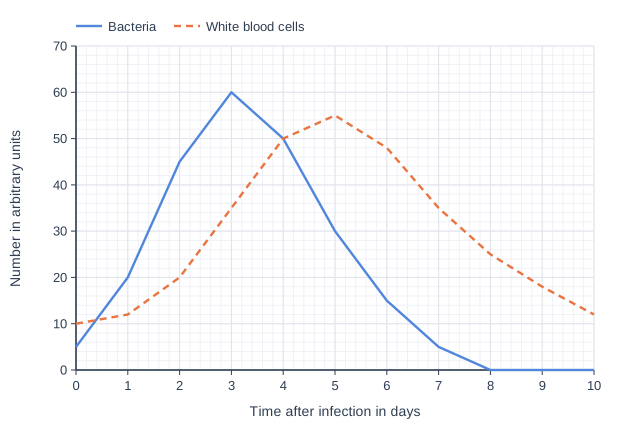
A patient was infected with a bacterium. The graph shows the number of bacteria and the number of white blood cells in a sample of the patient's blood over 10 days.

Describe and explain the changes in the number of bacteria and the number of white blood cells.

Line graph of number in arbitrary units (y-axis, 0 to 70) against time after infection in days (x-axis, 0 to 10). "Bacteria" joins the points (0, 5), (1, 20), (2, 45), (3, 60), (4, 50), (5, 30), (6, 15), (7, 5), (8, 0), (9, 0), (10, 0). "White blood cells" (dashed) joins the points (0, 10), (1, 12), (2, 20), (3, 35), (4, 50), (5, 55), (6, 48), (7, 35), (8, 25), (9, 18), (10, 12).

Model answer

The number of bacteria increased quickly at first and peaked at day 3, because the bacteria reproduced rapidly in the body. The number of white blood cells started to increase a little later and peaked at day 5. The white blood cells destroyed the bacteria by phagocytosis and by producing antibodies, so the number of bacteria fell to zero by day 8. Once the bacteria had been destroyed, the number of white blood cells fell back towards its starting level.

Explanation

The immune system takes time to respond, so white blood cell numbers rise after the bacteria have started to multiply. As white blood cells destroy the bacteria, bacterial numbers fall, and white blood cell numbers then return to normal.

Mark scheme
  1. 1 mark

    the number of bacteria increased (to a peak at day 3) because bacteria reproduce rapidly in the body

    max 4

  2. 1 mark

    the number of white blood cells increased after the bacteria increased / peaked later (day 5)

  3. 1 mark

    white blood cells destroy the bacteria by phagocytosis / by producing antibodies

  4. 1 mark

    so the number of bacteria fell to zero (by day 8)

  5. 1 mark

    the number of white blood cells then fell back once the bacteria had been destroyed

Ready to try the rest? Every answer you write is marked against the mark scheme, so you can see exactly where the marks are.

Revision notes

Human defence systems

The big idea

Your body defends itself against pathogens in two ways. Non-specific defences try to stop pathogens getting into the body, and work in the same way against every pathogen. If a pathogen enters the body, the immune system tries to destroy it, and white blood cells do this job.

Non-specific defences

Part of the bodyHow it defends against pathogens
SkinCovers the body and acts as a barrier that pathogens cannot get through; produces antimicrobial secretions that kill pathogens; if the skin is cut, the blood clots and a scab seals the wound
NoseHairs and mucus in the nose trap particles that may contain pathogens
Trachea and bronchiSome cells lining the airways produce mucus, which traps pathogens. Other cells have cilia (tiny hair-like structures) that move the mucus up to the throat, where it is swallowed
StomachProduces hydrochloric acid, which kills pathogens in food, drink and swallowed mucus

These defences work together: pathogens trapped in mucus in the airways are swallowed, then killed by stomach acid. If a defence is damaged, infections become more likely. A large burn removes the skin barrier, and chemicals in cigarette smoke stop the cilia moving, so mucus full of pathogens builds up in the airways.

The immune system: white blood cells

White blood cells help to defend against pathogens in three ways: phagocytosis, antibody production and antitoxin production.

Diagram titled "Blood seen through a light microscope". Diagram of a sample of blood seen under a microscope (template blood_sample). A blood smear seen under a microscope: plasma (the pale yellow liquid), 12 red blood cells (biconcave discs with no nucleus; one is seen edge-on, showing the biconcave shape), one white blood cell (larger, with a lobed nucleus) and 4 platelets (small cell fragments). The label "white blood cell" points to the white blood cell; the label "red blood cell" points to a red blood cell (biconcave disc with no nucleus); the label "platelet" points to a platelet (a small cell fragment); the label "plasma" points to the plasma.
White blood cells are larger than red blood cells and have a nucleus; red blood cells have none.

Phagocytosis

Some white blood cells move towards a pathogen, engulf it (surround it and take it inside the cell) and then digest it with enzymes. This works against any pathogen.

Antibody production

Pathogens carry molecules on their surface called antigens. Some white blood cells (lymphocytes) produce antibodies, proteins whose shape fits one particular antigen, so each antibody is specific to one type of pathogen. The antibodies bind to the pathogens and clump them together, so they can be destroyed (for example by phagocytosis).

The first time the body meets a pathogen, it takes time to make the right antibodies, which is why you feel ill. If the same pathogen enters the body again, the white blood cells respond quickly to produce the correct antibodies, so you do not become ill (you are immune). Antibodies against one pathogen do not protect you from a different one.

Antitoxin production

Some bacteria release toxins. White blood cells produce antitoxins, which bind to the toxins and neutralise them, so the toxins can no longer damage cells. Antitoxins act on the toxins, not on the bacteria themselves.

Explaining an unfamiliar defence problem

Some people have an inherited condition in which the cilia in their airways do not beat. Suggest why they get more chest infections than other people.

  1. Mucus in the trachea and bronchi still traps pathogens.
  2. Normally the cilia move this mucus up to the throat, where it is swallowed.
  3. Without beating cilia, the mucus and the pathogens in it stay in the airways and can reach the lungs.
  4. There the pathogens can reproduce and cause an infection.

Remember

  • Skin: a barrier, plus antimicrobial secretions. Nose: hairs and mucus trap particles.
  • Trachea and bronchi: mucus traps pathogens; cilia move the mucus up to the throat.
  • Stomach: hydrochloric acid kills pathogens.
  • White blood cells: phagocytosis, antibody production and antitoxin production.

Common mistakes

  • Saying the cilia trap pathogens. The mucus traps them; the cilia move the mucus.
  • Confusing cilia (in the airways) with villi (in the small intestine).
  • Mixing up antibodies, antitoxins and antibiotics. Antibodies bind to pathogens, antitoxins neutralise toxins, and antibiotics are medicines, not made by the body.
  • Saying white blood cells "eat" pathogens. In phagocytosis they engulf and digest them.
  • Calling the stomach acid "sulfuric acid". It is hydrochloric acid.

Exam tip

For a 6-mark "describe the non-specific defences" question, cover every part named (skin, nose, trachea and bronchi, stomach) and say how each one works: a barrier, trapping, moving mucus, or killing. Naming the parts alone scores little. For white blood cells, name all three methods and say what each does to the pathogen or its toxins.

Study Helper Hints first, answers after you try

Stuck on this one? Ask for a hint and I’ll point you in the right direction, without giving the answer away. Once you’ve checked your answer, I’ll show you how the marks are awarded.