Practise 11 exam-style questions on Cancer for AQA GCSE Combined Science (Biology Paper 1). Write your answer as you would in the exam and get it marked in seconds against the mark scheme, point by point, with the Study Helper on hand if you get stuck.
11 questions
1–6 marks each
Instant marking
No sign-up needed
11 questions, marked as you go
Sample questions with model answers
Here are 4 of the questions in this topic, each with a model answer, an explanation of why it earns the marks and the mark scheme an examiner would use.
Question 1
2 marks
Cancer is the result of changes in cells.
Describe how these changes lead to the formation of a tumour.
Model answer
The changes mean that the cells no longer respond to the normal controls on growth, so they grow and divide uncontrollably. This produces a mass of abnormal cells, which is a tumour.
Explanation
Normally the body controls when cells divide, so cell division happens mainly for growth, repair and replacement. In cancer, changes in the cells stop this control working, so the cells keep dividing and form a lump called a tumour. The key word examiners look for is 'uncontrolled'.
Mark scheme
1 mark
the cells divide uncontrollably / uncontrolled cell division
allow cells divide by mitosis without stopping; ignore 'cells multiply' unless it is qualified as uncontrolled
1 mark
uncontrolled growth produces a mass / lump of abnormal cells (which is the tumour)
allow uncontrolled growth of cells
Question 2
3 marks
Compare benign tumours with malignant tumours.
Model answer
Both types of tumour are growths of abnormal cells caused by uncontrolled cell division. A benign tumour is contained in one area, usually within a membrane, and does not invade other parts of the body. A malignant tumour is a cancer: its cells invade neighbouring tissues and spread to other parts of the body in the blood, where they form secondary tumours.
Explanation
A 'compare' question needs similarities or differences, not two separate descriptions. The key differences are that malignant tumour cells invade nearby tissue and spread in the blood to form secondary tumours, while benign tumours stay in one place. Do not say benign tumours are harmless: a large benign tumour can still press on organs.
Mark scheme
1 mark
both are growths of abnormal cells / both are caused by uncontrolled cell division
max 3; allow points made about one type of tumour if the other is clearly implied, e.g. 'only malignant tumours spread'
1 mark
benign tumours stay in one area / are usually contained within a membrane, but malignant tumours are not
1 mark
malignant tumour cells invade neighbouring tissues, but benign tumours do not
1 mark
malignant tumour cells spread to other parts of the body (in the blood), but benign tumour cells do not
allow travel in the bloodstream
1 mark
malignant tumours form secondary tumours, but benign tumours do not
1 mark
malignant tumours are cancers, but benign tumours are not
Question 3
3 marks
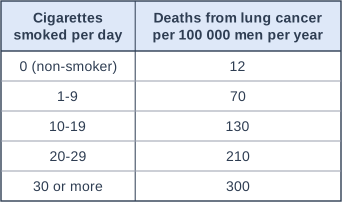
The table shows the death rate from lung cancer in men who smoked different numbers of cigarettes each day.
Describe the pattern shown in the table.
Calculate how many times greater the death rate is for men who smoked 20-29 cigarettes per day than for non-smokers.
Model answer
As the number of cigarettes smoked per day increases, the death rate from lung cancer increases. 210 ÷ 12 = 17.5 The death rate is 17.5 times greater for men who smoked 20-29 cigarettes per day.
Explanation
'How many times greater' means divide one value by the other, not subtract. The data show a positive correlation between the number of cigarettes smoked and lung cancer deaths, which is why smoking is described as a lifestyle risk factor for lung cancer.
Mark scheme
1 mark
the more cigarettes smoked per day, the higher the death rate from lung cancer
allow positive correlation; allow as the number of cigarettes increases the death rate increases
1 mark
210 ÷ 12
an answer of 17.5 (times) scores 2 marks for the calculation
1 mark
17.5 (times)
allow 17 or 18; do not accept 198 (that is the difference, not how many times greater)
Question 4
4 marks
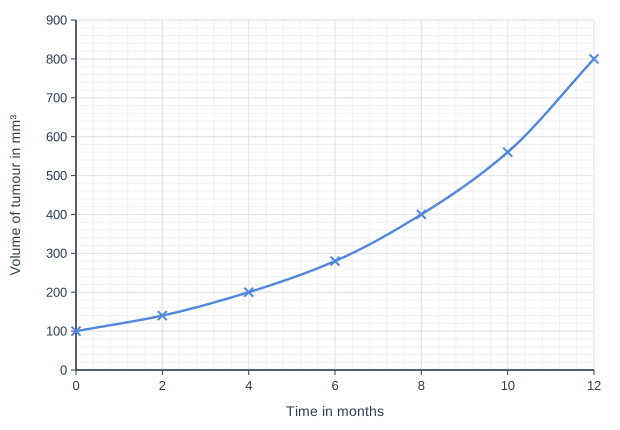
The graph shows the volume of a tumour in a patient's liver, measured using scans over 12 months.
Calculate the mean rate of growth of the tumour between 4 months and 12 months. Give the unit.
Suggest why the volume of the tumour increases more quickly as time goes on.
Model answer
Volume at 4 months = 200 mm³; volume at 12 months = 800 mm³ Increase = 800 − 200 = 600 mm³ Mean rate = 600 ÷ 8 = 75 mm³ per month As the tumour grows it contains more cells, and every cell keeps dividing uncontrollably, so more new cells are added each month and the volume increases more quickly.
Explanation
Mean rate of growth = change in volume ÷ time taken, so read both volumes carefully from the curve and divide by the 8 months between them. The unit is the volume unit divided by the time unit. Because every cancer cell keeps dividing, the more cells there are, the faster the tumour grows.
Mark scheme
1 mark
volume at 4 months = 200 and volume at 12 months = 800 / increase = 600 (mm³)
allow readings of 190-210 and 790-810; an answer of 75 mm³ per month scores the first 3 marks
1 mark
600 ÷ 8 = 75
allow 72-78; allow ecf from incorrect readings
1 mark
mm³ per month
allow mm³/month; the unit mark is independent of the numerical answer
1 mark
the tumour contains more cells, which are all dividing uncontrollably, so more new cells are produced each month
allow more cells dividing (uncontrollably); ignore 'cells divide faster' on its own
Ready to try the rest? Every answer you write is marked against the mark scheme, so you can see exactly where the marks are.
Ctrl + Enter to check
Study HelperHints first, answers after you try
Stuck on this one? Ask for a hint and I’ll point you in the right direction, without giving the answer away. Once you’ve checked your answer, I’ll show you how the marks are awarded.