Level:
Correct: 0
Incorrect: 0
Marks: 0/0

Discovery and development of drugs

Practise 16 exam-style questions on Discovery and development of drugs for AQA GCSE Combined Science (Biology Paper 1). Write your answer as you would in the exam and get it marked in seconds against the mark scheme, point by point, with the Study Helper on hand if you get stuck.

  • 16 questions
  • 1–6 marks each
  • Instant marking
  • No sign-up needed
16 questions, marked as you go

Sample questions with model answers

Here are 4 of the questions in this topic, each with a model answer, an explanation of why it earns the marks and the mark scheme an examiner would use.

Question 1

2 marks

Digitalis and aspirin are drugs that were first obtained from plants.

State what each drug is used for.

Model answer

Digitalis is a heart drug, used to treat heart conditions. Aspirin is a painkiller.

Explanation

Traditionally, drugs were extracted from plants and microorganisms: digitalis from foxgloves, aspirin from willow and penicillin from Penicillium mould. Today most drugs are synthesised by chemists.

Mark scheme
  1. 1 mark

    digitalis: to treat heart conditions / a heart drug

    allow to strengthen or slow the heartbeat

  2. 1 mark

    aspirin: a painkiller

    allow to relieve pain; allow to reduce fever

Question 2

2 marks

After a new drug has been shown to be safe in healthy volunteers, it is tested on patients who have the disease.

Give two reasons why the drug must be tested on patients.

Model answer

To find out whether the drug actually works in treating the disease, and to find the optimum dose for patients.

Explanation

Healthy volunteers can show whether a drug is safe, but only patients with the disease can show whether it works. Further clinical trials on patients are used to find the optimum dose.

Mark scheme
  1. 1 mark

    to find out whether the drug works / treats the disease (efficacy)

    allow to see if it is effective

  2. 1 mark

    to find the optimum dose

    allow to check it is safe in people with the disease

Question 3

3 marks

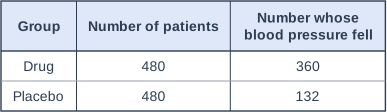
A double blind trial of a new drug to lower blood pressure was carried out. The table shows the results.

Calculate the percentage of patients whose blood pressure fell in each group.

What do the results suggest about the drug?

Table with columns "Group", "Number of patients", "Number whose blood pressure fell". Group: Drug; Number of patients: 480; Number whose blood pressure fell: 360 | Group: Placebo; Number of patients: 480; Number whose blood pressure fell: 132.

Model answer

Drug: 360 ÷ 480 × 100 = 75%
Placebo: 132 ÷ 480 × 100 = 27.5%
The drug appears to be effective at lowering blood pressure, because a much higher percentage of patients improved with the drug (75%) than with the placebo (27.5%).

Explanation

Some patients improve even on a placebo, so a drug is only shown to work if it does clearly better than the placebo. Calculating percentages lets the groups be compared directly.

Mark scheme
  1. 1 mark

    drug: 360 ÷ 480 × 100 = 75 (%)

  2. 1 mark

    placebo: 132 ÷ 480 × 100 = 27.5 (%)

    allow 27 or 28

  3. 1 mark

    the drug is effective / works, because a much higher percentage improved with the drug than with the placebo

    allow ecf from incorrect percentages if the conclusion matches them

Question 4

5 marks

In double blind trials of new drugs, some patients are given a placebo.

Explain what is meant by a double blind trial, and explain why placebos are used and why the trial is double blind.

Model answer

A placebo is a substance that looks exactly like the drug but does not contain the drug. Patients are put into groups at random: some are given the drug and some the placebo. In a double blind trial, neither the patients nor the doctors know who has been given the drug and who has been given the placebo. The placebo group acts as a control: some patients feel better just because they think they are being treated, so comparing the two groups shows whether the drug itself works. Keeping patients unaware stops their expectations affecting the results, and keeping doctors unaware stops them influencing the results, even unconsciously, for example in how they assess each patient.

Explanation

'Single blind' means only the patients do not know; 'double blind' means the doctors do not know either. Both features remove bias, so any difference between the groups can be put down to the drug.

Mark scheme
  1. 1 mark

    a placebo looks like the drug but does not contain the drug / has no active ingredient

    max 5

  2. 1 mark

    patients are put into groups at random to receive either the drug or the placebo

  3. 1 mark

    double blind: neither the patients nor the doctors know who is given the drug and who is given the placebo

    both patients and doctors needed

  4. 1 mark

    the placebo group is a control, to see whether the drug works better than no drug

    allow to rule out the placebo effect / patients feeling better because they think they are being treated

  5. 1 mark

    patients not knowing means their expectations do not affect the results

  6. 1 mark

    doctors not knowing means they cannot influence the results / it prevents bias in how they treat or assess patients

Ready to try the rest? Every answer you write is marked against the mark scheme, so you can see exactly where the marks are.

Revision notes

Discovery and development of drugs

The big idea

Medicines used to be taken straight from plants and microorganisms; today most new drugs are made by chemists. Whatever its source, every new drug must be tested and trialled before being used to check that it is safe and effective: first in a laboratory, then in people. You need to know the stages in order and why each one is done.

Where drugs come from

Traditionally drugs were extracted from plants and microorganisms. Learn these three as pairs:

DrugWhat it is used forWhere it originates
DigitalisA heart drugFoxgloves
AspirinA painkillerWillow
PenicillinAn antibioticThe Penicillium mould, discovered by Alexander Fleming

In 1928 Fleming noticed that bacteria would not grow near a Penicillium mould that had contaminated one of his dishes. The mould makes penicillin, which kills bacteria.

Most new drugs are synthesised by chemists in the pharmaceutical industry. However, the starting point may still be a chemical extracted from a plant. Making a drug in the laboratory gives large amounts of a pure chemical, so every tablet holds the same dose, and chemists can change the molecule to make it work better or cause fewer side effects.

What the tests check

New drugs are extensively tested for toxicity, efficacy and dose.

  • Toxicity: is the drug harmful? Does it have side effects?
  • Efficacy: does the drug work? How well does it treat the disease?
  • Dose: how much should be given, and how often? The optimum dose gives the best balance: enough to work, with as few side effects as possible.

The stages of testing

Developing a new drug. Flow chart of 6 boxes joined by arrows, read from top to bottom. The first box is "Possible drug found or synthesised", which leads to "Preclinical: tested on cells and tissues", which leads to "Preclinical: tested on live animals", which leads to "Very low doses: healthy volunteers" (shaded), which leads (along an arrow labelled "if the drug is safe") to "Patients: optimum dose, double blind" (shaded), which leads to "Peer review, then licensed for use".
The shaded boxes are the clinical trials, carried out on people.
  1. Preclinical testing is done in a laboratory using cells, tissues and live animals. Cells and tissues come first: it is quicker and cheaper, many chemicals can be tested, and fewer animals are used. Live animals then show how the drug affects a whole organism. Most possible drugs fail here because they are toxic or do not work.
  2. Clinical trials use healthy volunteers and patients. Animals are not identical to humans, so the drug may act differently in people.
    • Very low doses of the drug are given at the start of the clinical trial, to healthy volunteers, to check that it is safe.
    • If the drug is found to be safe, further clinical trials are carried out to find the optimum dose and to check that it works in patients who have the disease.
  3. Before the results are published, other scientists who are experts in the same field check the method, results and conclusions (peer review), so that false or biased claims are not published. The drug is licensed for doctors to use only when the trials show it is safe and effective.

Placebos and double blind trials

A placebo looks exactly like the drug but contains none of it. In double blind trials, some patients are given a placebo, and neither the patients nor the doctors know who has the drug and who has the placebo until the trial ends. This stops anyone's expectations biasing the results. Patients given a placebo often improve a little just because they think they are being treated (the placebo effect), so the real effect of the drug is the extra improvement beyond the placebo group.

Patients should be put into each group at random, and a large number should be used. For a serious illness, giving a placebo would be unethical, so the new drug is compared with the best existing drug instead.

Separating the drug's effect from the placebo effect

In a trial of a new sleeping drug, 300 patients took the drug and 200 took a placebo. 180 in the drug group and 50 in the placebo group slept better. How much of the improvement was due to the drug?

The groups are different sizes, so compare percentages. Drug group: \(\dfrac{180}{300} \times 100 = 60\%\). Placebo group: \(\dfrac{50}{200} \times 100 = 25\%\).

Effect of the drug: \(60 - 25 = 35\) percentage points.

Working out a dose

The optimum dose of a medicine for children is 30 mg per kg of body mass each day, split into 3 equal doses. The liquid medicine contains 125 mg in every 5 cm³. What volume should a 25 kg child take in each dose?

Daily dose: \(30 \times 25 = 750\text{ mg}\). Each dose: \(750 \div 3 = 250\text{ mg}\).

250 mg is twice 125 mg, so each dose is \(2 \times 5 = 10\text{ cm}^3\).

Common mistakes

  • Saying a placebo is a weaker dose or a different drug. It contains no drug at all.
  • Saying a double blind trial is one where the patients do not know. That is single blind: in double blind, neither doctors nor patients know.
  • Saying healthy volunteers show whether the drug works. They do not have the disease: low doses in healthy volunteers test safety.
  • Swapping the sources: digitalis is from foxgloves, aspirin from willow, penicillin from a mould (not a plant or bacteria).
  • Thinking the optimum dose is simply the dose that works best. It must also keep side effects low.

Exam tip

For a 6-mark "describe how a new drug is developed" answer, keep the stages in order and use the key words: preclinical testing on cells, tissues and live animals; toxicity, efficacy and dose; very low doses in healthy volunteers; optimum dose in patients; double blind trials with a placebo.

Study Helper Hints first, answers after you try

Stuck on this one? Ask for a hint and I’ll point you in the right direction, without giving the answer away. Once you’ve checked your answer, I’ll show you how the marks are awarded.