Practise 10 exam-style questions on Plant tissues for AQA GCSE Combined Science (Biology Paper 1). Write your answer as you would in the exam and get it marked in seconds against the mark scheme, point by point, with the Study Helper on hand if you get stuck.
10 questions
1–6 marks each
Instant marking
No sign-up needed
10 questions, marked as you go
Sample questions with model answers
Here are 4 of the questions in this topic, each with a model answer, an explanation of why it earns the marks and the mark scheme an examiner would use.
Question 1
2 marks
Palisade mesophyll tissue is found just below the upper epidermis of a leaf.
Explain one way in which palisade mesophyll tissue is adapted for photosynthesis.
Model answer
Palisade mesophyll cells contain many chloroplasts, which absorb light energy for photosynthesis, so the tissue can photosynthesise quickly.
Explanation
For a structure-and-function question, give the feature and then say why it helps. Palisade cells are packed with chloroplasts and sit near the upper surface where light is brightest, so most photosynthesis in a leaf happens in this tissue.
Mark scheme
1 mark
feature: the cells contain many chloroplasts / the tissue is near the top surface of the leaf / the cells are tall and tightly packed
1 mark
explanation linked to the feature: chloroplasts absorb light for photosynthesis / it receives the most light / many cells can be close to the light
the explanation must match the feature given
Question 2
2 marks
A leaf is described as a plant organ.
Explain why a leaf is described as an organ.
Model answer
A leaf is made of several different tissues, such as the epidermis, palisade mesophyll, spongy mesophyll, xylem and phloem, which work together to carry out a function: photosynthesis.
Explanation
Cells make up tissues, tissues make up organs, and organs work together in organ systems. A leaf contains several tissues working together, so it is an organ, just as the stomach is an organ in animals.
Mark scheme
1 mark
it is made of several different tissues
allow a named example of two or more tissues, e.g. epidermis and palisade mesophyll
1 mark
that work together to carry out a (specific) function, e.g. photosynthesis
Question 3
3 marks
Explain why meristem tissue is important for the growth of a plant.
Model answer
Meristem tissue at the tips of the shoots and roots contains cells that divide rapidly. The new cells are unspecialised and can differentiate into many different types of cell, such as xylem, phloem and epidermis cells. This produces new tissues, so the shoots and roots grow longer.
Explanation
Most plant growth happens at the tips of shoots and roots because that is where the meristem tissue is. Unlike most animal cells, these plant cells keep the ability to differentiate throughout the plant's life.
Mark scheme
1 mark
meristem cells divide (rapidly)
allow by mitosis
1 mark
the new cells are unspecialised / can differentiate into many different types of plant cell
allow can become xylem, phloem or epidermis cells, etc.
1 mark
so new tissues are produced and the shoots and roots grow longer
allow the plant can grow at the tips of shoots and roots
Question 4
4 marks
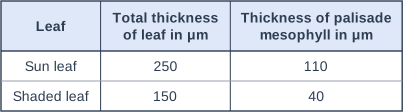
Leaves on the outside of a tree are in bright sunlight. Leaves inside the canopy are shaded. The table shows measurements of a sun leaf and a shaded leaf from the same tree.
Calculate the percentage of the thickness of the sun leaf that is palisade mesophyll.
Suggest why sun leaves have a thicker palisade mesophyll than shaded leaves.
Model answer
Percentage = 110 ÷ 250 × 100 = 44% Sun leaves receive much more light, and the light reaches further into the leaf. A thicker palisade layer has more cells containing chloroplasts, so the leaf can absorb more of the light and photosynthesise faster. In a shaded leaf, extra layers of palisade cells would receive too little light to photosynthesise much.
Explanation
Percentage = part ÷ whole × 100, so divide the palisade thickness by the total leaf thickness. The structure of the palisade mesophyll is related to its function: more palisade cells are only worth having where there is enough light for them to use.
Mark scheme
1 mark
110 ÷ 250 × 100
an answer of 44 (%) scores 2 marks for the calculation
1 mark
44 (%)
1 mark
more light reaches sun leaves / light penetrates further into a sun leaf
allow shaded leaves receive little light
1 mark
so more (layers of) palisade cells with chloroplasts can absorb light and photosynthesise / make more glucose
allow in shade, extra palisade cells would not get enough light to be useful
Ready to try the rest? Every answer you write is marked against the mark scheme, so you can see exactly where the marks are.
Ctrl + Enter to check
Study HelperHints first, answers after you try
Stuck on this one? Ask for a hint and I’ll point you in the right direction, without giving the answer away. Once you’ve checked your answer, I’ll show you how the marks are awarded.