Practise 10 exam-style questions on Fungal diseases for AQA GCSE Combined Science (Biology Paper 1). Write your answer as you would in the exam and get it marked in seconds against the mark scheme, point by point, with the Study Helper on hand if you get stuck.
10 questions
1–6 marks each
Instant marking
No sign-up needed
10 questions, marked as you go
Sample questions with model answers
Here are 4 of the questions in this topic, each with a model answer, an explanation of why it earns the marks and the mark scheme an examiner would use.
Question 1
2 marks
Describe the symptoms of rose black spot.
Model answer
Purple or black spots develop on the leaves. The leaves often turn yellow and drop off early.
Explanation
These two symptoms are the ones named in the specification. Do not confuse them with the mosaic pattern of discolouration caused by tobacco mosaic virus.
Mark scheme
1 mark
purple or black spots develop on the leaves
do not accept mosaic pattern
1 mark
the leaves (often) turn yellow and drop (fall off) early
allow either yellowing or early leaf fall
Question 2
2 marks
A gardener sprayed his roses, which had rose black spot, with an antibiotic. The disease did not improve.
Explain why.
Model answer
Antibiotics only kill bacteria. Rose black spot is caused by a fungus, so the antibiotic had no effect on it; the gardener should have used a fungicide.
Explanation
Treatments must match the type of pathogen. Antibiotics kill bacteria, fungicides kill fungi, and neither works against viruses.
Mark scheme
1 mark
antibiotics only kill bacteria
allow antibiotics do not kill fungi
1 mark
rose black spot is caused by a fungus, so a fungicide is needed
Question 3
3 marks
Rose growers are advised to plant rose bushes well apart and to water them at the base of the stem rather than over the leaves.
Suggest how each of these practices reduces the spread of rose black spot.
Model answer
Planting the bushes well apart means spores from an infected bush are less likely to be blown or splashed onto the leaves of another bush. Watering at the base keeps the leaves dry and avoids splashing, so spores are not carried in water from infected leaves to healthy ones.
Explanation
Rose black spot is spread by water and wind. Both practices cut down these routes: distance makes it harder for spores to reach another plant, and dry leaves mean no water to carry them.
Mark scheme
1 mark
planting apart: spores are less likely to be blown or splashed from one bush to another / leaves of different bushes do not touch
1 mark
watering at the base: water does not splash spores from infected leaves onto healthy leaves
1 mark
the leaves stay drier, so spores are less likely to be spread by water
allow the fungus spreads less on dry leaves
Question 4
4 marks
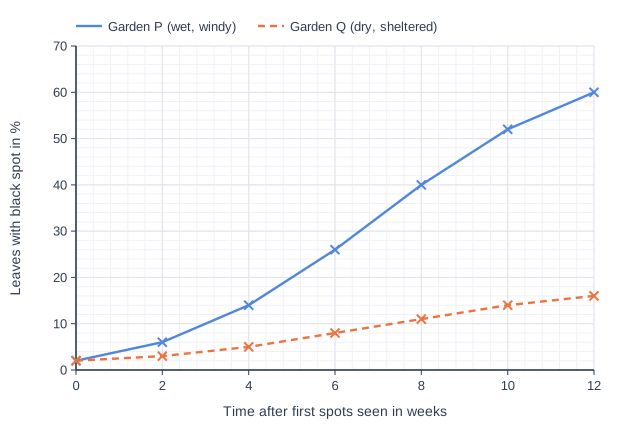
The graph shows how the percentage of rose leaves with black spot changed in two gardens. Garden P is in a wet, windy area. Garden Q is in a dry, sheltered area.
Describe the differences between the results for the two gardens and explain them.
Model answer
In both gardens the percentage of infected leaves increased, but it increased much faster in garden P. After 12 weeks, 60% of leaves were infected in garden P but only 16% in garden Q. Rose black spot is spread by water and by wind, so in the wet, windy garden the spores were splashed by rain and blown onto many more healthy leaves.
Explanation
Describe first (the trend in each, with data), then explain using the science: the fungus spreads by water and wind. Quote values at the same time for a fair comparison.
Mark scheme
1 mark
the percentage of leaves with black spot increased faster / to a higher value in garden P
max 4
1 mark
data, e.g. at 12 weeks 60% in garden P compared with 16% in garden Q
allow ± 2%; allow any correct comparison at the same time
1 mark
rose black spot (spores) are spread by water / rain splash
1 mark
and by wind
1 mark
so in the wet, windy garden more spores reach healthy leaves / more leaves are infected
Ready to try the rest? Every answer you write is marked against the mark scheme, so you can see exactly where the marks are.
Ctrl + Enter to check
Study HelperHints first, answers after you try
Stuck on this one? Ask for a hint and I’ll point you in the right direction, without giving the answer away. Once you’ve checked your answer, I’ll show you how the marks are awarded.