Practise 19 exam-style questions on The human digestive system for AQA GCSE Combined Science (Biology Paper 1). Write your answer as you would in the exam and get it marked in seconds against the mark scheme, point by point, with the Study Helper on hand if you get stuck.
19 questions
1–6 marks each
Instant marking
No sign-up needed
19 questions, marked as you go
Sample questions with model answers
Here are 4 of the questions in this topic, each with a model answer, an explanation of why it earns the marks and the mark scheme an examiner would use.
Question 1
2 marks
Lipase is an enzyme that digests lipids (fats).
Write a word equation for the breakdown of lipids by lipase.
Model answer
lipid → fatty acids + glycerol
Explanation
Lipases break lipids down into fatty acids and glycerol, which are small, soluble molecules that can be absorbed. Remember that the enzyme is not a reactant: it can be written above the arrow.
Mark scheme
1 mark
lipid / fat → ...
1 mark for lipid (fat) on the left; ignore lipase written over the arrow
1 mark
... → fatty acids + glycerol
both products needed for this mark; either order
Question 2
2 marks
Explain why food must be digested before it can be used by the body.
Model answer
Most food molecules, such as starch, proteins and lipids, are large and insoluble, so they cannot pass through the wall of the small intestine. Digestive enzymes break them down into small, soluble molecules, which can be absorbed into the bloodstream.
Explanation
The digestive system is an organ system in which several organs work together to digest and absorb food. Absorption is only possible once the molecules are small and soluble.
Mark scheme
1 mark
food contains large / insoluble molecules that cannot be absorbed
1 mark
digestive enzymes convert them into small soluble molecules that can be absorbed into the bloodstream
Question 3
3 marks
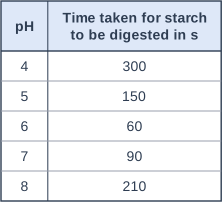
A student investigated the effect of pH on the time taken for amylase to digest starch. Every 30 seconds she tested a drop of the mixture with iodine solution. The table shows her results.
Give the optimum pH shown by these results. Explain why the student cannot be certain that this is the exact optimum pH, and suggest how she could find it more precisely.
Model answer
The optimum pH shown is pH 6, because starch was digested fastest (in 60 s). The pH values tested were a whole unit apart, so the true optimum could be anywhere between pH 5 and pH 7. She could repeat the investigation with buffers at smaller intervals around pH 6, such as pH 5.5, 6.0 and 6.5.
Explanation
Results can only show the best of the values tested. To locate an optimum more precisely, test more values closer together in the range where the optimum appears to be.
Mark scheme
1 mark
pH 6
1 mark
the pH values were 1 unit apart, so the optimum could be anywhere between pH 5 and pH 7
allow the true optimum may lie between the values tested
1 mark
repeat with smaller pH intervals around pH 6, e.g. 5.5, 5.75, 6.0, 6.25, 6.5
allow test pH values between 5 and 7 at intervals of 0.5 or less
Question 4
4 marks
Bile is released into the small intestine.
Explain how bile increases the rate of fat digestion.
Model answer
Bile is alkaline, so it neutralises the hydrochloric acid that enters the small intestine from the stomach. This provides the alkaline conditions in which lipase works best. Bile also emulsifies fats, breaking large fat globules into many small droplets, which greatly increases the surface area for lipase to act on. Both effects increase the rate of fat breakdown by lipase.
Explanation
Bile does not contain enzymes and does not chemically digest fats. It speeds up digestion by lipase in two ways: the right pH and a bigger surface area.
Mark scheme
1 mark
bile is alkaline and neutralises (hydrochloric) acid from the stomach
1 mark
giving alkaline conditions in which lipase works best
allow optimum pH for lipase
1 mark
bile emulsifies fats / breaks fat into small droplets
do not accept bile digests fat / breaks down fat into fatty acids
1 mark
which increases the surface area for lipase to act on
Ready to try the rest? Every answer you write is marked against the mark scheme, so you can see exactly where the marks are.
Ctrl + Enter to check
Study HelperHints first, answers after you try
Stuck on this one? Ask for a hint and I’ll point you in the right direction, without giving the answer away. Once you’ve checked your answer, I’ll show you how the marks are awarded.