Practise 18 exam-style questions on Diffusion for AQA GCSE Combined Science (Biology Paper 1). Write your answer as you would in the exam and get it marked in seconds against the mark scheme, point by point, with the Study Helper on hand if you get stuck.
18 questions
1–6 marks each
Instant marking
No sign-up needed
18 questions, marked as you go
Sample questions with model answers
Here are 4 of the questions in this topic, each with a model answer, an explanation of why it earns the marks and the mark scheme an examiner would use.
Question 1
2 marks
Urea is a waste product made in liver cells. It moves from the liver cells into the blood plasma, which carries it to the kidneys for excretion.
Explain how urea moves from the liver cells into the blood plasma.
Model answer
Urea moves by diffusion. Its concentration is higher inside the liver cells, where it is made, than in the blood plasma, so there is a net movement of urea out of the cells into the plasma.
Explanation
Diffusion always gives a net movement from higher to lower concentration. The blood keeps carrying urea away to the kidneys, which keeps the concentration in the plasma low.
Mark scheme
1 mark
by diffusion
1 mark
because the concentration of urea is higher in the liver cells than in the blood plasma
allow urea moves down its concentration gradient
Question 2
2 marks
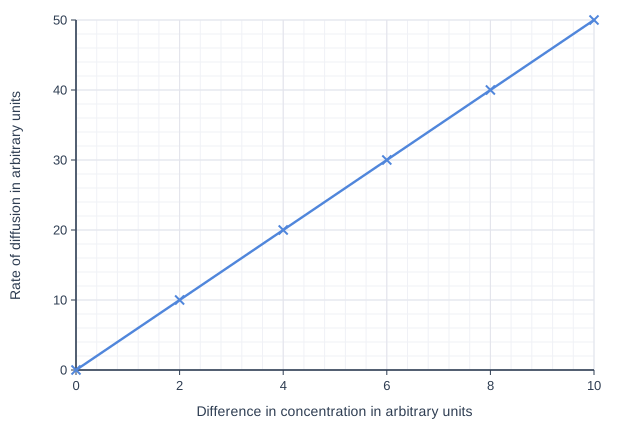
The graph shows how the rate of diffusion of a substance across a membrane changes with the difference in its concentration on the two sides of the membrane.
Describe the relationship shown by the graph.
Model answer
As the difference in concentration increases, the rate of diffusion increases. The graph is a straight line through the origin, so the rate of diffusion is directly proportional to the concentration difference: doubling the difference doubles the rate.
Explanation
A straight line through the origin shows direct proportionality, not just a positive correlation. This is why a steep concentration gradient makes exchange surfaces more effective.
Mark scheme
1 mark
as the difference in concentration increases, the rate of diffusion increases
1 mark
the rate of diffusion is directly proportional to the concentration difference
allow doubling the concentration difference doubles the rate; allow it is a straight line through the origin
Question 3
3 marks
The inner surface of the small intestine is covered with millions of finger-like projections called villi.
Explain how the villi are adapted for absorbing the products of digestion.
Model answer
The millions of villi give the small intestine a very large surface area for absorption. Each villus has a wall only one cell thick, so the diffusion path into the blood is short. Each villus also contains a network of capillaries, so absorbed molecules are carried away quickly, keeping the concentration gradient steep.
Explanation
Absorption in the small intestine depends on diffusion (and also active transport). Large surface area, a thin wall and a good blood supply all increase the rate of absorption.
Mark scheme
1 mark
villi give a large surface area
allow microvilli increase the surface area further
1 mark
the wall of each villus is thin / one cell thick, giving a short diffusion path
1 mark
each villus has a good blood supply / network of capillaries that maintains a steep concentration gradient
allow carries absorbed molecules away
Question 4
4 marks
Explain how the roots and the leaves of a plant are adapted for exchanging materials with their surroundings.
Model answer
Roots are covered in root hair cells, whose long projections give a very large surface area for absorbing water and mineral ions from the soil. Leaves are flat and thin, which gives a large surface area and a short diffusion distance for gases. They have stomata, which let carbon dioxide diffuse into the leaf and oxygen diffuse out, and air spaces inside the leaf give a large internal surface area for gases to diffuse into and out of the cells.
Explanation
Plants exchange materials at their roots (water and mineral ions) and leaves (carbon dioxide and oxygen). In each case the key adaptation is a large surface area, with short diffusion distances in the leaf.
Mark scheme
1 mark
roots have root hair cells
max 4
1 mark
which give a large surface area for absorbing water and mineral ions
1 mark
leaves are thin / flat, giving a large surface area and a short diffusion distance
1 mark
leaves have stomata that let carbon dioxide diffuse in and oxygen diffuse out
allow stomata for gas exchange
1 mark
leaves have air spaces (in the spongy mesophyll) that give a large surface area for gases to diffuse into cells
Ready to try the rest? Every answer you write is marked against the mark scheme, so you can see exactly where the marks are.
Ctrl + Enter to check
Study HelperHints first, answers after you try
Stuck on this one? Ask for a hint and I’ll point you in the right direction, without giving the answer away. Once you’ve checked your answer, I’ll show you how the marks are awarded.