Level:
Correct: 0
Incorrect: 0
Marks: 0/0

Protist diseases

Practise 10 exam-style questions on Protist diseases for AQA GCSE Combined Science (Biology Paper 1). Write your answer as you would in the exam and get it marked in seconds against the mark scheme, point by point, with the Study Helper on hand if you get stuck.

  • 10 questions
  • 1–6 marks each
  • Instant marking
  • No sign-up needed
10 questions, marked as you go

Sample questions with model answers

Here are 4 of the questions in this topic, each with a model answer, an explanation of why it earns the marks and the mark scheme an examiner would use.

Question 1

2 marks

Describe the effects of malaria on a person.

Model answer

Malaria causes recurrent episodes of fever, which come back again and again. It can be fatal.

Explanation

The word 'recurrent' matters: malaria fever returns in repeated episodes. Malaria is one of the most deadly communicable diseases in the world.

Mark scheme
  1. 1 mark

    recurrent episodes of fever

    allow fever that keeps coming back; fever on its own scores 0 for this mark

  2. 1 mark

    it can be fatal

    allow can kill / cause death

Question 2

2 marks

Malaria cannot be caught by touching an infected person or by breathing in droplets from their coughs.

Explain why.

Model answer

The malarial protists live in the person's blood, not in droplets from coughs or on the skin. The protist's life cycle includes the mosquito, so it can only reach another person when a mosquito bites an infected person and then bites someone else.

Explanation

Different pathogens are spread in different ways. Malaria depends on a vector, so it is controlled by targeting mosquitoes rather than by isolating patients or covering coughs.

Mark scheme
  1. 1 mark

    the malarial protists are in the blood (not in droplets or on the skin)

  2. 1 mark

    they are only passed on by a mosquito (vector) biting / the protist's life cycle includes the mosquito

    allow the protist must be carried by a mosquito to reach another person

Question 3

3 marks

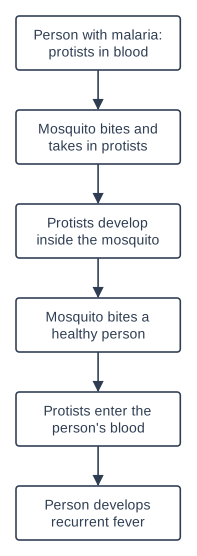
The flow chart shows how the malarial protist is passed from one person to another.

Use the flow chart to explain why reducing the number of mosquitoes reduces the number of malaria cases, and why a person who already has malaria should also sleep under a mosquito net.

Flow chart of 6 boxes joined by arrows, read from top to bottom. The first box is "Person with malaria: protists in blood", which leads to "Mosquito bites and takes in protists", which leads to "Protists develop inside the mosquito", which leads to "Mosquito bites a healthy person", which leads to "Protists enter the person's blood", which leads to "Person develops recurrent fever".

Model answer

The protist can only pass from person to person inside a mosquito. With fewer mosquitoes, fewer mosquitoes bite infected people and take in protists, and fewer healthy people are bitten, so fewer protists enter people's blood. A person who already has malaria should sleep under a net because it stops mosquitoes biting them and taking in protists from their blood, so those mosquitoes cannot pass malaria on to other people.

Explanation

The flow chart shows that the mosquito is needed at two points: picking up protists and passing them on. Mosquito nets protect healthy people from being infected and also stop infected people being a source of protists for mosquitoes.

Mark scheme
  1. 1 mark

    with fewer mosquitoes, fewer infected people are bitten / fewer protists are taken in by mosquitoes

  2. 1 mark

    and fewer healthy people are bitten, so fewer protists enter people's blood

  3. 1 mark

    a net stops mosquitoes biting the infected person and taking in protists from their blood, so they cannot carry it to others

    allow breaks the cycle at the first step

Question 4

4 marks

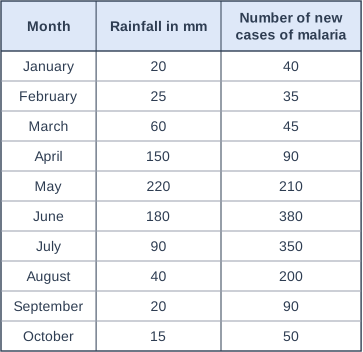
The table shows the monthly rainfall and the number of new cases of malaria in one region of a country.

Describe the relationship between rainfall and the number of new cases of malaria, and explain it.

Table with columns "Month", "Rainfall in mm", "Number of new cases of malaria". Month: January; Rainfall in mm: 20; Number of new cases of malaria: 40 | Month: February; Rainfall in mm: 25; Number of new cases of malaria: 35 | Month: March; Rainfall in mm: 60; Number of new cases of malaria: 45 | Month: April; Rainfall in mm: 150; Number of new cases of malaria: 90 | Month: May; Rainfall in mm: 220; Number of new cases of malaria: 210 | Month: June; Rainfall in mm: 180; Number of new cases of malaria: 380 | Month: July; Rainfall in mm: 90; Number of new cases of malaria: 350 | Month: August; Rainfall in mm: 40; Number of new cases of malaria: 200 | Month: September; Rainfall in mm: 20; Number of new cases of malaria: 90 | Month: October; Rainfall in mm: 15; Number of new cases of malaria: 50.

Model answer

As rainfall increases, the number of new malaria cases increases, but with a delay: rainfall peaks in May (220 mm) and cases peak in June (380). Rain creates more standing water, where mosquitoes lay their eggs, so more mosquitoes develop. More mosquitoes bite more people and pass on more malarial protists. The delay is because it takes time for the new mosquitoes to develop and for infected people to become ill.

Explanation

Look for a time lag when describing data like this: cases follow rainfall rather than rising at exactly the same time. Link the data to the biology: rain leads to breeding sites, then more vectors, then more infections.

Mark scheme
  1. 1 mark

    months with high rainfall are followed by more cases of malaria

    max 4; allow positive correlation

  2. 1 mark

    the number of cases peaks in June, one month after the peak in rainfall in May

    allow there is a delay of about one month

  3. 1 mark

    rain produces more standing water where mosquitoes can breed / lay eggs

  4. 1 mark

    so there are more mosquitoes to bite people and pass on the protist

  5. 1 mark

    the delay is because it takes time for new mosquitoes to develop / for the protist to develop and cause fever

Ready to try the rest? Every answer you write is marked against the mark scheme, so you can see exactly where the marks are.

Revision notes

Protist diseases

The big idea

Protists are mostly single-celled organisms whose genetic material is enclosed in a nucleus, so they are eukaryotic. Some protists are pathogens. The pathogens that cause malaria are protists, and they are passed between people by mosquitoes. Malaria is controlled mainly by targeting the mosquito.

Malaria

  • Cause: a protist.
  • Symptoms: recurrent episodes of fever: the high temperature comes back again and again, with near-normal temperature in between. Malaria can be fatal.
  • Life cycle: the malarial protist has a life cycle that includes the mosquito.

The mosquito is a vector: an organism that carries a pathogen and passes it to another organism. The mosquito does not cause malaria. The protist does.

How malaria is passed on. Diagram of 3 boxes joined by 3 arrows. The boxes are: "Person with malaria (protists in blood)" (top row, left), "Mosquito (the vector)" (top row, right), "Healthy person" (bottom row, centre). Arrows go from "Person with malaria (protists in blood)" to "Mosquito (the vector)", labelled "bites and takes in protists"; from "Mosquito (the vector)" to "Healthy person", labelled "bites and passes protists on"; from "Healthy person" to "Person with malaria (protists in blood)", labelled "protists reproduce; malaria develops".
  1. A mosquito bites a person who has malaria and takes in protists with the blood.
  2. The protists develop inside the mosquito.
  3. The mosquito bites a healthy person and passes the protists into their blood.
  4. The protists reproduce in the new person, who develops malaria.

Malaria is not spread by touching, droplets or food: it needs the mosquito.

Controlling the spread

The spread of malaria is controlled by preventing the vectors, mosquitoes, from breeding and by using mosquito nets to avoid being bitten.

MethodHow it reduces malaria
Drain or cover still water, empty containers that collect rainMosquitoes lay eggs in still water, so fewer adult mosquitoes develop
Spray insecticide where mosquitoes breed, or add fish that eat the larvaeKills the young mosquitoes, so there are fewer vectors
Sleep under a mosquito netMosquitoes bite mainly at night; the net is a barrier, so protists are not passed into the blood
Use insecticide-treated netsAlso kills mosquitoes that land on them, protecting people without nets too

Malaria is most common in hot, wet countries, and cases rise after the rainy season: rain leaves more pools of still water, so more mosquitoes breed and more people are bitten. Insect repellent, clothing that covers the skin and antimalarial drugs also help. Antibiotics and condoms do not.

Comparing groups of different sizes

In village A, 800 people were given insect repellent and 96 caught malaria in a year. In village B, 600 people had no repellent and 168 caught malaria. Did the repellent help?

Village A: \(\dfrac{96}{800} \times 100 = 12\%\). Village B: \(\dfrac{168}{600} \times 100 = 28\%\).

A smaller percentage caught malaria with repellent, which supports the idea that it helps. But the villages may differ in other ways, such as how close they are to breeding sites, so other factors cannot be ruled out.

Common mistakes

  • Saying the mosquito is the pathogen. The protist is the pathogen; the mosquito is the vector.
  • Saying malaria is caused by a bacterium or a virus. It is caused by a protist.
  • Saying malaria spreads by contact or in the air. It is passed on by mosquito bites.
  • Comparing the numbers of cases in groups of different sizes. Work out percentages first.

Exam tip

For "explain how this method reduces malaria", follow the chain through the vector: fewer mosquitoes (or fewer bites), so fewer protists passed into people's blood, so fewer people infected. Naming the method alone scores little.

Study Helper Hints first, answers after you try

Stuck on this one? Ask for a hint and I’ll point you in the right direction, without giving the answer away. Once you’ve checked your answer, I’ll show you how the marks are awarded.