Level:
Correct: 0
Incorrect: 0
Marks: 0/0

Plant organ system

Practise 19 exam-style questions on Plant organ system for AQA GCSE Combined Science (Biology Paper 1). Write your answer as you would in the exam and get it marked in seconds against the mark scheme, point by point, with the Study Helper on hand if you get stuck.

  • 19 questions
  • 1–6 marks each
  • Instant marking
  • No sign-up needed
19 questions, marked as you go

Sample questions with model answers

Here are 4 of the questions in this topic, each with a model answer, an explanation of why it earns the marks and the mark scheme an examiner would use.

Question 1

2 marks

Root hair cells have a long, thin extension that grows out between soil particles.

Explain how this helps the root hair cell take up water efficiently.

Model answer

The extension gives the root hair cell a large surface area in contact with the soil water, so more water can enter the cell by osmosis at the same time.

Explanation

The larger the surface area, the faster a substance can be exchanged. Root hair cells absorb water by osmosis, so a large surface area means more water enters the root each second.

Mark scheme
  1. 1 mark

    it gives a large surface area

    allow increases the surface area (of the root)

  2. 1 mark

    so more water can be absorbed by osmosis (at the same time)

    must mention osmosis; do not accept active transport of water

Question 2

3 marks

The concentration of nitrate ions in the cytoplasm of root hair cells is often higher than the concentration in the soil water.

Explain how root hair cells absorb nitrate ions from the soil.

Model answer

The root hair cells absorb nitrate ions by active transport. The ions are moved from the dilute soil water into the cell, against the concentration gradient. Active transport needs energy, which is released by respiration in the many mitochondria of the root hair cells.

Explanation

Diffusion only moves particles down a concentration gradient, so it cannot move ions from dilute soil water into a more concentrated cell. Active transport uses energy from respiration to do this. Remember that energy is transferred or released, never produced.

Mark scheme
  1. 1 mark

    by active transport

    do not accept diffusion or osmosis

  2. 1 mark

    ions move against the concentration gradient / from a dilute solution (in the soil) to a more concentrated solution (in the cell)

    allow from low to high concentration

  3. 1 mark

    this needs energy from respiration

    allow root hair cells have many mitochondria to release the energy; do not accept 'produce energy'

Question 3

3 marks

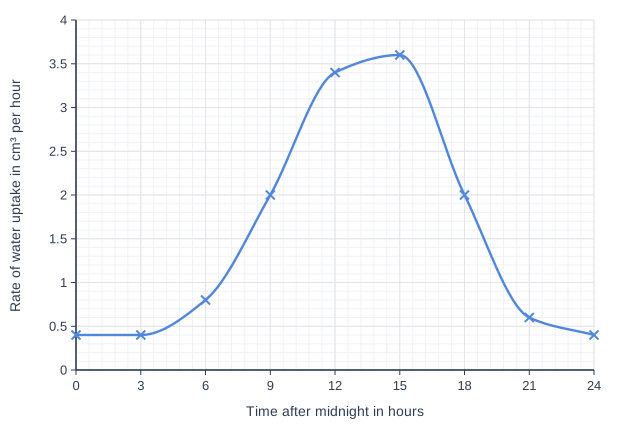
The graph shows the rate of water uptake by a sunflower plant over 24 hours on a sunny summer day.

Explain the changes in the rate of water uptake shown by the graph.

Line graph of rate of water uptake in cm³ per hour (y-axis, 0 to 4) against time after midnight in hours (x-axis, 0 to 24). The line is a smooth curve through (0, 0.4), (3, 0.4), (6, 0.8), (9, 2), (12, 3.4), (15, 3.6), (18, 2), (21, 0.6), (24, 0.4).

Model answer

At night, from 0 to about 6 hours and after about 21 hours, the rate of water uptake is low (0.4 cm³ per hour) because it is dark and most stomata are closed, so little water vapour is lost. As light intensity increases in the morning, more stomata open, and the temperature rises so water evaporates and diffuses out of the leaves faster. The rate peaks at about 15 hours (3.6 cm³ per hour), when it is warm and bright. In the evening, light intensity and temperature fall, stomata close and the rate decreases. The plant takes up water to replace the water lost by transpiration.

Explanation

Water uptake follows transpiration, because water lost from the leaves is replaced by water drawn up through the xylem. Light controls whether stomata are open, and temperature controls how fast water evaporates, so the rate follows the daily pattern of light and temperature.

Mark scheme
  1. 1 mark

    the rate is low at night (before about 6 hours and after about 21 hours) because it is dark so the stomata are (mostly) closed

    max 3; max 2 if no times or values from the graph are used

  2. 1 mark

    the rate increases during the morning because light intensity increases so more stomata open

    allow stomata open wider

  3. 1 mark

    temperature rises during the day so water evaporates and diffuses out of the leaves faster

  4. 1 mark

    the rate is highest at about 15 hours (early afternoon) when it is warmest / light is intense

    allow 12-15 hours

  5. 1 mark

    more water lost by transpiration means more water is taken up to replace it

Question 4

4 marks

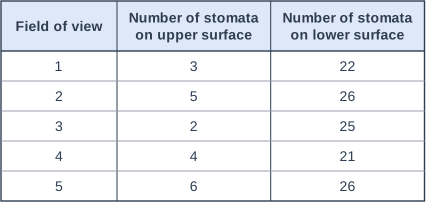
A student counted the stomata in five fields of view on the upper and lower surfaces of a leaf. The table shows the results.

The field of view was a circle with a radius of 0.20 mm.
Area of a circle = 3.14 × (radius)²

Calculate the mean number of stomata per mm² on the lower surface. Give your answer to 2 significant figures.

Suggest why the student counted stomata in five different fields of view.

Table with columns "Field of view", "Number of stomata on upper surface", "Number of stomata on lower surface". Field of view: 1; Number of stomata on upper surface: 3; Number of stomata on lower surface: 22 | Field of view: 2; Number of stomata on upper surface: 5; Number of stomata on lower surface: 26 | Field of view: 3; Number of stomata on upper surface: 2; Number of stomata on lower surface: 25 | Field of view: 4; Number of stomata on upper surface: 4; Number of stomata on lower surface: 21 | Field of view: 5; Number of stomata on upper surface: 6; Number of stomata on lower surface: 26.

Model answer

Mean on the lower surface = (22 + 26 + 25 + 21 + 26) ÷ 5 = 120 ÷ 5 = 24 stomata per field of view
Area of field of view = 3.14 × 0.20² = 0.1256 mm²
Stomata per mm² = 24 ÷ 0.1256 = 191 = 190 (2 s.f.)
The number of stomata is different in different parts of the leaf, so counting five fields of view gives a mean that is more representative of the whole leaf.

Explanation

To find a number per mm², divide the mean count by the area of the field of view. This is sampling: you cannot count every stoma on a leaf, so you count several samples and calculate a mean, which reduces the effect of any one unusual sample.

Mark scheme
  1. 1 mark

    mean number on lower surface = 120 ÷ 5 = 24

    an answer of 190 (stomata per mm²) scores the first 3 marks

  2. 1 mark

    area of field of view = 3.14 × 0.20² = 0.1256 (mm²)

    allow 0.126 or 0.13

  3. 1 mark

    24 ÷ 0.1256 = 190 (stomata per mm²)

    must be 2 significant figures; allow 180-190 if the area was rounded; allow ecf

  4. 1 mark

    the number of stomata varies across the leaf, so several samples give a more representative mean

    allow to reduce the effect of an unusual / anomalous field of view; allow so the mean is more accurate; ignore 'to make it fair'

Ready to try the rest? Every answer you write is marked against the mark scheme, so you can see exactly where the marks are.

Revision notes

Plant organ system

The big idea

The roots, stem and leaves are organs that work together as a plant organ system for transporting substances. Water and mineral ions travel up from the roots in the xylem, and sugars made in the leaves travel to the rest of the plant in the phloem. Water is pulled up the plant because it evaporates from the leaves: transpiration.

Diagram of a flowering plant, with part of its stem magnified. A flowering plant grows in soil. It has a flower at the top of the stem, leaves on both sides of the stem, and branching roots in the soil with fine root hairs near the tips of the thin roots. A dashed box on the stem is shown magnified on the right: on the left of the magnified view is phloem (a sieve tube divided by sieve plates, with narrow companion cells beside it), and on the right is a xylem vessel (a wide hollow tube with thick ringed walls and no cross-walls). In the magnified view, an arrow in the xylem points upwards, and two arrows in the phloem point upwards and downwards. Wavy arrows come out of the underside of a leaf on the left. The xylem arrow shows water and dissolved mineral ions moving up from the roots to the leaves (the transpiration stream); xylem vessels are dead, hollow and strengthened with lignin. The phloem arrows show dissolved sugars moving both up and down the plant from the leaves to where they are used or stored (translocation); phloem is living sieve tube cells with sieve plates. The wavy arrows are water vapour evaporating from the leaf and diffusing out through the stomata (transpiration). The label "leaf" points to one of the flat green structures on the stalk; the label "stem" points to the upright green stalk; the label "root" points to the branching structures in the soil; the label "root hairs" points to the fine hairs near the tips of the thin branches in the soil; the label "xylem" points to the wide hollow tube with thick ringed walls, on the right of the magnified view; the label "phloem" points to the tube divided by perforated cross-walls, with narrow cells beside it, on the left of the magnified view; the label "water vapour" points to the wavy arrows leaving the underside of a flat green structure on the left.
Water moves up the xylem only; dissolved sugars move up and down the phloem.

Taking in water and mineral ions

Root hair cells have a long, thin root hair that gives a large surface area for absorption.

  • Water enters by osmosis: the soil water is more dilute than the cell sap, so water moves into the cell through the partially permeable membrane.
  • Mineral ions enter by active transport: the ions are more concentrated inside the cell than in the soil, so they must be moved against the concentration gradient. This needs energy from respiration, so root hair cells contain many mitochondria.

Xylem and phloem

XylemPhloem
CarriesWater and mineral ionsDissolved sugars (cell sap)
DirectionUp only: roots \(\rightarrow\) stem \(\rightarrow\) leavesUp and down: from the leaves to the rest of the plant, for immediate use or storage
StructureHollow tubes strengthened by lignin, with no end walls, so water flows easily and the tubes do not collapseTubes of elongated cells; cell sap moves from one cell to the next through pores in the end walls
ProcessThe transpiration streamTranslocation

Translocation is the movement of food molecules (dissolved sugars) through the phloem. Roots and growing tips cannot make enough sugar themselves, so they rely on it for respiration, growth and storage (as starch).

Transpiration and stomata

Transpiration is the loss of water vapour from the leaves. Water evaporates from the surfaces of cells inside the leaf into the air spaces, then water vapour diffuses out through the stomata. This pulls more water up the xylem from the roots, forming the transpiration stream. The stream is useful: it carries water for photosynthesis and mineral ions to the leaves, keeps cells firm so the plant does not wilt, and cools the leaves.

The guard cells control gas exchange and water loss. When they are full of water they curve apart and the stoma opens; when the plant is short of water they lose water and the stoma closes. Stomata usually open in the light (so carbon dioxide can diffuse in for photosynthesis) and close in the dark.

What affects the rate of transpiration

FactorEffect on rateWhy
Higher temperatureIncreasesWater molecules have more energy, so evaporation and diffusion are faster
Higher humidityDecreasesMore water vapour in the air, so a smaller concentration gradient
More air movementIncreasesWater vapour is blown away from the leaf, keeping the concentration gradient steep
Higher light intensityIncreases, then levels offMore stomata open for photosynthesis; once they are fully open another factor limits the rate

A potometer measures how fast a leafy shoot takes up water, which is used to estimate the rate of transpiration (a little water is used in the plant, so the two are not exactly equal). Cut and fit the shoot under water so no air gets into the xylem, and keep the apparatus airtight.

Diagram of a leafy shoot connected to a water-filled glass tube with a scale (a bubble potometer). A leafy shoot at the top left is pushed into a short piece of rubber tubing on the end of a glass tube full of water. The tube runs down and then right; on the way it is joined from above by a reservoir of water with a tap underneath. It continues as a long capillary tube along a scale numbered 0 to 10 (cm), and its end bends down into a beaker of water. There is an air bubble in the liquid in the narrow tube, above the scale. The label "leafy shoot" points to the leafy shoot; the label "reservoir" points to the reservoir of water; the label "capillary tube" points to the capillary tube; the label "air bubble" points to the air bubble; the label "scale" points to the scale. (the air bubble is at 3 on the scale (0 to 10 cm, 0 at the left).)
As the shoot takes up water, the air bubble moves along the scale; the reservoir resets it.

Rate of water uptake from a potometer

The bubble moves 36 mm in 4 minutes. The capillary tube has a radius of 0.40 mm. Calculate the rate of water uptake in mm³ per minute. (\(\pi = 3.14\))

Cross-section area: \(\pi r^2 = 3.14 \times 0.40^2 = 0.5024\text{ mm}^2\)

Volume: \(0.5024 \times 36 = 18.09\text{ mm}^3\)

Rate: \(18.09 \div 4 = 4.52\text{ mm}^3\) per minute

When you plot results, use a line graph if the independent variable is continuous (such as temperature), and choose scales so the points cover at least half of the grid.

Common mistakes

  • Saying water enters root hairs by diffusion or active transport. Water enters by osmosis; mineral ions by active transport.
  • Describing transpiration as the movement of sugars. Transpiration is the loss of water vapour from the leaves; sugars move by translocation.
  • Putting translocation in the xylem. It happens in the phloem.
  • Using the diameter as the radius, or forgetting to divide by the time, in potometer calculations.
  • Saying respiration "makes" energy for active transport. Respiration releases energy.

Exam tip

For "describe and explain" questions on transpiration graphs, quote values from the graph, then explain with evaporation, diffusion and the concentration gradient of water vapour. For light intensity, explain through the stomata opening, not through heat.

Study Helper Hints first, answers after you try

Stuck on this one? Ask for a hint and I’ll point you in the right direction, without giving the answer away. Once you’ve checked your answer, I’ll show you how the marks are awarded.