Practise 17 exam-style questions on Programmable devices and output components for AQA GCSE Engineering. Write your answer as you would in the exam and get it marked in seconds against the mark scheme, point by point, with the Study Helper on hand if you get stuck.
17 questions
1–8 marks each
Instant marking
No sign-up needed
17 questions, marked as you go
Sample questions with model answers
Here are 4 of the questions in this topic, each with a model answer, an explanation of why it earns the marks and the mark scheme an examiner would use.
Question 1
1 mark
Which component is used in a power supply to rectify alternating current (AC) into direct current (DC)?
Choose your answer.
A Capacitor
B Diode
C Relay
D Variable resistor
Model answer
B Diode
Explanation
A rectifying diode lets current flow through it in one direction only, so it blocks the half of the AC cycle that flows the wrong way, turning AC into DC. A capacitor is often added afterwards to smooth the DC, but it does not rectify on its own.
Mark scheme
1 mark
B / Diode
Accept the letter or the option text. If more than one option is given, 0 marks.
Question 2
2 marks
A field-effect transistor (FET) can be used instead of a bipolar transistor as the driver for a motor in a microcontroller circuit.
Give one advantage of using a FET and explain why it is an advantage.
Model answer
A FET is switched on by the voltage at its gate and draws almost no current from the microcontroller, so it puts virtually no load on the output pin and the pin cannot be overloaded.
Explanation
A FET (such as a MOSFET) is voltage-controlled: its gate takes almost no current, whereas a bipolar transistor needs a base current. FETs also have a very low resistance when fully on, so they waste little power as heat when switching large currents. The second mark is for explaining why the advantage matters in the circuit.
Mark scheme
1 mark
Advantage identified, e.g. a FET draws (almost) no current from the output pin / it is switched by a voltage, not a current / it has a very low resistance when switched on / it can switch large currents
Do not accept 'it is better', 'it is cheaper' or 'it is faster' with no reason.
1 mark
Explanation linked to the advantage, e.g. so it puts almost no load on the microcontroller output (one pin can drive it easily, no base resistor is needed) / so very little power is wasted as heat, so no heat sink is needed and a battery lasts longer
The explanation must be a consequence of the advantage given.
Question 3
2 marks
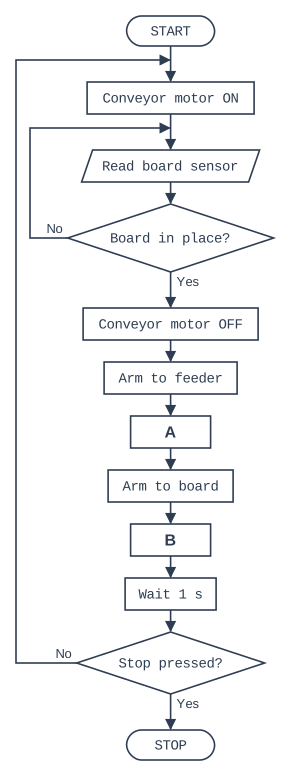
A pick and place machine puts electronic components onto circuit boards. It has a conveyor motor, an arm motor and a vacuum nozzle that picks components up by suction. Figure 1 shows the flowchart of its control program.
State what should be written in box A and in box B.
Model answer
Box A: Vacuum ON (the nozzle picks up a component from the feeder). Box B: Vacuum OFF (the component is released onto the board).
Explanation
Follow the sequence: the arm moves to the feeder, so the next step must pick the component up (vacuum on); the arm then moves to the board, so the next step must release it (vacuum off). The program then waits and loops back to bring the next board in until the stop button is pressed.
Mark scheme
1 mark
Box A: vacuum on / switch on the suction (to pick up the component)
Accept 'pick up component', 'nozzle suction ON'.
1 mark
Box B: vacuum off / switch off the suction (to release / place the component on the board)
Accept 'release component', 'place component'. Do not accept 'arm motor off' or 'conveyor on'.
Question 4
4 marks
A battery-powered smoke alarm has an LED that shows it is working. The LED needs a voltage of 2.0 V across it and a current of 20 mA. The supply is 9 V. A resistor is connected in series with the LED.
Calculate the resistance of the series resistor needed.
Model answer
Voltage across resistor = 9 − 2.0 = 7 V I = 20 mA = 0.02 A R = V ÷ I = 7 ÷ 0.02 R = 350 Ω
Explanation
The resistor and the LED are in series, so they share the 9 V: the resistor takes 9 − 2 = 7 V. The same 20 mA (0.02 A) flows through both, so R = V ÷ I = 7 ÷ 0.02 = 350 Ω. The commonest errors are using the whole 9 V (giving 450 Ω) and forgetting to change mA into A.
Mark scheme
1 mark
Voltage across the resistor = 9 − 2.0 = 7 V; or a correct final answer of 350 Ω with no working
An answer of 350 Ω (or 0.35 kΩ) with no working scores 4 marks.
1 mark
Current converted: 20 mA = 0.02 A
Accept the conversion shown in the substitution.
1 mark
Ohm's law rearranged and substituted: R = V ÷ I = 7 ÷ 0.02
Allow ECF: their voltage ÷ their current. 9 ÷ 0.02 = 450 Ω (LED voltage not taken away) scores 2 marks (conversion and this mark). 7 ÷ 20 = 0.35 Ω (no conversion) scores 2 marks (first point and this mark).
1 mark
R = 350 Ω
Accept 0.35 kΩ. 7 × 0.02 = 0.14 scores the first two marks only.
Ready to try the rest? Every answer you write is marked against the mark scheme, so you can see exactly where the marks are.
Ctrl + Enter to check
Study HelperHints first, answers after you try
Stuck on this one? Ask for a hint and I’ll point you in the right direction, without giving the answer away. Once you’ve checked your answer, I’ll show you how the marks are awarded.