
Level:
Correct: 0
Incorrect: 0
Marks: 0/0
Exam Practice
Course:
Topics:
AQA GCSE Engineering Smart practice A mixed round aimed at your weak spots
Unit 1
Engineering materials
Unit 2
Engineering manufacturing processes
Additive manufacturing
Material removal
Material removal
Casting and moulding
Joining and assembly
Heat and chemical treatment
Surface finishing
Surface finishing
Unit 3
Systems
Unit 4
Testing and investigation
Unit 5
The impact of modern technologies
Unit 6
Practical engineering skills
Avg
score:
–
Topics
done:
0/32

Gears, chains and pulleys

Practise 16 exam-style questions on Gears, chains and pulleys for AQA GCSE Engineering. Write your answer as you would in the exam and get it marked in seconds against the mark scheme, point by point, with the Study Helper on hand if you get stuck.

  • 16 questions
  • 1–8 marks each
  • Instant marking
  • No sign-up needed
16 questions, marked as you go

Sample questions with model answers

Here are 4 of the questions in this topic, each with a model answer, an explanation of why it earns the marks and the mark scheme an examiner would use.

Question 1

1 mark

How do the two sprockets in a chain and sprocket drive turn?

Choose your answer.

  • A In opposite directions, at the same speed
  • B In opposite directions, at speeds set by their numbers of teeth
  • C In the same direction, at the same speed whatever their numbers of teeth
  • D In the same direction, at speeds set by their numbers of teeth

Model answer

D In the same direction, at speeds set by their numbers of teeth

Explanation

A chain wraps round the outside of both sprockets, so they turn the same way, unlike two meshing gears. The chain passes the same number of teeth on each sprocket every second, so a sprocket with fewer teeth turns faster: the gear ratio is driven teeth ÷ driver teeth, just as for gears.

Mark scheme
  1. 1 mark

    D / In the same direction, at speeds set by their numbers of teeth

    Accept the letter or the option text. If more than one option is given, 0 marks.
Question 2

2 marks

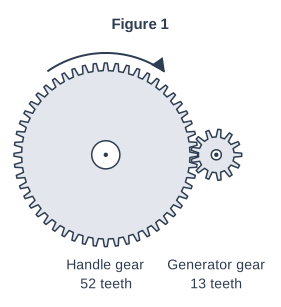
Figure 1 shows the gears inside a wind-up torch. Turning the handle turns the handle gear, which drives the generator gear.

Calculate the gear ratio, and state how many times the generator gear turns for each turn of the handle.

Figure 1. A gear train of 2 meshing gears in a row, from left to right: the gear labelled "Handle gear" (52 teeth) and the gear labelled "Generator gear" (13 teeth). Curved arrows show the gear labelled "Handle gear" turning clockwise.

Model answer

Gear ratio = driven teeth ÷ driver teeth = 13 ÷ 52 = 0.25 (1:4)
The generator gear turns 52 ÷ 13 = 4 times for each turn of the handle.

Explanation

Here the driver (the handle gear, 52 teeth) is bigger than the driven gear (13 teeth), so the gear ratio is less than 1 and the output speeds up: each turn of the handle passes 52 teeth, which turns the 13-tooth gear 4 times. Generators need to spin fast, so the torch gears up the slow turning of the handle.

Mark scheme
  1. 1 mark

    Gear ratio = 13 ÷ 52 = 0.25 / 1:4

    Accept 1/4 or 0.25:1. 4 or 4:1 (ratio upside down) scores 0 for this point.

  2. 1 mark

    The generator gear turns 4 times for each turn of the handle

    Mark independently. Do not accept 0.25 turns.

Question 3

3 marks

The fan in a workshop extractor is driven by an electric motor through a belt and two pulleys.

- The motor turns at 1450 rpm.
- The pulley on the motor has a diameter of 80 mm.
- The pulley on the fan has a diameter of 200 mm.

Fan speed = motor speed × (diameter of motor pulley ÷ diameter of fan pulley)

The fan must turn at between 550 rpm and 650 rpm. Calculate the fan speed and state whether it is suitable.

Model answer

Fan speed = 1450 × (80 ÷ 200) = 1450 × 0.4 = 580 rpm
580 rpm is between 550 rpm and 650 rpm, so the fan speed is suitable.

Explanation

A belt drive works like a gear train with pulley diameters instead of teeth: a small driver pulley turning a larger driven pulley slows the output down, here by a ratio of 200 ÷ 80 = 2.5. Substitute carefully into the formula given, then compare the answer with the required range. Putting the diameters the wrong way round gives a fan speed faster than the motor, which should be a warning sign.

Mark scheme
  1. 1 mark

    Fan speed = 1450 × (80 ÷ 200); or a correct final answer of 580 rpm with no working

    Accept 1450 × 0.4 or 1450 ÷ 2.5. A correct answer of 580 rpm with no working scores the 2 calculation marks.

  2. 1 mark

    580 rpm

    3625 rpm (pulley ratio upside down) scores 0 for points 1 and 2.

  3. 1 mark

    Suitable, because their 580 rpm is between 550 rpm and 650 rpm

    Allow ECF: a correct conclusion from their speed (e.g. 3625 rpm, not suitable, scores this mark). The conclusion must refer to the range.

Question 4

6 marks

A pillar drill has stepped (cone) pulleys on the motor and on the spindle, joined by a V-belt.

Describe, in stages, how the belt is moved to give a lower spindle speed. Include any safety precautions.

Model answer

1. Switch off the pillar drill and turn off the isolator at the wall so it cannot be started by accident. Wait until the spindle has completely stopped.
2. Open the belt guard on top of the drill.
3. Release the belt tension by loosening the tension lever (or motor clamp) and moving the motor towards the spindle, so the belt goes slack.
4. Check the speed chart inside the guard to find which pair of pulleys gives the speed needed.
5. For a lower speed, the belt must run on a small pulley on the motor and a large pulley on the spindle. Lift the belt off the larger pulley first, then fit it into the correct grooves, rolling it on by hand. Never use a screwdriver to lever it, and never touch the belt while it is moving.
6. Check that the belt is straight between matching steps and sits fully in the V-grooves.
7. Move the motor back to tension the belt so that it only deflects slightly when pressed, then lock the tension lever.
8. Close the guard (the drill should not run with it open), switch the isolator back on and run the drill to check it runs smoothly at the new, lower speed.

Explanation

A top answer starts with isolating the machine, gives the stages in order (open the guard, slacken, move the belt, check alignment, re-tension, close the guard, test) and states the key engineering fact: a small motor pulley driving a large spindle pulley lowers the spindle speed. Safety must run through the answer. A list of steps with no detail is capped at 2 marks.

Mark scheme
  1. 6 marks

    Levels of response (6 marks).
    Level 3 (5-6 marks): Detailed explanation including all key stages to change the belt to a lower spindle speed, with the equipment/tools used and safety. Notes are clear and in a logical order.
    Level 2 (3-4 marks): Some stages described in detail OR the majority of stages covered but with insufficient detail to allow the speed to be changed correctly and safely.
    Level 1 (1-2 marks): One or more basic steps/stages listed.
    0 marks: No response or nothing worthy of credit.

    Max 2 if the stages are only listed with no detail. Max 4 if the answer does not say which pulleys give a lower speed.
    Indicative content (in order; accept all other valid responses):
    - Switch off the drill and isolate it at the wall/isolator so it cannot be started; wait for the spindle to stop.
    - Open the belt guard (pulley cover).
    - Release the belt tension, e.g. loosen the motor clamp or tension lever so the motor moves towards the spindle.
    - Check the speed chart on the machine for the required speed.
    - Move the belt onto the smaller motor pulley and the larger spindle pulley: a small driver and a large driven pulley give a lower speed. Move it onto the smaller pulley first, then roll it onto the larger one by hand; never force it with a tool.
    - Check the belt sits fully in the V-grooves and is straight between the matching steps.
    - Re-tension the belt (a small amount of deflection when pressed) and lock the tension lever.
    - Close the guard, restore the power and run the drill to check that it runs smoothly at the new speed.
    Safety: power isolated before opening the guard; never touch the belt or pulleys while they are moving; guard closed before use; hair tied back and no loose clothing.

Ready to try the rest? Every answer you write is marked against the mark scheme, so you can see exactly where the marks are.

Study Helper Hints first, answers after you try

Stuck on this one? Ask for a hint and I’ll point you in the right direction, without giving the answer away. Once you’ve checked your answer, I’ll show you how the marks are awarded.