
Level:
Correct: 0
Incorrect: 0
Marks: 0/0
Exam Practice
Course:
Topics:
AQA GCSE Engineering Smart practice A mixed round aimed at your weak spots
Unit 1
Engineering materials
Unit 2
Engineering manufacturing processes
Additive manufacturing
Material removal
Material removal
Casting and moulding
Joining and assembly
Heat and chemical treatment
Surface finishing
Surface finishing
Unit 3
Systems
Unit 4
Testing and investigation
Unit 5
The impact of modern technologies
Unit 6
Practical engineering skills
Avg
score:
–
Topics
done:
0/32

Engineered lifespans and maintenance

Practise 16 exam-style questions on Engineered lifespans and maintenance for AQA GCSE Engineering. Write your answer as you would in the exam and get it marked in seconds against the mark scheme, point by point, with the Study Helper on hand if you get stuck.

  • 16 questions
  • 1–8 marks each
  • Instant marking
  • No sign-up needed
16 questions, marked as you go

Sample questions with model answers

Here are 4 of the questions in this topic, each with a model answer, an explanation of why it earns the marks and the mark scheme an examiner would use.

Question 1

1 mark

A Paralympic sprinter needs a prosthetic running blade that is as light as possible but also very stiff and strong.

Which material best meets these requirements?

Choose your answer.

  • A Cast iron
  • B Carbon fibre reinforced polymer
  • C Low carbon steel
  • D Polypropylene

Model answer

B Carbon fibre reinforced polymer

Explanation

Carbon fibre reinforced polymer (CFRP) has a very high strength and stiffness for its weight, which is why it is chosen when users need lower weight with high strength. It needs specialist processes such as composite lay-up, so it costs more. Cast iron is heavy and brittle, low carbon steel is strong but much heavier, and polypropylene is light but not stiff or strong enough to store and return energy with each stride.

Mark scheme
  1. 1 mark

    B / Carbon fibre reinforced polymer

    Accept the letter or the option text. If more than one option is given, 0 marks.
Question 2

2 marks

Explain how regular maintenance helps a machine to operate efficiently.

Model answer

Lubricating the bearings and gears reduces friction between the moving parts. Less of the motor's energy is wasted as heat, so the machine needs less power to do the same work and costs less to run.

Explanation

Efficiency is about how much of the input energy does useful work. Maintenance tasks such as lubrication, belt adjustment and keeping cutting tools sharp reduce energy wasted as heat, noise or slipping. Answers about safety alone do not answer this question.

Mark scheme
  1. 1 mark

    A maintenance task linked to efficiency, e.g. lubricating moving parts reduces friction / adjusting belts so that they do not slip / sharpening or replacing blunt cutting tools / cleaning or replacing blocked filters / replacing worn parts

    Do not accept 'keeps it working' or 'makes it safe' on its own: the answer must explain efficiency.

  2. 1 mark

    so less energy is wasted (e.g. as heat or noise) / less power is needed for the same output, so running costs are lower / the machine works at its full rated speed or output

    Must be linked to the task given in the first point.

Question 3

3 marks

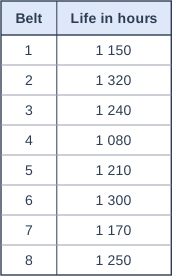
A factory recorded how long eight drive belts on a conveyor lasted before they failed. Figure 1 shows the results.

The factory will replace every belt when it has run for 80% of the mean lifetime of the belts.

Calculate the number of hours after which each belt should be replaced.

Table with columns "Belt", "Life in hours". Belt: 1; Life in hours: 1 150 | Belt: 2; Life in hours: 1 320 | Belt: 3; Life in hours: 1 240 | Belt: 4; Life in hours: 1 080 | Belt: 5; Life in hours: 1 210 | Belt: 6; Life in hours: 1 300 | Belt: 7; Life in hours: 1 170 | Belt: 8; Life in hours: 1 250.

Model answer

Total = 1 150 + 1 320 + 1 240 + 1 080 + 1 210 + 1 300 + 1 170 + 1 250 = 9 720 hours
Mean = 9 720 ÷ 8 = 1 215 hours
Replace after 0.8 × 1 215 = 972 hours

Explanation

The mean is the total divided by the number of belts (8). Replacing belts at 80% of the mean gives a safety margin: every belt in the test lasted at least 1 080 hours, so replacing at 972 hours should stop belts breaking during production. Stopping at the mean (1 215 hours) would mean several belts failed before being replaced.

Mark scheme
  1. 1 mark

    Total = 9 720 hours; or a correct final answer of 972 hours with no working

    An answer of 972 hours with no working scores 3 marks.

  2. 1 mark

    Mean = 9 720 ÷ 8 = 1 215 hours

    Allow ECF from a wrong total if divided by 8. Dividing by 7 does not score.

  3. 1 mark

    80% of 1 215 = 0.8 × 1 215 = 972 hours

    Allow ECF from their mean. 1 215 hours (the mean, with no 80%) scores 2 marks.

Question 4

6 marks

When a car reaches the end of its life (EOL), it is taken to an authorised treatment facility so that its materials can be recovered.

Describe, in stages, how the materials are recovered from the car.

Model answer

1. Depollution: the car is put on a sealed drainage area. The battery is removed and the fuel, engine oil, coolant and brake fluid are drained into labelled containers so they do not pollute the ground. The air-conditioning gas is recovered with special equipment, and the airbags are removed or set off safely because they contain explosive charges. Workers wear gloves and goggles.
2. Reusable parts such as the engine, alternator, doors and wheels are removed, tested and sold as second-hand spares.
3. The tyres, glass, catalytic converter (which contains precious metals) and large plastic parts such as bumpers are taken off to be recycled separately.
4. The stripped body shell is crushed and fed into a shredder, which tears it into fist-sized pieces.
5. Powerful magnets pull out the steel. An eddy current separator then removes the aluminium and copper, and air blowers separate the light plastic, foam and fabric.
6. The metals are sold to steelworks and foundries to be melted and made into new products. The remaining waste is used for energy recovery where possible, and only what is left goes to landfill.

Explanation

Top-level answers give the stages in a logical order (depollute, remove reusable parts, remove recyclable materials, shred, separate, reprocess) with detail of how each is done, the equipment used and safety. Depollution comes first because fluids, batteries and airbags are hazardous. Simply listing 'take it apart, crush it, recycle it' is capped at 2 marks.

Mark scheme
  1. 6 marks

    Levels of response (6 marks).
    Level 3 (5-6 marks): Detailed explanation including all key stages to recover the materials from the car, with the equipment used and safety. Notes are clear and in a logical order.
    Level 2 (3-4 marks): Some stages described in detail OR the majority of stages covered but with insufficient detail to allow the materials to be correctly recovered.
    Level 1 (1-2 marks): One or more basic steps/stages listed.
    0 marks: No response or nothing worthy of credit.

    Max 2 if the stages are only listed with no detail. Indicative content, key stages in order (accept all other valid responses):
    1. Depollution: the battery is removed; fuel, engine oil, coolant, brake fluid and the air-conditioning gas are drained or recovered into sealed containers; airbags are removed or set off safely; the catalytic converter is removed (it contains precious metals).
    2. Parts that can be reused, such as the engine, gearbox, doors, wheels and lights, are removed, tested and sold as spare parts.
    3. Other materials are removed for recycling: tyres, glass, large polymer parts such as bumpers, and wiring (copper).
    4. The remaining shell is crushed or flattened and taken to a shredder, which tears it into small pieces.
    5. Ferrous metals (steel) are separated from the shredded material with large magnets; non-ferrous metals such as aluminium and copper are separated by eddy current separators or flotation.
    6. The separated metals are melted down and reused; the remaining plastics, foam and fabric (shredder residue) are sorted for recycling or energy recovery, and the rest goes to landfill.
    Safety: PPE such as gloves and goggles; fluids drained over a sealed surface with interceptors so they cannot pollute the ground; fuel removed to reduce the fire risk; airbags handled carefully because they contain explosive charges; battery acid; specialist training for high-voltage batteries in electric cars.

Ready to try the rest? Every answer you write is marked against the mark scheme, so you can see exactly where the marks are.

Study Helper Hints first, answers after you try

Stuck on this one? Ask for a hint and I’ll point you in the right direction, without giving the answer away. Once you’ve checked your answer, I’ll show you how the marks are awarded.