Practise 12 exam-style questions on Aerodynamics for AQA GCSE Engineering. Write your answer as you would in the exam and get it marked in seconds against the mark scheme, point by point, with the Study Helper on hand if you get stuck.
12 questions
1–8 marks each
Instant marking
No sign-up needed
12 questions, marked as you go
Sample questions with model answers
Here are 4 of the questions in this topic, each with a model answer, an explanation of why it earns the marks and the mark scheme an examiner would use.
Question 1
1 mark
An aircraft is flying horizontally at a constant speed.
Which two forces acting on the aircraft must be equal in size?
Choose your answer.
A Lift and drag
B Thrust and drag
C Thrust and weight
D Drag and weight
Model answer
B Thrust and drag
Explanation
At a constant speed in level flight the forces are balanced: the forward thrust equals the backward drag, and the upward lift equals the downward weight. The other options pair forces that act in different directions (one horizontal, one vertical), so they cannot balance each other.
Mark scheme
1 mark
B / Thrust and drag
Accept the letter or the option text. If more than one option is given, 0 marks.
Question 2
2 marks
Many racing cars are fitted with a rear wing, shaped like an upside-down aircraft wing.
Explain why a racing car is fitted with a rear wing.
Model answer
The upside-down wing produces downforce (negative lift), which pushes the car down onto the track. This increases the grip of the tyres, so the car can go round corners and brake at higher speeds without skidding.
Explanation
An aircraft wing produces lift upwards; turned upside down, the same shape pushes the car downwards. The extra downward force on the tyres gives more grip, which matters most when cornering and braking at high speed. The wing actually adds drag, so 'reduces drag' is wrong.
Mark scheme
1 mark
it produces downforce / negative lift, pushing the car down onto the track
Accept 'pushes the rear wheels down onto the road'. Do not accept 'to reduce drag' (a rear wing increases drag) or 'for decoration / to look sporty'.
1 mark
which increases the grip (traction) of the tyres, so the car can corner, accelerate or brake faster without skidding / is more stable at high speed
Must be linked to the downforce.
Question 3
3 marks
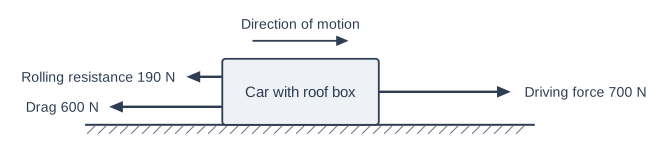
Figure 1 shows the horizontal forces acting on a car travelling along a motorway after a roof box has been fitted. The driving force is 700 N, the drag is 600 N and the rolling resistance is 190 N.
Calculate the resultant force on the car and explain what happens to the speed of the car.
Model answer
Total force acting backwards = drag + rolling resistance = 600 + 190 = 790 N Resultant force = 790 − 700 = 90 N backwards (against the direction of motion) Because the resultant force acts backwards, the car slows down (decelerates). As it slows, the drag falls until the forces are balanced again, and the car then travels at a lower constant speed.
Explanation
Add the forces acting backwards (drag and rolling resistance) and compare them with the forward driving force. The roof box has increased the drag, so the backward forces are now bigger and the 90 N resultant slows the car. The car does not stop or reverse; it slows down until drag falls enough for the forces to balance.
Mark scheme
1 mark
total backward force = 600 + 190 = 790 N; or a correct final answer of 90 N backwards (and the car slows down) with no working
A correct resultant and direction with a correct statement about speed, with no working, scores 3 marks.
1 mark
resultant = 790 − 700 = 90 N backwards / opposite to the direction of motion
The direction is needed for this mark. Leaving out the rolling resistance (100 N forwards) loses this mark and the first.
1 mark
the car slows down (decelerates), because the resultant force acts against its motion
Allow ECF: 'speeds up' for a forward resultant they have calculated. Accept 'slows down until the forces are balanced again, then travels at a lower constant speed'. Do not accept 'stops' or 'goes backwards'.
Question 4
6 marks
A student has made two different body designs for a CO2-powered dragster.
Describe, in stages, how a wind tunnel could be used to compare the drag on the two designs.
Model answer
1. Make the two models the same size and mass, with the same wheels and surface finish, so that the only difference is the body shape. 2. Fix the first model securely in the working section of the wind tunnel, attached to a force sensor (load cell) that measures the backward force on it. Check the model cannot come loose and be blown into the fan, and that the fan guard is in place. 3. Switch on the fan and set it to a fixed air speed, for example 20 m/s, checked with an anemometer. Let the airflow settle. 4. Release thin streams of smoke in front of the model and watch how they flow around it: smooth lines that stay close to the body show streamlined flow, while swirls and a wide wake behind the model show turbulence. 5. Record the drag force from the sensor. Repeat the reading three times and calculate a mean. 6. Switch off, replace the first model with the second design in exactly the same position, and repeat steps 3 to 5 at the same air speed. 7. Compare the mean drag forces. The design with the lower drag force is more aerodynamic. The smoke patterns show where turbulence forms, so the shape can be refined, for example by rounding the nose or covering the wheels, and tested again.
Explanation
A top answer describes a fair test: identical conditions and models that differ only in shape, a force sensor to measure drag at a set air speed, smoke to show the airflow, repeat readings and a clear comparison. Safety around the fan should be included. Answers that only say 'put each car in the wind tunnel and see which is best' stay in Level 1.
Mark scheme
6 marks
Levels of response (6 marks). Level 3 (5-6 marks): Detailed explanation including all key stages to carry out a fair wind tunnel test of both designs and compare their drag, with the equipment used and safety. Notes are clear and in a logical order. Level 2 (3-4 marks): Some stages described in detail OR the majority of stages covered but with insufficient detail to allow a fair comparison to be made. Level 1 (1-2 marks): One or more basic steps/stages listed. 0 marks: No response or nothing worthy of credit.
Max 2 if the stages are only listed with no detail. Indicative content (key stages in order; accept all other valid responses): make both models to the same scale, with the same wheels and finish, so only the body shape differs (fair test); mount the first model securely in the working section, attached to a force sensor (load cell, force meter or spring balance) that measures the backward force; set the fan to a fixed air speed (e.g. 20 m/s, checked with an anemometer) and let the airflow settle; release smoke streams into the airflow to show how the air flows round the body: smooth lines show streamlined flow, swirls and a large wake show turbulence; record the drag force reading; repeat several times and calculate a mean; repeat with the second design under exactly the same conditions (same air speed, same position); compare the mean drag forces: the design with the lower drag is better; use the smoke patterns to find where turbulence forms and refine the shape. Safety: guard over the fan, keep hands and loose items away from the airflow, secure the model so it cannot be blown into the fan, eye protection, ventilation for the smoke.
Ready to try the rest? Every answer you write is marked against the mark scheme, so you can see exactly where the marks are.
Ctrl + Enter to check
Study HelperHints first, answers after you try
Stuck on this one? Ask for a hint and I’ll point you in the right direction, without giving the answer away. Once you’ve checked your answer, I’ll show you how the marks are awarded.