
Level:
Correct: 0
Incorrect: 0
Marks: 0/0
Exam Practice
Course:
Topics:
AQA GCSE Engineering Smart practice A mixed round aimed at your weak spots
Unit 1
Engineering materials
Unit 2
Engineering manufacturing processes
Additive manufacturing
Material removal
Material removal
Casting and moulding
Joining and assembly
Heat and chemical treatment
Surface finishing
Surface finishing
Unit 3
Systems
Unit 4
Testing and investigation
Unit 5
The impact of modern technologies
Unit 6
Practical engineering skills
Avg
score:
–
Topics
done:
0/32

Modelling and calculating

Practise 18 exam-style questions on Modelling and calculating for AQA GCSE Engineering. Write your answer as you would in the exam and get it marked in seconds against the mark scheme, point by point, with the Study Helper on hand if you get stuck.

  • 18 questions
  • 1–8 marks each
  • Instant marking
  • No sign-up needed
18 questions, marked as you go

Sample questions with model answers

Here are 4 of the questions in this topic, each with a model answer, an explanation of why it earns the marks and the mark scheme an examiner would use.

Question 1

1 mark

The chain on a workshop hoist is designed with a factor of safety of 6.

State what a factor of safety of 6 means for the chain.

Model answer

The chain can withstand six times the maximum working load it is designed to carry before it yields or fails.

Explanation

Factor of safety = yield stress ÷ working stress, so a factor of safety of 6 means the stress at which the chain would yield is six times the stress it carries in normal use. Engineers build in this margin to allow for overloading, wear and faults in the material. Answers such as '6 times stronger' do not score unless they say what it is stronger than.

Mark scheme
  1. 1 mark

    the chain can withstand six times the (maximum) working load / working stress before it fails / yields; or the yield (failure) stress of the chain is six times the working stress

    Accept 'it could carry 6 times the load it is designed to lift before it breaks' and 'it is six times stronger than it needs to be for its working load'. The answer must link the 6 to the working load or working stress. Do not accept 'it is 6 times stronger' or 'it is 6 times safer' on their own, or 'it can lift 6 loads'.
Question 2

3 marks

Two springs, P and Q, are tested for the coin return mechanism of a vending machine.

Spring P extends by 8 mm when a force of 120 N is applied.
Spring Q extends by 25 mm when a force of 300 N is applied.

Stiffness = force ÷ extension

Calculate the stiffness of each spring and state which spring is stiffer.

Model answer

Stiffness of P = 120 ÷ 8 = 15 N/mm
Stiffness of Q = 300 ÷ 25 = 12 N/mm
Spring P is stiffer, because it needs 15 N for each mm of extension compared with 12 N for spring Q.

Explanation

Stiffness is the force needed per unit of extension, so divide each force by its extension: P = 15 N/mm and Q = 12 N/mm. The higher value means the stiffer spring, so P is stiffer even though Q was tested with a bigger force. Dividing extension by force gives the reciprocal and reverses the conclusion.

Mark scheme
  1. 1 mark

    stiffness of P = 120 ÷ 8 = 15 N/mm; or correct final answers (P 15 N/mm, Q 12 N/mm, P is stiffer) with no working

    Correct values for both springs and 'P is stiffer' with no working scores 3 marks. Units are not needed for these marks, but if given they must be correct (N/mm, or 15 000 N/m and 12 000 N/m).

  2. 1 mark

    stiffness of Q = 300 ÷ 25 = 12 N/mm

    25 ÷ 300 or 8 ÷ 120 (extension ÷ force) scores 0 for that spring.

  3. 1 mark

    spring P is stiffer (it has the higher stiffness / needs more force for each mm of extension)

    Allow ECF: the spring with the higher of their two stiffness values. Do not accept 'Q is stiffer because it takes a bigger force': Q needs less force per mm of extension.

Question 3

4 marks

A CNC milling machine has a weight of 12 kN. It stands on four square feet, each measuring 80 mm × 80 mm, and its weight is shared equally between the feet.

The workshop floor can safely withstand a pressure of 0.4 N/mm².

Calculate the pressure under the feet and state whether the floor can safely support the machine.

Model answer

Area of one foot = 80 × 80 = 6400 mm²
Total area = 4 × 6400 = 25 600 mm²
Force = 12 kN = 12 000 N
Pressure = force ÷ area = 12 000 ÷ 25 600 = 0.47 N/mm²
0.47 N/mm² is greater than 0.4 N/mm², so the floor cannot safely support the machine on these feet. Larger feet are needed to spread the load.

Explanation

Pressure = force ÷ area, so the 12 000 N weight is divided by the total area of all four feet. The answer, 0.47 N/mm², is above the floor's safe limit, so the feet must be made bigger to spread the load. Common errors are using the area of just one foot or leaving the force in kN, which gives a tiny pressure and the wrong conclusion.

Mark scheme
  1. 1 mark

    total area of the feet = 4 × (80 × 80) = 4 × 6400 = 25 600 mm²; or a correct final answer of 0.47 N/mm² and 'not safe' with no working

    A correct pressure (accept 0.468 to 0.47 N/mm²) and the correct decision with no working scores 4 marks.

  2. 1 mark

    12 kN converted to 12 000 N and substituted: pressure = force ÷ area = 12 000 ÷ 25 600

    Allow 12 000 ÷ their total area. Using the area of one foot (12 000 ÷ 6400) scores this mark. 12 ÷ 25 600 (kN not converted) loses this mark.

  3. 1 mark

    pressure = 0.47 N/mm² (0.46875; accept 0.468 to 0.47)

    Allow ECF from their area: using one foot only gives 1.875 N/mm² (3 marks in total, with a correct decision).

  4. 1 mark

    not safe, because 0.47 N/mm² is greater than the 0.4 N/mm² the floor can withstand

    Allow ECF: a decision that is correct for their pressure, with the comparison made. Leaving the force in kN (0.00047 N/mm², 'safe') scores 2 marks (the area and the decision). A suggestion such as fitting larger feet or a spreader plate is creditworthy but not required.

Question 4

4 marks

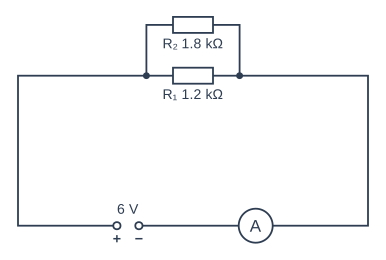
Figure 1 shows two resistors, R₁ and R₂, connected in parallel to a 6 V supply. R₁ is 1.2 kΩ and R₂ is 1.8 kΩ.

For resistors in parallel: 1/Rt = 1/R₁ + 1/R₂

Calculate the current shown on the ammeter. Give your answer in mA to two decimal places.

Circuit diagram. Going round the loop from the + terminal of the d.c. power supply (labelled 6 V): two branches in parallel (one branch has a resistor labelled R₁ 1.2 kΩ; the other branch has a resistor labelled R₂ 1.8 kΩ); then an ammeter; and back to the − terminal of the d.c. power supply.

Model answer

1/Rt = 1/1200 + 1/1800 = 0.0013889
Rt = 1 ÷ 0.0013889 = 720 Ω
I = V ÷ R = 6 ÷ 720 = 0.008333 A
0.008333 × 1000 = 8.33 mA

Explanation

Use the given formula to find the combined resistance, remembering to take the reciprocal at the end: Rt = 720 Ω, which is less than either resistor, as it must be in parallel. Ohm's law then gives I = 6 ÷ 720 = 0.00833 A = 8.33 mA. Adding the resistors as if they were in series is the commonest error.

Mark scheme
  1. 1 mark

    1/Rt = 1/1200 + 1/1800 (= 0.00139); or a correct final answer of 8.33 mA with no working

    Accept working in kΩ (1/1.2 + 1/1.8) and the product-over-sum form Rt = (R₁ × R₂) ÷ (R₁ + R₂). An answer of 8.33 mA with no working scores 4 marks.

  2. 1 mark

    Rt = 720 Ω (0.72 kΩ)

    Leaving 1/Rt uninverted (0.00139 used as the resistance) loses this mark.

  3. 1 mark

    I = V ÷ R = 6 ÷ 720 (= 0.00833 A)

    Allow 6 ÷ their Rt. Accept 6 ÷ 0.72 = 8.33 with the resistance in kΩ (the answer is then in mA).

  4. 1 mark

    8.33 mA (accept 8.3 mA)

    Allow ECF from their Rt for an answer in mA. 0.00833 A not converted to mA scores 3 marks. Adding the resistors as if in series (3000 Ω, 2.00 mA) scores 2 marks (this mark and the previous one).

Ready to try the rest? Every answer you write is marked against the mark scheme, so you can see exactly where the marks are.

Study Helper Hints first, answers after you try

Stuck on this one? Ask for a hint and I’ll point you in the right direction, without giving the answer away. Once you’ve checked your answer, I’ll show you how the marks are awarded.