Practise 14 exam-style questions on Composite materials for AQA GCSE Engineering. Write your answer as you would in the exam and get it marked in seconds against the mark scheme, point by point, with the Study Helper on hand if you get stuck.
14 questions
1–8 marks each
Instant marking
No sign-up needed
14 questions, marked as you go
Sample questions with model answers
Here are 4 of the questions in this topic, each with a model answer, an explanation of why it earns the marks and the mark scheme an examiner would use.
Question 1
1 mark
The arms of a professional camera drone must be as light and as stiff as possible. Cost is not important.
Which composite is the most suitable for the arms?
Choose your answer.
A Carbon-fibre reinforced polymer (CFRP)
B Glass reinforced plastic (GRP)
C Medium density fibreboard (MDF)
D Oriented strand board (OSB)
Model answer
A Carbon-fibre reinforced polymer (CFRP)
Explanation
CFRP has the best stiffness and strength for its weight of the composites listed, which is why it is used for drones, racing cars and aircraft. GRP is cheaper but heavier and less stiff. MDF and OSB are wood-based boards, far too heavy and weak for this use. CFRP is expensive, but the question says cost is not important.
Mark scheme
1 mark
A / Carbon-fibre reinforced polymer (CFRP)
Accept the letter or the option text. If more than one option is given, 0 marks.
Question 2
2 marks
A company that makes glass fibre composite body shells for kit cars changes the matrix it uses from polyester resin to epoxy resin.
Explain one way this change could affect the properties of the body shells.
Model answer
Epoxy resin bonds more strongly to the glass fibres than polyester resin does and is tougher. This means the load is passed between the fibres more effectively, so the body shells are stronger and less likely to crack in a minor impact, or they could be made thinner and lighter for the same strength.
Explanation
The matrix in which the reinforcement is placed affects a composite's properties, because the matrix holds the fibres in place and transfers the load between them. Epoxy generally gives stronger, tougher, more water-resistant composites than polyester, but it is more expensive. One mark is for the change in the matrix and one for its effect on the product.
Mark scheme
1 mark
Epoxy bonds more strongly to the glass fibres / is stronger / is tougher / absorbs less water / shrinks less as it cures
One valid difference in the matrix. Do not accept 'epoxy is better' on its own.
1 mark
So the body shell is stronger / tougher and less likely to crack on impact / can be made thinner and lighter for the same strength / lasts longer when wet / keeps a more accurate shape
A linked effect on the body shells. Ignore references to cost (cost is not a property), but do not penalise an answer that also says epoxy costs more.
Question 3
3 marks
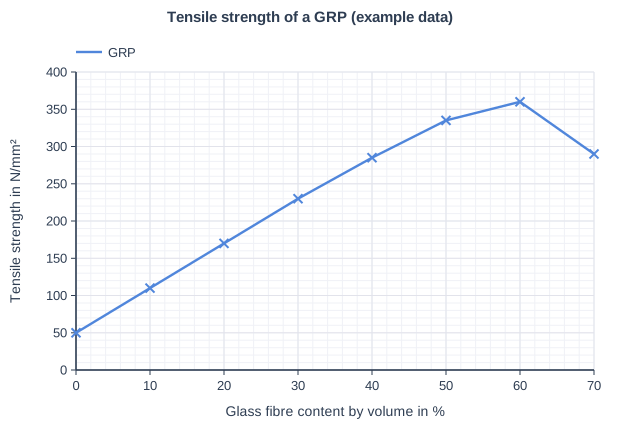
Figure 1 shows test results for a glass reinforced plastic (GRP). It shows how the tensile strength of the GRP changes as the amount of glass fibre in it is increased.
State the glass fibre content that gives the greatest tensile strength, and explain why the strength falls when even more glass fibre is added.
Model answer
The greatest tensile strength (360 N/mm²) is at 60% glass fibre. When more fibre is added, there is not enough resin to surround and bond to every fibre. The load can no longer be passed from fibre to fibre through the resin, and air gaps form between fibres that touch, so the GRP becomes weaker.
Explanation
The amount of reinforcement changes a composite's properties. Adding fibre increases the strength at first, because the fibres are much stronger than the resin, but the fibres only work if the matrix binds them together and passes the load between them. Too little resin leaves dry, poorly bonded fibres, so the strength falls.
Mark scheme
1 mark
60% (glass fibre by volume)
Accept 60. Do not accept 70%.
1 mark
Above this there is not enough resin (matrix) to surround / bond to / wet out all the fibres
Must refer to too little resin or matrix for the amount of fibre.
1 mark
So the load cannot be transferred between the fibres / air gaps (voids) form / the fibres touch and rub against each other, so the composite is weaker
A linked consequence of having too little matrix.
Question 4
6 marks
Plywood, medium density fibreboard (MDF) and oriented strand board (OSB) are all composites made from wood.
Explain how the way each board is made gives it its properties, and give a suitable use for each board.
Model answer
Plywood is made from an odd number of thin veneers glued together with the grain of each layer at right angles to the next. Because the grain runs both ways, plywood is strong in both directions, does not split easily along the grain and is less likely to warp than solid wood. Exterior grades use waterproof glue, so plywood is used for boat building, van linings and concrete formwork.
MDF is made by breaking wood down into fine fibres, mixing them with resin and pressing them into sheets under heat. The fibres are evenly spread with no grain, so MDF has the same properties in every direction and a very smooth surface that takes paint well and can be routed with crisp edges. However, it swells if it gets wet and screws hold poorly in its edges, so it suits indoor uses such as painted kitchen doors and furniture.
OSB is made from large strands of wood laid in layers, with the outer layers lined up lengthways and the inner layers across, bonded with waterproof resin under heat and pressure. The aligned strands make it strong and stiff for its low cost, and it can be made from small, fast-growing trees. Its surface is rough, so it is used where it will not be seen, such as roof decking and wall sheathing in timber-framed houses.
Explanation
Level 3 needs all three boards, each with how it is made, how that gives its properties and a suitable use. The key ideas are cross-grained layers (plywood), fine fibres with no grain (MDF) and aligned strands in cross layers (OSB). Lists of uses or properties without the link to how the board is made stay at Level 1 or 2.
Mark scheme
6 marks
Levels of response (6 marks). Level 3 (5-6 marks): Detailed explanation of how the structure of all three boards gives their properties, with a suitable use for each. The answer is clear and logically organised. Level 2 (3-4 marks): Two boards explained in detail, OR all three boards covered but with limited explanation of how the way they are made gives their properties. Level 1 (1-2 marks): Basic statements about one or more boards, such as a property or a use listed with little or no explanation. 0 marks: No response or nothing worthy of credit.
Max 4 if only two boards are covered. Max 2 if only one board is covered. Indicative content (accept all other valid responses): Plywood: an odd number of thin wood veneers (plies) glued with the grain of each layer at 90° to the next, so it is strong in both directions, resists splitting at the edges and is stable (warps less than solid wood); exterior and marine grades use waterproof glue. Uses: boat building, van linings, flooring, furniture, concrete formwork. MDF: wood fibres mixed with resin and wax and pressed under heat, so it is uniform with no grain, has the same properties in every direction, a very smooth surface that paints well and machines or routs with clean edges; but it swells if it gets wet and screws hold poorly in its edges. Uses: indoor furniture, kitchen and wardrobe doors, display units, speaker cabinets. OSB: large strands of wood aligned in cross layers and bonded with waterproof resin under heat and pressure, so it is strong and stiff for its cost and has some moisture resistance; it is cheap because it uses small, fast-grown trees; the surface is rough. Uses: roof decking, wall sheathing in timber-framed houses, floors, site hoarding.
Ready to try the rest? Every answer you write is marked against the mark scheme, so you can see exactly where the marks are.
Ctrl + Enter to check
Study HelperHints first, answers after you try
Stuck on this one? Ask for a hint and I’ll point you in the right direction, without giving the answer away. Once you’ve checked your answer, I’ll show you how the marks are awarded.