
Level:
Correct: 0
Incorrect: 0
Marks: 0/0
Exam Practice
Course:
Topics:
AQA GCSE Engineering Smart practice A mixed round aimed at your weak spots
Unit 1
Engineering materials
Unit 2
Engineering manufacturing processes
Additive manufacturing
Material removal
Material removal
Casting and moulding
Joining and assembly
Heat and chemical treatment
Surface finishing
Surface finishing
Unit 3
Systems
Unit 4
Testing and investigation
Unit 5
The impact of modern technologies
Unit 6
Practical engineering skills
Avg
score:
–
Topics
done:
0/32

Metals and alloys

Practise 16 exam-style questions on Metals and alloys for AQA GCSE Engineering. Write your answer as you would in the exam and get it marked in seconds against the mark scheme, point by point, with the Study Helper on hand if you get stuck.

  • 16 questions
  • 1–8 marks each
  • Instant marking
  • No sign-up needed
16 questions, marked as you go

Sample questions with model answers

Here are 4 of the questions in this topic, each with a model answer, an explanation of why it earns the marks and the mark scheme an examiner would use.

Question 1

1 mark

Stainless steel is made by adding other metals to steel.

Name one metal that is added to steel to make stainless steel.

Model answer

Chromium

Explanation

Stainless steel contains at least about 10.5% chromium, which forms a thin, invisible oxide layer on the surface that stops the steel rusting. Nickel is also added to many grades to improve toughness and corrosion resistance. Stainless steel is still a ferrous alloy because it is mostly iron.

Mark scheme
  1. 1 mark

    Chromium / nickel

    Also allow molybdenum. Do not accept carbon (not a metal and already in steel), iron, tin, zinc or aluminium.
Question 2

2 marks

A student heats a low carbon steel bracket until it is red hot and then quenches it in cold water, hoping to make it much harder. Afterwards the bracket is hardly any harder.

Explain why.

Model answer

Low carbon steel has less than about 0.3% carbon, which is not enough carbon for it to harden when it is quenched. Only steels with more carbon, about 0.4% or more, can be hardened in this way. To harden the bracket's surface, carbon would first have to be added to it by case hardening.

Explanation

Hardening by heating and quenching depends on the carbon in the steel, so it works on medium and high carbon steels but has little effect on low carbon steel. Adding carbon to the surface of low carbon steel (case hardening) is a way round this: it gives a hard surface with a tough core.

Mark scheme
  1. 1 mark

    Low carbon steel contains too little carbon (less than about 0.3%)

    Must refer to the carbon content being too low. Do not accept 'the water was not cold enough' or 'it was not heated enough'.

  2. 1 mark

    A steel needs more carbon (about 0.4% or more, i.e. a medium or high carbon steel) to be hardened by heating and quenching / to harden the surface, carbon would first have to be added to it (case hardening)

    Accept either development: the carbon needed for hardening (about 0.3% to 0.4% or more, or 'a medium or high carbon steel'), or that adding carbon to the surface (case hardening / carburising) would allow the surface to be hardened. This mark needs more than the first mark: do not award it for only restating that there is not enough carbon.

Question 3

3 marks

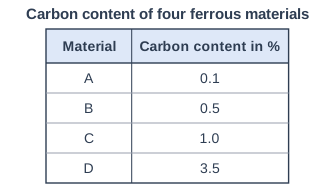
Figure 1 shows the carbon content of four ferrous materials, A, B, C and D.

Give the letter of the material that is most suitable for each of these products:

• a car door panel that is press formed from thin sheet
• a file for shaping metal
• the bed of a lathe, which is cast to shape.

Carbon content of four ferrous materials. Table with columns "Material", "Carbon content in %". Material: A; Carbon content in %: 0.1 | Material: B; Carbon content in %: 0.5 | Material: C; Carbon content in %: 1.0 | Material: D; Carbon content in %: 3.5.

Model answer

Car door panel: A
File: C
Lathe bed: D

Explanation

Adding carbon to iron makes it harder and stronger but less ductile. A (0.1% carbon) is low carbon steel, soft and malleable enough to press into panels. C (1.0%) is high carbon steel, which can be hardened for cutting tools such as files. D (3.5%) is cast iron, which melts at a lower temperature and casts well, and is rigid and absorbs vibration - ideal for a lathe bed. B is a medium carbon steel, which is not the best choice for any of these.

Mark scheme
  1. 1 mark

    Car door panel: A

    Low carbon steel is the most ductile and malleable, so it can be press formed without cracking.

  2. 1 mark

    File: C

    High carbon steel can be hardened so the teeth stay sharp. Do not accept B (medium carbon) or D (cast iron, too brittle).

  3. 1 mark

    Lathe bed: D

    Cast iron. The three answers are credited separately. Accept the material names (low carbon steel, high carbon steel, cast iron) if clearly matched to the products.

Question 4

4 marks

A car maker wants to reduce the mass of a bracket. The bracket is a solid plate measuring 150 mm × 80 mm × 20 mm.

It is made from low carbon steel, which has a density of 7.85 g/cm³. An aluminium alloy with a density of 2.70 g/cm³ is being considered for the same bracket.

Calculate the percentage reduction in mass if the bracket is made from the aluminium alloy instead of low carbon steel.

Show your working.

Model answer

Volume = 150 × 80 × 20 = 240 000 mm³ = 240 cm³
Steel bracket: 240 × 7.85 = 1884 g
Aluminium bracket: 240 × 2.70 = 648 g
Reduction = 1884 − 648 = 1236 g
Percentage reduction = 1236 ÷ 1884 × 100 = 65.6%

Explanation

Find both masses using mass = density × volume, then the percentage reduction = reduction ÷ original mass × 100. The most common error is dividing by the new (aluminium) mass instead of the original steel mass. Because the volume is the same, you could also compare the densities directly: (7.85 − 2.70) ÷ 7.85 × 100 = 65.6%.

Mark scheme
  1. 1 mark

    Volume = 150 × 80 × 20 = 240 000 mm³ = 240 cm³; or a correct final answer of 65.6% with no working

    An answer of 65.6% (accept 65.5% to 65.7%, or 66%) with no working scores 4 marks. A method using the densities only, (7.85 − 2.70) ÷ 7.85 × 100 = 65.6%, is valid and scores 4 marks. Allow error carried forward (ECF) throughout.

  2. 1 mark

    Masses: steel = 240 × 7.85 = 1884 g and aluminium = 240 × 2.70 = 648 g

    Both masses needed, using their volume. Accept the masses in kg (1.884 kg and 0.648 kg).

  3. 1 mark

    Reduction in mass = 1884 − 648 = 1236 g

    ECF from their masses.

  4. 1 mark

    Percentage reduction = 1236 ÷ 1884 × 100 = 65.6%

    Accept 65.5% to 65.7%, or 66%. Dividing by the aluminium mass (1236 ÷ 648 × 100 = 190.7%) loses this mark only. An answer of 34.4% (the aluminium mass as a percentage of the steel mass) scores the first two marks only.

Ready to try the rest? Every answer you write is marked against the mark scheme, so you can see exactly where the marks are.

Study Helper Hints first, answers after you try

Stuck on this one? Ask for a hint and I’ll point you in the right direction, without giving the answer away. Once you’ve checked your answer, I’ll show you how the marks are awarded.