Level:
Correct: 0
Incorrect: 0
Marks: 0/0
Practice
Course:
Topics:
Year 9 Maths Smart practice A mixed round aimed at your weak spots
Unit 1
Number: standard form, indices and accuracy
Unit 2
Percentages and money
Unit 3
Algebraic expressions and proof
Unit 4
Equations and inequalities
Unit 5
Graphs and sequences
Unit 6
Ratio, proportion and rates
Unit 7
Congruence, similarity and transformations
Unit 8
Pythagoras' theorem and trigonometry
Unit 9
3D shapes and measures
Unit 10
Probability
Unit 11
Statistics
Avg
score:
–
Topics
done:
0/46

Venn diagrams and set notation

Practise 22 questions on Venn diagrams and set notation for Year 9 Maths. Write your answer and get it marked in seconds against the mark scheme, point by point, with the Study Helper on hand if you get stuck.

  • 22 questions
  • 1–5 marks each
  • Instant marking
  • No sign-up needed
20 questions, marked as you go

Sample questions with model answers

Here are 4 of the questions in this topic, each with a model answer, an explanation of why it earns the marks and the mark scheme.

Question 1

1 mark

ξ = {cars in a car park}
E = {electric cars}
R = {red cars}

Write the set of cars that are electric but not red. Use set notation.

Model answer

Electric: E
Not red: \(R'\)
Both must be true: \(E \cap R'\)

Explanation

Split the description into parts. 'Electric' is E and 'not red' is \(R'\). A car must be in both, so join them with \(\cap\) (intersection). A common mistake is to use \(\cup\) (union), which would also include every car that is not red, whether it is electric or not.

Mark scheme
  1. 1 mark

    \(E \cap R'\)

    Accept \(R' \cap E\), and typed forms such as E n R' or E intersect R'. Do not accept \(E \cup R'\) (this also includes cars that are neither electric nor red), \(E' \cap R\) (red but not electric) or \(E \cap R\) (red electric cars).

Question 2

2 marks

ξ = {whole numbers from 20 to 32}
A = {even numbers}
B = {multiples of 5}

List the members of \((A \cup B)'\).

Model answer

A = {20, 22, 24, 26, 28, 30, 32}
B = {20, 25, 30}
\(A \cup B\) = {20, 22, 24, 25, 26, 28, 30, 32}
\((A \cup B)'\) = {21, 23, 27, 29, 31}

Explanation

First list A and B, then join them to make \(A \cup B\) (everything in A or B or both). \((A \cup B)'\) is every number from 20 to 32 that is left over: the odd numbers that are not multiples of 5. A common mistake is to give all the odd numbers, but 25 is a multiple of 5, so it is in B.

Mark scheme
  1. 1 mark

    \(A \cup B\) = {20, 22, 24, 25, 26, 28, 30, 32}, or A and B both listed correctly; or the correct answer 21, 23, 27, 29, 31 with no working

    A = {20, 22, 24, 26, 28, 30, 32} and B = {20, 25, 30}.

  2. 1 mark

    21, 23, 27, 29, 31

    All five numbers and no others, in any order, with or without brackets { }. Do not accept 21, 23, 25, 27, 29, 31 (this is \(A'\): 25 is in B) or the members of \(A \cup B\). A correct answer with no working scores full marks.

Question 3

2 marks

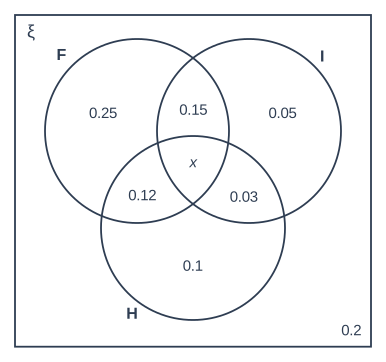
ξ = {books in a school library}
F = {fiction books}
I = {books with illustrations}
H = {hardback books}

One book is chosen at random. The Venn diagram shows the probability that this book is in each region.

Work out the probability that the book is a hardback.

A Venn diagram: a rectangle labelled ξ (the universal set) containing three overlapping circles labelled F, I and H, each overlapping the other two. The numbers written in each region are: F ∩ I′ ∩ H′ (in F only): 0.25; F′ ∩ I ∩ H′ (in I only): 0.05; F′ ∩ I′ ∩ H (in H only): 0.1; F ∩ I ∩ H′ (in F and I but not H): 0.15; F ∩ I′ ∩ H (in F and H but not I): 0.12; F′ ∩ I ∩ H (in I and H but not F): 0.03; F ∩ I ∩ H (in all three): x; F′ ∩ I′ ∩ H′ (outside all three circles): 0.2.

Model answer

The probabilities add up to 1.
\(0.25 + 0.05 + 0.1 + 0.15 + 0.12 + 0.03 + 0.2 = 0.9\), so \(x = 1 - 0.9 = 0.1\)
Hardback: \(0.1 + 0.12 + 0.03 + 0.1 = 0.35\)

Explanation

The eight regions cover every possibility, so their probabilities add up to 1. That gives \(x = 0.1\). A hardback book is anywhere inside circle H, so add the four probabilities inside that circle, including the middle one. A common mistake is to forget the middle region and give 0.25.

Mark scheme
  1. 1 mark

    \(x = 1 - 0.9\) or \(x = 0.1\); or the correct answer 0.35 with no working

    The eight probabilities add up to 1, and the seven numbers given add up to 0.9.

  2. 1 mark

    0.35

    From \(0.1 + 0.12 + 0.03 + 0.1\). Accept \(\dfrac{7}{20}\) (or any equivalent fraction) or 35%. A ratio (7 : 13) or words ('35 out of 100') do not score. Follow through \(0.25 +\) their \(x\). Do not accept 0.25 (missing the middle region) or 0.1 (hardback only). A correct answer with no working scores full marks.

Question 4

4 marks

A hockey team played 40 matches last season.

The team scored in the first half in 24 matches.
The team scored in the second half in 26 matches.
In 6 matches, the team did not score at all.

One of the 40 matches is chosen at random. Given that the team scored in the second half of this match, work out the probability that it also scored in the first half.

Model answer

Scored in at least one half: \(40 - 6 = 34\) matches
Scored in both halves: \(24 + 26 - 34 = 16\) matches
First half only: \(24 - 16 = 8\); second half only: \(26 - 16 = 10\)
The team scored in the second half in 26 matches, and in 16 of these it also scored in the first half.
Probability \(= \dfrac{16}{26} = \dfrac{8}{13}\)

Explanation

Think of a Venn diagram with a circle for each half. 34 matches are inside the circles, but \(24 + 26 = 50\), so 16 matches have been counted twice: these are in the overlap. 'Given that the team scored in the second half' means you choose only from those 26 matches, so 26 is the bottom of the fraction. A common mistake is to divide by 40, the number of all the matches.

Mark scheme
  1. 1 mark

    34 matches with a goal in at least one half (\(40 - 6\)), or \(24 + 26 + 6 - 40\) seen; or the correct answer \(\dfrac{8}{13}\) with no working

  2. 1 mark

    16 matches with a goal in both halves

    From \(24 + 26 - 34\). A Venn diagram (or a list) showing 8 (first half only), 16 (both), 10 (second half only) and 6 (neither) scores the first two marks.

  3. 1 mark

    Their number of matches with a goal in both halves over 26, for example \(\dfrac{16}{26}\)

    Follow through their number for both halves. 26 (the matches with a goal in the second half) must be the denominator.

  4. 1 mark

    \(\dfrac{16}{26}\) or \(\dfrac{8}{13}\)

    Accept any equivalent fraction, or 0.62 or 62% (or a more accurate decimal or percentage, such as 0.615 or 61.5%). Do not accept \(\dfrac{16}{40}\) (out of all the matches), \(\dfrac{16}{24}\) (given a goal in the first half), \(\dfrac{24}{26}\), a ratio (16 : 26) or words ('16 out of 26'). A correct answer with no working scores full marks.

Ready to try the rest? Every answer you write is marked against the mark scheme, so you can see exactly where the marks are.

Topic notes

Venn diagrams and set notation

The big idea

Set notation is a short way to describe groups of things and how they overlap. With a few symbols you can name any part of a Venn diagram, list its members, count them and find probabilities. In Year 9 you combine the symbols and work with three sets.

Reminder from Year 8: \(A \cap B\) (the intersection) is the overlap; \(A \cup B\) (the union) is in A or B or both; \(A'\) (the complement) is everything not in A.

The symbols

SymbolMeaningExample
\(\xi\)the universal set: everything you are choosing from\(\xi\) = {whole numbers from 1 to 20}
\(\in\)"is a member of"\(7 \in\) {odd numbers}
\(A \cap B\)in A and in Bthe overlap of the circles
\(A \cup B\)in A or B or botheverything inside the two circles
\(A'\)not in Aeverything outside circle A

Combining the symbols

Read a combined set one piece at a time, working from the inside of any brackets outwards.

  • \(A \cap B'\): in A but not in B ("A only").
  • \(A' \cup B\): not in A, or in B, or both. That is everything except "A only".
  • \((A \cup B)'\): in neither A nor B, so outside both circles. This is the same set as \(A' \cap B'\).
  • \((A \cap B)'\): not in both, so everything except the overlap.
A Venn diagram: a rectangle labelled ξ containing two overlapping circles, R and S. Inside R but outside S: Jan, Feb, Mar, Oct and Dec. In the overlap of R and S: Apr, Sep and Nov. Inside S but outside R: Jun. Outside both circles: May, Jul and Aug.
ξ = {months of the year}, R = {months with the letter r in their name} and S = {months with 30 days}.

Use the Venn diagram of the months to list the members of \(R \cap S\), \(S \cap R'\) and \((R \cup S)'\). Is it true that June \(\in R\)?

\(R \cap S\) is the overlap: {April, September, November}

\(S \cap R'\) is in S but outside R: {June}

\(R \cup S\) is everything inside the circles, so \((R \cup S)'\) is everything outside them: {May, July, August}

June has no r in its name, so June is not a member of R. "June \(\in R\)" is false.

Three sets

Three circles make 8 regions: three for one set only, three for exactly two sets, one in the middle for all three, and one outside. To count a set, add all four regions inside its circle.

If you are told how many are in each overlap, fill in the middle region first. Take it away from each overlap to get the regions for exactly two sets: if 7 pupils have a cat and a dog, and 1 has all three pets, write \(7 - 1 = 6\) for cat and dog only. Then work out the "only" regions. A missing region comes from the total: all 8 regions add up to the number in \(\xi\).

Probabilities from a Venn diagram

When one member of \(\xi\) is chosen at random, the probability of a set is the number in its regions divided by the number in \(\xi\).

A Venn diagram: a rectangle labelled ξ containing three overlapping circles, C, D and F. The numbers in the regions are: C only 9, D only 14, F only 4, C and D but not F 6, C and F but not D 2, D and F but not C 3, all three circles 1, and outside all three circles 21.
ξ = {a group of 60 pupils}, C = {pupils with a cat}, D = {pupils with a dog} and F = {pupils with fish}.

Use the pets diagram. How many pupils have a dog? One pupil is chosen at random. Find \(P(C \cap D')\).

Check the total first: \(9 + 14 + 4 + 6 + 2 + 3 + 1 + 21 = 60\)

Dog: add all four regions inside circle D: \(14 + 6 + 3 + 1 = 24\) pupils.

\(C \cap D'\) means a cat but not a dog: the regions inside C and outside D, \(9 + 2 = 11\) pupils.

\(P(C \cap D') = \dfrac{11}{60}\)

Stretch: "given that"

"Given that" tells you which group the choice is made from. Only that group counts, so its total goes on the bottom of the fraction, not the number in \(\xi\).

A pupil is picked at random from the 60. Given that this pupil has no cat, find the probability that they have fish.

No cat is \(C'\): every region outside circle C, \(14 + 4 + 3 + 21 = 42\) pupils.

Of these 42 pupils, the ones inside circle F: \(4 + 3 = 7\) pupils.

Probability \(= \dfrac{7}{42} = \dfrac{1}{6}\)

Remember

  • \(\xi\) is everything you are choosing from, and \(\in\) means "is a member of".
  • \(\cap\) means "and", \(\cup\) means "or (or both)" and a dash means "not".
  • To count a set, add every region inside its circle, overlaps included.
  • The regions add up to the number in \(\xi\) (or to 1 when they show probabilities).

Common mistakes

  • Using only the "only" part of a circle: 24 pupils have a dog, not just the 14 in D only.
  • Mixing up \(\cap\) and \(\cup\): \(A \cap B\) is only the overlap, but \(A \cup B\) is everything in either circle.
  • Thinking \(A'\) is only the region outside both circles. It includes "B only" too.
  • Sharing out a dash: \((A \cap B)'\) is everything except the overlap, which is not \(A' \cap B'\).
  • With three sets, writing the number in both A and B straight into the region for A and B only. Take off the middle region first.

Top tip

For a combined set, make a quick sketch of the Venn diagram and tick each region that fits, one symbol at a time. Then add the numbers in the ticked regions.

Study Helper Hints first, answers after you try

Stuck on this one? Ask for a hint and I’ll point you in the right direction, without giving the answer away. Once you’ve checked your answer, I’ll show you how the marks are awarded.