Practise 22 questions on Composite solids and problem solving for Year 9 Maths. Write your answer and get it marked in seconds against the mark scheme, point by point, with the Study Helper on hand if you get stuck.
22 questions
1–5 marks each
Instant marking
No sign-up needed
20 questions, marked as you go
Sample questions with model answers
Here are 4 of the questions in this topic, each with a model answer, an explanation of why it earns the marks and the mark scheme.
Question 1
1 mark
A tower is made from 5 identical cubes stacked one on top of another. The total volume of the tower is 40 cm³.
How tall is the tower?
Model answer
Volume of one cube: \(40 \div 5 = 8\) cm³ Edge of one cube: \(2 \times 2 \times 2 = 8\), so 2 cm Height of the tower: \(5 \times 2 = 10\) cm
Explanation
Share the volume between the 5 cubes: each cube is 8 cm³. A cube of volume 8 cm³ has edges of 2 cm, because \(2^3 = 8\). Five cubes on top of each other make a tower \(5 \times 2 = 10\) cm tall. A common mistake is to give the volume of one cube as the height.
Mark scheme
1 mark
10 (cm)
Each cube is \(40 \div 5 = 8\) cm³, so its edge is 2 cm, and \(5 \times 2 = 10\). Do not accept 8 (the volume of one cube) or 40. A correct answer with no working scores full marks.
Question 2
2 marks
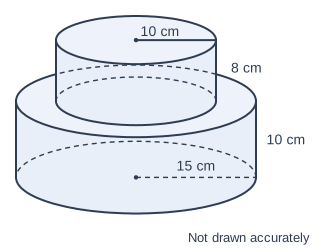
The diagram shows a cake with two layers. Each layer is a cylinder.
The bottom layer has radius 15 cm and height 10 cm. The top layer has radius 10 cm and height 8 cm.
Work out the total volume of the cake. Give your answer in terms of \(\pi\).
Each layer is a cylinder, so its volume is \(\pi r^2 h\). Keep \(\pi\) as a letter and add the two volumes like terms: \(2250\pi + 800\pi = 3050\pi\) cm³. Leaving the answer in terms of \(\pi\) keeps it exact. A common mistake is to forget to square the radius.
Mark scheme
1 mark
One layer correct: \(\pi \times 15^2 \times 10 = 2250\pi\) or \(\pi \times 10^2 \times 8 = 800\pi\); or the correct answer \(3050\pi\) cm³ with no working
1 mark
\(3050\pi\) (cm³)
Accept 3050π however π is typed (3050pi). The question asks for an answer in terms of π, so 9581.8... (or 9582) scores the first mark only. Do not accept \(230\pi\) (the radii not squared). A correct answer with no working scores full marks.
Question 3
3 marks
You may use a calculator.
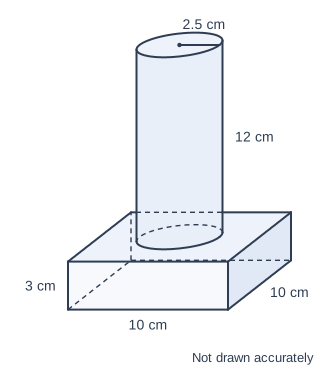
The diagram shows a trophy. It is made from a cuboid with a cylinder standing on it.
The cuboid is 10 cm long, 10 cm wide and 3 cm high. The cylinder has radius 2.5 cm and height 12 cm.
Work out the volume of the trophy. Give your answer correct to 1 decimal place.
Split the trophy into the parts you know: a cuboid and a cylinder. Work out each volume and add them. Use the \(\pi\) button and keep all the digits until the last step, then round to 1 decimal place. A common mistake is to use the diameter, 5 cm, in place of the radius.
Mark scheme
1 mark
Volume of the cuboid \(10 \times 10 \times 3 = 300\) (cm³); or the correct answer 535.6 cm³ with no working
Max 2 if the answer is not given correct to 1 decimal place.
1 mark
Volume of the cylinder \(\pi \times 2.5^2 \times 12\) (= 235.6...) (cm³)
Accept \(75\pi\).
1 mark
535.6 (cm³)
Accept [535.55, 535.65] given to 1 decimal place, i.e. 535.6. The unrounded value 535.619... scores the first two marks only; using \(\pi = 3.14\) gives 535.5, which also scores the first two marks. Do not accept 1242.5 (the diameter used as the radius) or 394.2 (the radius not squared). A correct answer with no working scores full marks.
Question 4
4 marks
You may use a calculator.
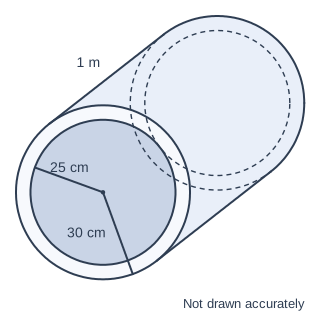
The diagram shows a concrete pipe. The pipe is a hollow cylinder 1 m long. Its outer radius is 30 cm and its inner radius is 25 cm.
The concrete has a density of 2.4 g/cm³.
Work out the mass of the pipe in kilograms. Give your answer correct to 3 significant figures.
Model answer
Area of the end: \(\pi \times 30^2 - \pi \times 25^2 = 900\pi - 625\pi = 275\pi\) cm² Volume: \(275\pi \times 100 = 27{,}500\pi = 86{,}393.79...\) cm³ Mass: \(86{,}393.79... \times 2.4 = 207{,}345.1...\) g \(207{,}345.1... \div 1000 = 207.345...\) kg The mass is 207 kg (3 s.f.).
Explanation
The concrete is the big cylinder with the small cylinder of the hole taken away. Change the length to 100 cm so that all the lengths are in centimetres, which matches the density in g/cm³. Then mass = volume × density, and divide by 1000 to change grams to kilograms. A common mistake is to subtract the radii before squaring.
Mark scheme
1 mark
Area of the end of the pipe \(\pi \times 30^2 - \pi \times 25^2\) (= \(275\pi\) or 863.9...) (cm²), or the volume of one whole cylinder, e.g. \(\pi \times 30^2 \times 100\); or the correct answer 207 kg with no working
Max 3 if the answer is not given correct to 3 significant figures.
1 mark
Volume of concrete \(275\pi \times 100 = 27500\pi\) or 86,393.7... (cm³)
The length 1 m must be used as 100 cm.
1 mark
Mass \(86393.7... \times 2.4 = 207345\)... (g)
Follow through: their volume × 2.4.
1 mark
207 (kg)
Accept [206.5, 207.5] given to 3 significant figures, i.e. 207. The unrounded value 207.345... scores the first three marks only. Follow through: their mass in grams ÷ 1000, given to 3 significant figures. Do not accept 18.8 (from \(\pi \times 5^2 \times 100 \times 2.4\), the radii subtracted before squaring) or 2.07 (the length used as 1 cm instead of 100 cm). A correct answer with no working scores full marks.
Ready to try the rest? Every answer you write is marked against the mark scheme, so you can see exactly where the marks are.
Ctrl + Enter to check
Study HelperHints first, answers after you try
Stuck on this one? Ask for a hint and I’ll point you in the right direction, without giving the answer away. Once you’ve checked your answer, I’ll show you how the marks are awarded.