Level:
Correct: 0
Incorrect: 0
Marks: 0/0
Practice
Course:
Topics:
Year 9 Maths Smart practice A mixed round aimed at your weak spots
Unit 1
Number: standard form, indices and accuracy
Unit 2
Percentages and money
Unit 3
Algebraic expressions and proof
Unit 4
Equations and inequalities
Unit 5
Graphs and sequences
Unit 6
Ratio, proportion and rates
Unit 7
Congruence, similarity and transformations
Unit 8
Pythagoras' theorem and trigonometry
Unit 9
3D shapes and measures
Unit 10
Probability
Unit 11
Statistics
Avg
score:
–
Topics
done:
0/46

Bearings and scale drawings

Practise 22 questions on Bearings and scale drawings for Year 9 Maths. Write your answer and get it marked in seconds against the mark scheme, point by point, with the Study Helper on hand if you get stuck.

  • 22 questions
  • 1–5 marks each
  • Instant marking
  • No sign-up needed
20 questions, marked as you go

Sample questions with model answers

Here are 4 of the questions in this topic, each with a model answer, an explanation of why it earns the marks and the mark scheme.

Question 1

1 mark

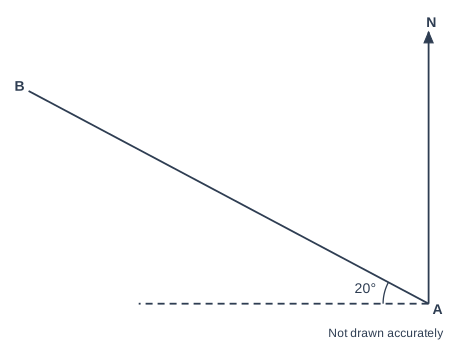
The diagram shows the positions of two points, A and B. The arrow AN points north, and the dashed line from A points due west.

What is the bearing of B from A?

Choose your answer.

  • 070°
  • 110°
  • 250°
  • 290°
Geometry diagram, marked "Not drawn accurately". Line segment AN is drawn. A dashed line is drawn from A going to the left. Line segment AB is drawn. AN has an arrow pointing from A to N. The angle at A between the line going to the left from A and AB is marked 20°.

Model answer

Turning clockwise from north to due west is \(270^\circ\).
B is a further \(20^\circ\) round, towards north.
\(270 + 20 = 290\)
The bearing of B from A is \(290^\circ\).

Explanation

Bearings are measured clockwise from north. Due west is three quarters of a turn, \(270^\circ\), and AB is \(20^\circ\) further round, between west and north. So the bearing is \(270 + 20 = 290^\circ\). A common mistake is to subtract the \(20^\circ\) and get \(250^\circ\), which points below the west line instead of above it.

Mark scheme
  1. 1 mark

    290°

    Do not accept any other option. Turning clockwise from north to due west is \(270^\circ\), and B is a further \(20^\circ\) round: \(270 + 20 = 290^\circ\). 250° comes from \(270 - 20\); 110° and 070° come from \(90 + 20\) and \(90 - 20\) (using east instead of west).

Question 2

2 marks

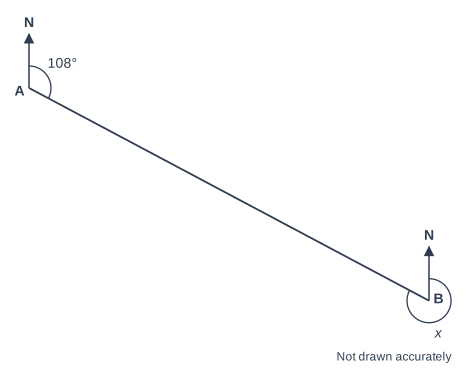
A helicopter flies from its base A to a hospital B on a bearing of \(108^\circ\), as the diagram shows. It then flies straight back to its base.

Work out the bearing of the return flight, marked \(x\).

Geometry diagram, marked "Not drawn accurately". Line segment AB is drawn. A north line (an arrow pointing straight up, labelled N) is drawn at A. At A, the angle measured clockwise from north round to AB is marked 108° (the bearing of B from A). A north line (an arrow pointing straight up, labelled N) is drawn at B. At B, the angle measured clockwise from north round to BA is marked x (the bearing of A from B).

Model answer

The north lines at A and B are parallel.
A is in the opposite direction from B, so add \(180^\circ\).
\(108 + 180 = 288\)
\(x = 288^\circ\)

Explanation

The north lines at A and B are parallel, and A is in exactly the opposite direction from B as B is from A. Opposite directions differ by \(180^\circ\), so add \(180^\circ\): \(108 + 180 = 288^\circ\). You can also use co-interior angles: the angle at B between north and BA is \(180 - 108 = 72^\circ\), so the bearing is \(360 - 72 = 288^\circ\). A common mistake is to work out \(360 - 108\).

Mark scheme
  1. 1 mark

    \(108 + 180\) seen; or the correct answer \(x = 288^\circ\) with no working

    Or the angle between the north line at B and BA, \(180 - 108 = 72^\circ\) (co-interior angles), then \(360 - 72\).

  2. 1 mark

    \(x = 288^\circ\)

    Accept 288. Do not accept \(252^\circ\) (\(360 - 108\)) or \(072^\circ\). A correct answer with no working scores full marks.

Question 3

2 marks

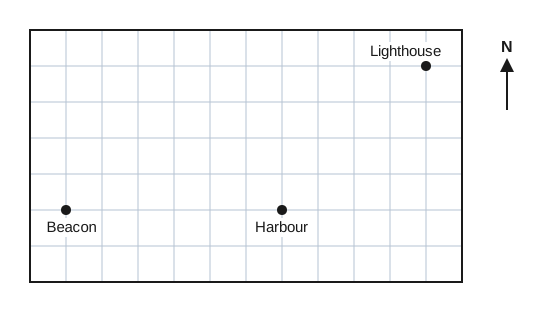
The map shows a harbour, a lighthouse and a beacon on a square grid. North is straight up the page.
Each square is 1 cm on the map, and the scale of the map is 1 cm represents 250 m.

Write the bearing of the lighthouse from the harbour.
Work out the real distance from the harbour to the beacon.

A map on a square grid, 12 squares across and 7 squares down, with a north arrow beside it pointing straight up the page. Three places are marked with dots where grid lines cross, counting from the left edge and down from the top edge: the Harbour is 7 squares from the left and 5 squares down; the Lighthouse is 11 squares from the left and 1 square down; the Beacon is 1 square from the left and 5 squares down.

Model answer

The lighthouse is 4 squares right and 4 squares up from the harbour, so it is exactly north-east: \(045^\circ\).
The beacon is 6 squares to the left of the harbour: 6 cm on the map.
\(6 \times 250 = 1500\) m = 1.5 km

Explanation

Equal numbers of squares across and up mean the lighthouse is on a diagonal, exactly north-east of the harbour, which is \(045^\circ\). For the distance, count the squares along the grid line: 6 squares is 6 cm, and each centimetre stands for 250 m, so the beacon is 1500 m, or 1.5 km, from the harbour. A common mistake is to count the grid lines instead of the gaps between them.

Mark scheme
  1. 1 mark

    \(045^\circ\) (a correct answer with no working scores this mark)

    Accept 045 or 45. The lighthouse is 4 squares east and 4 squares north of the harbour, so it is exactly north-east. Do not accept \(225^\circ\).

  2. 1 mark

    1.5 km or 1500 m

    6 squares is 6 cm, and \(6 \times 250 = 1500\) m. The distance is read from the grid, so accept any value from 1375 m to 1625 m (1.375 km to 1.625 km), which is 6 squares plus or minus half a square. Do not accept 6 km, 0.15 km or 1750 m (counting 7 squares). A correct answer with no working scores full marks.

Question 4

4 marks

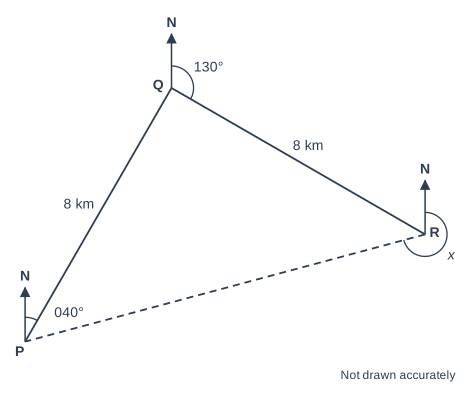
A ship sails 8 km from a port P to a buoy Q, on a bearing of \(040^\circ\).
It then sails 8 km from Q to a rock R, on a bearing of \(130^\circ\).

Work out the bearing of P from R, marked \(x\) in the diagram.

Geometry diagram, marked "Not drawn accurately". Line segments PQ and QR are drawn. Dashed line segment RP is drawn. PQ is labelled 8 km. QR is labelled 8 km. A north line (an arrow pointing straight up, labelled N) is drawn at P. At P, the angle measured clockwise from north round to PQ is marked 040° (the bearing of Q from P). A north line (an arrow pointing straight up, labelled N) is drawn at Q. At Q, the angle measured clockwise from north round to QR is marked 130° (the bearing of R from Q). A north line (an arrow pointing straight up, labelled N) is drawn at R. At R, the angle measured clockwise from north round to RP is marked x (the bearing of P from R).

Model answer

Bearing of P from Q \(= 40 + 180 = 220^\circ\)
Angle PQR \(= 220 - 130 = 90^\circ\)
PQ = QR, so triangle PQR is isosceles: angle QPR \(= (180 - 90) \div 2 = 45^\circ\)
Bearing of R from P \(= 40 + 45 = 85^\circ\)
Bearing of P from R \(= 85 + 180 = 265^\circ\)
\(x = 265^\circ\)

Explanation

Find the angle inside the triangle at Q first. From Q, P is on the bearing back from \(040^\circ\), which is \(220^\circ\), and R is on \(130^\circ\), so angle PQR is \(220 - 130 = 90^\circ\). Both legs are 8 km, so the triangle is isosceles and the other two angles are \(45^\circ\) each. That gives the bearing of R from P, \(40 + 45 = 085^\circ\), and the bearing back from R is \(265^\circ\). A common mistake is to stop at \(085^\circ\), which is the bearing of R from P, not of P from R.

Mark scheme
  1. 1 mark

    Angle PQR \(= 90^\circ\), e.g. bearing of P from Q \(= 40 + 180 = 220^\circ\) and \(220 - 130 = 90\); or the correct answer \(x = 265^\circ\) with no working

    Or \(360 - 140 - 130 = 90\), using the co-interior angle \(180 - 40 = 140^\circ\) between north and QP. Any correct method for the angle at Q.

  2. 1 mark

    Angle QPR or angle QRP \(= (180 - 90) \div 2 = 45^\circ\), because triangle PQR is isosceles (PQ = QR)

    Follow through their angle PQR.

  3. 1 mark

    Bearing of R from P \(= 40 + 45 = 085^\circ\); or bearing of Q from R \(= 130 + 180 = 310^\circ\) and \(310 - 45\)

    Follow through their base angle.

  4. 1 mark

    \(x = 265^\circ\)

    Accept 265. Do not accept \(085^\circ\) (the bearing of R from P) or \(310^\circ\) (the bearing of Q from R). A correct answer with no working scores full marks.

Ready to try the rest? Every answer you write is marked against the mark scheme, so you can see exactly where the marks are.

Topic notes

Bearings and scale drawings

The big idea

A bearing gives a direction as an angle: "065°" is far more exact than "roughly north-east". Together with a distance from a scale drawing or map, a bearing pins down exactly where a place is.

Reminder from Year 7: a map scale of \(1 : 50{,}000\) means 1 cm on the map stands for 50,000 cm (500 m) in real life.

Three-figure bearings

Three rules:

  1. Start facing north.
  2. Turn clockwise.
  3. Write the angle with three figures: 7° is written 007°, and 52° is written 052°.

"The bearing of B from A" means: stand at A, face north and turn clockwise until you face B. The word "from" tells you where the north line goes.

DirectionNNEESESSWWNW
Bearing000°045°090°135°180°225°270°315°

A drone pilot is given four directions: due east, north-west, 8° clockwise from north, and 15° anticlockwise from north. Write each one as a three-figure bearing.

Due east is a quarter turn clockwise: 090°.

North-west is halfway between west (270°) and north (360°): \(270 + 45 = 315^\circ\).

8° clockwise from north: 008°.

15° anticlockwise from north is 15° short of a full turn: \(360 - 15 = 345^\circ\).

The bearing back

North lines at different places are all parallel, so the parallel-line facts from Year 8 turn the bearing of B from A into the bearing of A from B, the back bearing.

Points A and B joined by a straight line, with B up and to the right of A. A north line, labelled N, goes straight up from each point, and the two north lines are marked as parallel. At A, the angle from north clockwise round to AB is marked 064°. At B, the angle between north and BA is marked 116°, and the reflex angle from north clockwise round to BA is marked 244°.
The north lines at A and B are parallel. The bearing of B from A is 064°. At B, the co-interior angle between north and BA is 116°, so the bearing of A from B is 244°.

The angle between north and BA at B is \(180 - 64 = 116^\circ\) (co-interior angles add up to 180°). It is measured anticlockwise, so the bearing of A from B is \(360 - 116 = 244^\circ\), which is \(64 + 180\).

The quick rule: a back bearing differs by 180°. If the bearing is less than 180°, add 180°; if it is 180° or more, subtract 180°. So 318° gives \(318 - 180 = 138^\circ\).

Angles from bearings

Two bearings measured at the same point differ by the angle between the two directions (if the difference is over 180°, take it away from 360°). Bearings measured at different points need a back bearing or a parallel-line fact first.

Coastguard stations A and B are on a straight coast, with B due east of A. A kayak K is on a bearing of 050° from A and 320° from B. Work out angle AKB and the bearing of A from K.

Geometry diagram, marked "Diagram NOT accurately drawn". Line segments AB, AK and BK are drawn. A north line (an arrow pointing straight up, labelled N) is drawn at A. At A, the angle measured clockwise from north round to AK is marked 050° (the bearing of K from A). A north line (an arrow pointing straight up, labelled N) is drawn at B. At B, the angle measured clockwise from north round to BK is marked 320° (the bearing of K from B).
Station B is due east of station A. The kayak K is on a bearing of 050° from A and 320° from B.

B is due east of A, on a bearing of 090°, so angle KAB \(= 90 - 50 = 40^\circ\).

A is due west of B, on a bearing of 270°, so angle ABK \(= 320 - 270 = 50^\circ\).

Angle AKB \(= 180 - 40 - 50 = 90^\circ\) (angles in a triangle add up to 180°).

From K, A is on the back bearing of 050°: \(50 + 180 = 230^\circ\).

Check: from K, B is on a bearing of \(320 - 180 = 140^\circ\), and \(230 - 140 = 90^\circ\) ✓.

Scale drawings and maps

A scale drawing shrinks every length by the same scale but keeps every angle, so a bearing measured on a map is the real bearing.

  • Map to real life: multiply by the scale, then change the units.
  • Real life to map: change the length into centimetres, then divide by the scale.
  • A scale such as "1 cm represents 20 m" works the same way: 3.5 cm on a plan is \(3.5 \times 20 = 70\) m.

Remember that 1 m = 100 cm and 1 km = 100,000 cm.

A cycle-trail map has a scale of \(1 : 50{,}000\). A straight trail from a café to a viewpoint is 7.4 cm long on the map, on a bearing of 205°. Find the real length of the trail and the bearing back. How long is the trail on a \(1 : 100{,}000\) map?

Real length: \(7.4 \times 50{,}000 = 370{,}000\) cm. Then \(370{,}000 \div 100 = 3700\) m, which is 3.7 km.

Bearing back: 205° is over 180°, so subtract: \(205 - 180 = 25\), written 025°.

On the second map: \(370{,}000 \div 100{,}000 = 3.7\) cm. The bearing is still 205°: a new scale changes the lengths, not the angles.

Remember

  • Bearings are measured from north, clockwise, with three figures.
  • The north line goes at the point after "from".
  • A back bearing differs by 180°.
  • A scale changes lengths but never angles.

Common mistakes

  • Turning anticlockwise from north, or using the north line at the wrong point.
  • Writing 9° instead of 009°.
  • Taking the bearing away from 360° to get the bearing back: the bearing back from 115° is 295°, not 245°.
  • Adding 180° to a bearing over 180°: \(290 + 180 = 470\) is more than a full turn, so subtract to get 110°.
  • Calling the first answer metres: on a \(1 : 50{,}000\) map, 7.4 cm stands for 370,000 cm, not 370,000 m.

Top tip

Sketch a north line at the point after "from" first. Then check that your answer points the right way: a bearing between 090° and 180° points south-east, for example.

Study Helper Hints first, answers after you try

Stuck on this one? Ask for a hint and I’ll point you in the right direction, without giving the answer away. Once you’ve checked your answer, I’ll show you how the marks are awarded.