Level:
Correct: 0
Incorrect: 0
Marks: 0/0
Practice
Course:
Topics:
Year 9 Maths Smart practice A mixed round aimed at your weak spots
Unit 1
Number: standard form, indices and accuracy
Unit 2
Percentages and money
Unit 3
Algebraic expressions and proof
Unit 4
Equations and inequalities
Unit 5
Graphs and sequences
Unit 6
Ratio, proportion and rates
Unit 7
Congruence, similarity and transformations
Unit 8
Pythagoras' theorem and trigonometry
Unit 9
3D shapes and measures
Unit 10
Probability
Unit 11
Statistics
Avg
score:
–
Topics
done:
0/46

Repeated percentage change and compound interest

Practise 27 questions on Repeated percentage change and compound interest for Year 9 Maths. Write your answer and get it marked in seconds against the mark scheme, point by point, with the Study Helper on hand if you get stuck.

  • 27 questions
  • 1–5 marks each
  • Instant marking
  • No sign-up needed
20 questions, marked as you go

Sample questions with model answers

Here are 4 of the questions in this topic, each with a model answer, an explanation of why it earns the marks and the mark scheme.

Question 1

1 mark

Nia buys a bike for £450. Its value goes down by 20% each year.

Write an expression for the value of the bike, in pounds, after \(n\) years.

Model answer

Multiplier for a 20% decrease: 0.8
Value after \(n\) years \(= 450 \times 0.8^n\) pounds

Explanation

Losing 20% leaves 80% of the value, so each year the value is multiplied by 0.8. After \(n\) years it has been multiplied by 0.8 \(n\) times, which is \(0.8^n\). A common mistake is \(450 - 90n\): that takes off the same £90 every year, but 20% of a smaller value is less than £90.

Mark scheme
  1. 1 mark

    \(450 \times 0.8^n\)

    Accept any equivalent form, e.g. \(450(0.8)^n\) or \(450 \times \left(\dfrac{4}{5}\right)^n\). Do not accept \(450 \times 0.2^n\), \(450 \times 0.8n\), \(450 \times 0.8 \times n\) or \(450 - 90n\).

Question 2

2 marks

You may use a calculator.

A wildlife group counts 850 frogs in a nature reserve. The number of frogs increases by 12% each year.

If this rate of increase continues, how many frogs will there be after 5 years? Give your answer to the nearest whole number.

Model answer

Multiplier for a 12% increase: 1.12
\(850 \times 1.12^5 = 1497.99...\)
About 1498 frogs

Explanation

Each year the number of frogs is multiplied by 1.12, so after 5 years it is \(850 \times 1.12^5\). This is called growth. A common mistake is to add 12% five times, which is 60% of 850; but each year's 12% is of a bigger number, so the growth speeds up.

Mark scheme
  1. 1 mark

    \(850 \times 1.12^5\) or 1497.9...; or the correct answer 1498 with no working

  2. 1 mark

    1498 (frogs)

    Accept [1497.5, 1498.5] given to the nearest whole number, i.e. 1498. The unrounded value 1497.99... scores the first mark only. Do not accept 1360 (adding 60% of 850). A correct answer with no working scores full marks.

Question 3

3 marks

You may use a calculator.

Mohammed invests £6,000 for 3 years. The account pays 3.2% compound interest per year.

How much interest does he earn in the 3 years? Give your answer to the nearest penny.

Model answer

\(6000 \times 1.032^3 = 6000 \times 1.099104768 = 6594.628608\)
Interest: \(6594.628608 - 6000 = 594.628608\)
Mohammed earns £594.63 interest.

Explanation

First find the total after 3 years with the multiplier: \(6000 \times 1.032^3 = 6594.628...\). The interest is the part he has gained, so take away the £6,000 he put in. A common mistake is to stop at the total, £6,594.63; read the question again to check what it asks for.

Mark scheme
  1. 1 mark

    \(6000 \times 1.032^3\), or the values year by year (£6,192 and £6,390.14); or the correct answer £594.63 with no working

  2. 1 mark

    6594.628... or £6,594.63 (the total after 3 years)

  3. 1 mark

    £594.63

    Accept [594.625, 594.635] given to the nearest penny, i.e. £594.63. The unrounded value 594.628... scores the first two marks only. £6,594.63 as the final answer (the total, not the interest) scores the first two marks only. Do not accept £576 (simple interest). A correct answer with no working scores full marks.

Question 4

4 marks

You may use a calculator.

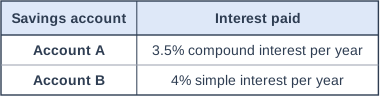
Chloe has £4,000 to save for 4 years. The table shows two savings accounts she could choose.

After 4 years, which account will give Chloe more money, and how much more? Give your answer to the nearest penny.

Table with columns "Savings account", "Interest paid". Savings account: Account A; Interest paid: 3.5% compound interest per year | Savings account: Account B; Interest paid: 4% simple interest per year.

Model answer

Account A: \(4000 \times 1.035^4 = 4590.092...\), so £4,590.09
Account B: interest \(= 4000 \times 0.04 \times 4 = 640\), so £4,640
Account B gives more, by \(4640 - 4590.09 = 49.91\), so £49.91.

Explanation

Compound interest grows faster than simple interest at the same rate, but here the simple interest rate is higher. Over 4 years the higher rate wins: Account B gives £640 interest and Account A gives £590.09. A common mistake is to choose Account A because compound interest sounds better, so always work out both totals. Over a much longer time Account A would catch up and overtake.

Mark scheme
  1. 1 mark

    Account A: \(4000 \times 1.035^4\); or the correct answer Account B, by £49.91, with no working

  2. 1 mark

    Account A total: £4,590.09 (or 4590.092...)

  3. 1 mark

    Account B total: £4,640, or its interest \(4000 \times 0.04 \times 4 = 640\)

  4. 1 mark

    Account B, by £49.91

    Accept [49.905, 49.915] given to the nearest penny, i.e. £49.91 (the same whether or not Account A's total is rounded first). The unrounded difference 49.907... scores the first three marks only. Needs the account and the difference. Do not accept Account A. A correct answer with no working scores full marks.

Ready to try the rest? Every answer you write is marked against the mark scheme, so you can see exactly where the marks are.

Topic notes

Repeated percentage change and compound interest

The big idea

When an amount changes by a percentage again and again, each change is a percentage of the amount at that time, not of the starting amount. So savings grow faster and faster, while a car loses less money each year as its value falls. A multiplier with a power does all the changes in one calculation.

Reminder from Year 8: an increase of 4% is \(\times 1.04\), and a decrease of 15% is \(\times 0.85\). Simple interest is the same every year, because it is always worked out on the starting amount.

Compound interest

With compound interest, the interest is added on at the end of each year, and the next year's interest is worked out on the new, bigger amount. You earn interest on your interest. A loan works the same way.

Sam borrows £1,500 at 8% compound interest per year and pays nothing back for 2 years. How much does Sam owe then? How much less would it be with 8% simple interest?

The multiplier is 1.08.

After 1 year: \(1500 \times 1.08 = 1620\), so £1,620 (£120 interest).

After 2 years: \(1620 \times 1.08 = 1749.60\), so £1,749.60 (£129.60 interest: 8% of £1,620).

Simple interest adds £120 each year: \(1500 + 2 \times 120 = 1740\), so £1,740.

Sam owes £1,749.60. With simple interest it would be \(1749.60 - 1740 = 9.60\) pounds less.

Multiplying by 1.08 twice is multiplying by \(1.08^2\): \(1500 \times 1.08^2 = 1749.60\). For any number of years, \(n\):

\[ \text{amount after } n \text{ years} = \text{starting amount} \times \text{multiplier}^{n} \]
Line graph of amount saved (£) (y-axis, 0 to 3000) against time (years) (x-axis, 0 to 20). "Simple interest" joins the points (0, 1000), (20, 2000). "Compound interest" is a smooth curve through (0, 1000), (2, 1102.5), (4, 1215.51), (6, 1340.1), (8, 1477.46), (10, 1628.89), (12, 1795.86), (14, 1979.93), (16, 2182.87), (18, 2406.62), (20, 2653.3).
£1,000 saved at 5% a year. Simple interest adds £50 every year, so its graph is a straight line. Compound interest grows faster each year: after 20 years the savings are £2,653.30, not £2,000.

Depreciation and growth

The same rule works for any repeated percentage change. Losing value each year is called depreciation (multiplier less than 1). A population going up by the same percentage each year shows growth (multiplier more than 1).

A sailing boat costs £18,500 when new. It loses 7% of its value each year. How much value has it lost after 5 years, to the nearest penny?

Use a calculator.

Losing 7% leaves 93%, so the multiplier is 0.93.

Value after 5 years \(= 18500 \times 0.93^5\)

Key in 18500 × 0.93, then the power key (\(x^{\square}\) or \(x^y\)), then 5, then =. The display shows 12870.2348...

Value lost: key in 18500 − Ans = to get 5629.7651..., so the boat has lost £5,629.77 to the nearest penny.

Changes in several stages

For different percentage changes, write a multiplier for each one and multiply them together. Never just add or subtract the percentages: each change is a percentage of a different amount. Up 50% then down 50% is \(1.5 \times 0.5 = 0.75\), so you end 25% lower, not back where you started.

A website's visitor numbers went up by 20% in March, then down by 25% in April. What was the overall percentage change?

Up 20% is \(\times 1.2\), and down 25% is \(\times 0.75\).

Overall multiplier: \(1.2 \times 0.75 = 0.9\)

0.9 is 90%, so the number of visitors fell by \(100\% - 90\% = 10\%\) overall.

It is not a 5% fall: the 25% is a percentage of the bigger number after the rise.

Stretch: how many years?

To find when an amount reaches a target, try numbers of years until you pass it. Show the year just before and the first year past the target.

Savings earn 6% compound interest each year. How many whole years does it take for them to more than double?

Use a calculator.

Doubling means the overall multiplier passes 2, whatever the starting amount, so find the first \(n\) that makes \(1.06^n\) more than 2. Key in 1.06, the power key, the number of years, then =.

\(1.06^{10} = 1.79...\), \(1.06^{11} = 1.89...\) and \(1.06^{12} = 2.01...\)

After 11 years the savings have not quite doubled; after 12 years they have. The answer is 12 years.

Remember

  • Amount after \(n\) years = starting amount × \(\text{multiplier}^n\).
  • Compound interest grows faster than simple interest, because you earn interest on interest.
  • For several different changes, multiply the multipliers.

Common mistakes

  • Multiplying by the number of years: \(2000 \times 1.04 \times 3\) more than triples the money; you need \(2000 \times 1.04^3\).
  • Adding the percentages: 10% growth for 3 years is \(1.1^3 = 1.331\), an increase of 33.1%, not 30%.
  • Using the wrong multiplier: 4% a year is \(\times 1.04\), not \(\times 0.04\) (the rate) or \(\times 1.4\) (a 40% rise).
  • Giving the total when the question asks for the interest: interest = total − starting amount.
  • Rounding each year's amount: keep the full calculator value and round only at the end.

Top tip

Check the direction first: growth needs a multiplier more than 1, depreciation one less than 1. An answer on the wrong side of the starting amount means the multiplier is wrong.

Study Helper Hints first, answers after you try

Stuck on this one? Ask for a hint and I’ll point you in the right direction, without giving the answer away. Once you’ve checked your answer, I’ll show you how the marks are awarded.