Level:
Correct: 0
Incorrect: 0
Marks: 0/0
Practice
Course:
Topics:
Year 9 Maths Smart practice A mixed round aimed at your weak spots
Unit 1
Number: standard form, indices and accuracy
Unit 2
Percentages and money
Unit 3
Algebraic expressions and proof
Unit 4
Equations and inequalities
Unit 5
Graphs and sequences
Unit 6
Ratio, proportion and rates
Unit 7
Congruence, similarity and transformations
Unit 8
Pythagoras' theorem and trigonometry
Unit 9
3D shapes and measures
Unit 10
Probability
Unit 11
Statistics
Avg
score:
–
Topics
done:
0/46

Similar shapes

Practise 27 questions on Similar shapes for Year 9 Maths. Write your answer and get it marked in seconds against the mark scheme, point by point, with the Study Helper on hand if you get stuck.

  • 27 questions
  • 1–5 marks each
  • Instant marking
  • No sign-up needed
20 questions, marked as you go

Sample questions with model answers

Here are 4 of the questions in this topic, each with a model answer, an explanation of why it earns the marks and the mark scheme.

Question 1

1 mark

The sides of triangle A are 6 cm, 8 cm and 9 cm.
Triangle B is similar to triangle A. Its sides, in the same order, are 9 cm, \(x\) cm and 13.5 cm.

What is the value of \(x\)?

Choose your answer.

  • 11
  • 12
  • 12.5
  • 16

Model answer

Scale factor \(= 9 \div 6 = 1.5\)
\(x = 8 \times 1.5 = 12\)

Explanation

In similar triangles every side is multiplied by the same scale factor. The first sides give \(9 \div 6 = 1.5\), and the last sides check it: \(9 \times 1.5 = 13.5\). So \(x = 8 \times 1.5 = 12\). A common mistake is to add the difference, 3 cm, to each side.

Mark scheme
  1. 1 mark

    12

    Do not accept any other option. The scale factor is \(9 \div 6 = 1.5\), and \(8 \times 1.5 = 12\). 11 adds 3 and 12.5 adds 4.5 (the differences between the other pairs of sides), and 16 doubles 8.

Question 2

2 marks

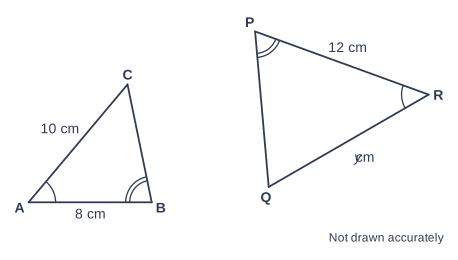
In the diagram, triangles ABC and PQR are similar, but triangle PQR has been turned round.
Angles with the same number of arcs are equal.

Work out the value of \(y\).

Geometry diagram, marked "Not drawn accurately". Triangle ABC. Triangle PQR. Side AB is labelled 8 cm. Side AC is labelled 10 cm. Side RP is labelled 12 cm. Side RQ is labelled y cm. Angle CAB and angle QRP are each marked with a single arc (equal angles). Angle ABC and angle RPQ are each marked with a double arc (equal angles).

Model answer

Angle A = angle R and angle B = angle P, so AB corresponds to RP and AC corresponds to RQ.
Scale factor \(= 12 \div 8 = 1.5\)
\(y = 10 \times 1.5 = 15\)

Explanation

Triangle PQR has been turned round, so use the arcs to match the vertices: A with R and B with P. Then side AB matches side RP, and side AC matches side RQ. The scale factor is \(12 \div 8 = 1.5\), so \(y = 10 \times 1.5 = 15\). A common mistake is to pair the sides by where they sit on the page.

Mark scheme
  1. 1 mark

    Matches AB with RP and finds the scale factor \(12 \div 8 = 1.5\); or the correct answer \(y = 15\) with no working

    Accept \(\dfrac{3}{2}\), or the method \(\dfrac{y}{10} = \dfrac{12}{8}\).

  2. 1 mark

    \(y = 15\)

    Accept 15. Do not accept 9.6 (from matching RP with AC: \(8 \times \dfrac{12}{10}\)) or 14 (adding 4). A correct answer with no working scores full marks.

Question 3

2 marks

Jade says, "Any two triangles that are both right-angled and isosceles must be similar."

Is Jade right? Explain how you know.

Model answer

Yes.
The right angle is \(90^\circ\), so the other two angles add up to \(180 - 90 = 90^\circ\).
The triangle is isosceles, so these two angles are equal: \(90 \div 2 = 45^\circ\) each.
Every right-angled isosceles triangle has angles \(90^\circ\), \(45^\circ\) and \(45^\circ\), so any two of them are similar.

Explanation

Triangles are similar when their angles are equal. In an isosceles triangle with a right angle, the right angle cannot be one of the two equal angles (two right angles would leave nothing for the third angle), so the other two angles are equal and share \(90^\circ\): they are \(45^\circ\) each. So all these triangles have the same three angles, whatever their size. A common mistake is to answer No because two such triangles can be different sizes, but similar shapes are allowed to be different sizes.

Mark scheme
  1. 1 mark

    Yes, with a relevant but incomplete reason, e.g. 'they always have the same angles' with no values, or 'the two equal angles are always the same size'

    'Yes' on its own scores 0.

  2. 1 mark

    A complete correct reason: in a right-angled isosceles triangle the two equal angles share \(180 - 90 = 90^\circ\), so they are \(45^\circ\) each; every such triangle has angles of \(90^\circ\), \(45^\circ\) and \(45^\circ\), so any two of them are similar

    The values \(90^\circ\), \(45^\circ\), \(45^\circ\) (or a clear reason why the equal angles must be \(45^\circ\)) are needed for this mark. A complete correct reason on its own scores both marks.

Question 4

4 marks

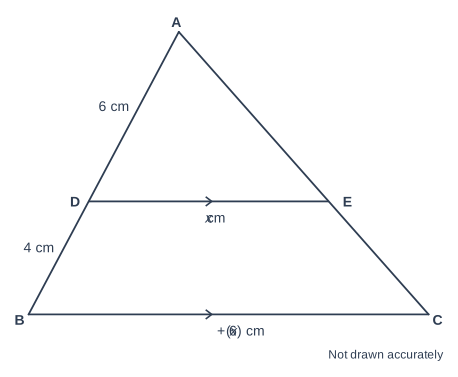
In the diagram, points D and E lie on the sides AB and AC of triangle ABC, and DE is parallel to BC.
AD = 6 cm, DB = 4 cm, DE = \(x\) cm and BC = \((x + 6)\) cm.

Work out the value of \(x\).

Geometry diagram, marked "Not drawn accurately". Triangle ABC. Line segment DE is drawn. D lies on side AB. E lies on side AC. Side AD is labelled 6 cm. Side DB is labelled 4 cm. DE is labelled x cm. Side BC is labelled (x + 6) cm. DE and BC are each marked with an arrowhead (parallel lines).

Model answer

Triangles ADE and ABC are similar, and AB = 6 + 4 = 10 cm.
\(\dfrac{x}{x + 6} = \dfrac{6}{10}\)
\(10x = 6(x + 6)\)
\(10x = 6x + 36\)
\(4x = 36\)
\(x = 9\)

Explanation

DE is parallel to BC, so triangle ADE is similar to triangle ABC, and DE : BC is the same as AD : AB. The whole side AB is 10 cm. Write the ratios of corresponding sides as an equation, multiply both sides by \(10(x + 6)\) and solve. Check: DE = 9 cm and BC = 15 cm, and \(\dfrac{9}{15} = \dfrac{6}{10}\). A common mistake is to use DB instead of AB.

Mark scheme
  1. 1 mark

    AB = 10 (cm) used as the side matching AD; or the correct answer \(x = 9\) with no working

  2. 1 mark

    A correct equation, e.g. \(\dfrac{x}{x + 6} = \dfrac{6}{10}\) or \(10x = 6(x + 6)\)

    Or a correct method without algebra, e.g. DE is \(\dfrac{6}{10} = \dfrac{3}{5}\) of BC, so the 6 cm difference is \(\dfrac{2}{5}\) of BC.

  3. 1 mark

    \(10x = 6x + 36\) or \(4x = 36\); or BC = 15

    Follow through their equation.

  4. 1 mark

    \(x = 9\)

    Accept DE = 9 cm. Do not accept 4 (from \(\dfrac{x}{x + 6} = \dfrac{4}{10}\), using DB instead of AD) or 15 (the length of BC). A correct answer with no working scores full marks.

Ready to try the rest? Every answer you write is marked against the mark scheme, so you can see exactly where the marks are.

Topic notes

Similar shapes

The big idea

Two shapes are similar when one is an enlargement of the other: the same shape, but possibly different sizes. Corresponding (matching) angles are equal, and corresponding sides are all in the same ratio, because every length is multiplied by the same scale factor. Congruent shapes are similar too, with scale factor 1.

What makes shapes similar

For triangles, equal angles are enough. If two pairs of angles are equal, the third pair must be equal too, because the angles in a triangle add up to 180°.

For other shapes, check the sides as well. All rectangles have four right angles, but a 6 cm by 4 cm rectangle and an 8 cm by 6 cm rectangle are not similar, because \(8 \div 6\) (long sides) is not the same as \(6 \div 4\) (short sides). Any two squares are similar.

Scale factors and missing lengths

  1. Match the corresponding sides. In triangles, a side matches the side between the same two angles.
  2. Find a pair of corresponding sides whose lengths you know. Scale factor = length in the second shape ÷ matching length in the first.
  3. Multiply by the scale factor to go from the first shape to the second. Divide to go back.

Show that triangles ABC and PQR are similar. Then find \(x\) and \(y\).

Two triangles. In triangle ABC, AB is 6 cm along the bottom, BC is 5.6 cm and CA is y cm; angle A is marked 61° and angle B is marked 49°. Triangle PQR is the other way round: RQ is 9 cm along the bottom, PQ is 7.2 cm and RP is x cm; angle P, at the top, is marked 70° and angle Q is marked 61°.
Triangle ABC and triangle PQR. Triangle PQR is the other way round.

Angle C \(= 180 - 61 - 49 = 70^\circ\) and angle R \(= 180 - 70 - 61 = 49^\circ\).

Both triangles have angles of 61°, 49° and 70°, so they are similar.

Match the corners by their angles: A with Q (61°), B with R (49°) and C with P (70°).

AB matches QR, so the scale factor from ABC to PQR is \(9 \div 6 = 1.5\).

BC matches RP: \(x = 5.6 \times 1.5 = 8.4\)

CA matches PQ. To go back from PQR to ABC, divide: \(y = 7.2 \div 1.5 = 4.8\)

A triangle inside a triangle

When a line crosses a triangle parallel to one of its sides, it cuts off a small triangle that is similar to the whole triangle. Compare the small triangle with the whole big triangle, not with the part left over.

An A-frame for a swing has legs AB and AC and a crossbar DE, which is parallel to the ground BC. AD = 1.2 m, DE = 0.8 m and BC = 2 m. Find the length DB.

Triangle ABC with A at the top and the ground BC along the bottom, labelled 2 m. D is on AB and E is on AC, and the crossbar DE joins them. DE and BC are marked as parallel. AD is labelled 1.2 m and DE is labelled 0.8 m.
The A-frame ABC with the crossbar DE parallel to the ground BC.

Angle ADE = angle ABC and angle AED = angle ACB (corresponding angles are equal, because DE is parallel to BC). Angle A is in both triangles. So triangles ADE and ABC are similar.

Scale factor from ADE to ABC: \(2 \div 0.8 = 2.5\)

The whole leg: AB \(= 1.2 \times 2.5 = 3\) m

So DB \(= 3 - 1.2 = 1.8\) m

Similar shapes in real life

Photos, models and shadows all use similar shapes. At the same time and place, the sun's rays hit level ground at the same angle, so upright objects and their shadows make similar triangles. Put both lengths in the same units before you divide. A model's scale is often a ratio: 1 : 36 means every real length is 36 times the model's length.

A toy car is a 1 : 36 model of a real car. The toy is 11.5 cm long. The real car's roof is 1.44 m high. Find the length of the real car in metres, and the height of the toy's roof.

Real length: \(11.5 \times 36 = 414\) cm, which is 4.14 m.

Change the real height into centimetres: 1.44 m = 144 cm.

Toy roof: \(144 \div 36 = 4\) cm

Stretch: areas of similar shapes

When all the lengths are multiplied by the scale factor \(k\), the area is multiplied by \(k^2\) (the area factor), because the base and the height are both multiplied by \(k\).

Two triangular sails are similar. The small sail has a base of 1.5 m and an area of 2 m². The large sail has a base of 3 m. Find the area of the large sail.

Scale factor for lengths: \(3 \div 1.5 = 2\)

Area factor: \(2^2 = 4\)

Area of the large sail: \(2 \times 4 = 8\) m²

Common mistakes

  • Adding the difference instead of multiplying: if 6 cm becomes 9 cm, a 4 cm side becomes \(4 \times 1.5 = 6\) cm, not 7 cm.
  • Dividing the wrong way round. If the second shape is bigger, the scale factor must be more than 1.
  • Using part of a side, such as DB, instead of the whole side AB in a triangle inside a triangle.
  • Matching sides by where they are on the page when one triangle is turned round. Use the angles.
  • Multiplying an area by \(k\) instead of \(k^2\).

Top tip

Before you calculate, decide whether the length you want is in the bigger shape or the smaller one. Then check that your answer is bigger (or smaller) to match.

Study Helper Hints first, answers after you try

Stuck on this one? Ask for a hint and I’ll point you in the right direction, without giving the answer away. Once you’ve checked your answer, I’ll show you how the marks are awarded.