Practise 28 questions on Trigonometry: finding sides for Year 9 Maths. Write your answer and get it marked in seconds against the mark scheme, point by point, with the Study Helper on hand if you get stuck.
28 questions
1–5 marks each
Instant marking
No sign-up needed
20 questions, marked as you go
Sample questions with model answers
Here are 4 of the questions in this topic, each with a model answer, an explanation of why it earns the marks and the mark scheme.
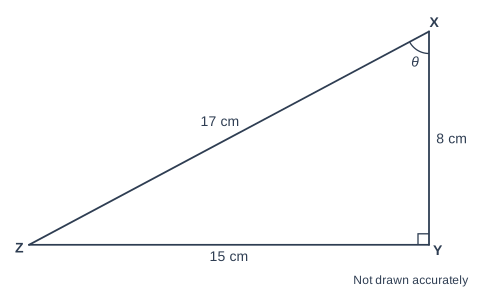
First name the sides from the angle \(\theta\): the hypotenuse is 17 cm (opposite the right angle), the opposite side is 15 cm (it does not touch \(\theta\)) and the adjacent side is 8 cm. CAH says \(\cos\theta\) = adjacent \(\div\) hypotenuse, so \(\cos\theta = \dfrac{8}{17}\). A common mistake is to use the 15 cm side because it is the longer of the two shorter sides.
Mark scheme
1 mark
\(\dfrac{8}{17}\)
\(\cos\theta\) = adjacent \(\div\) hypotenuse. Accept an equivalent fraction such as \(\dfrac{16}{34}\). Do not accept \(\dfrac{15}{17}\) (that is \(\sin\theta\)), \(\dfrac{15}{8}\) (\(\tan\theta\)) or \(\dfrac{8}{15}\). A rounded decimal such as 0.47 does not answer the question, which asks for a fraction.
Question 2
2 marks
You may use a calculator.
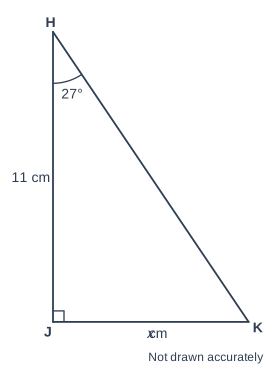
The diagram shows a right-angled triangle HJK. HJ is 11 cm long and angle JHK is \(27^\circ\).
Find the length of JK, marked \(x\) cm. Give your answer correct to 1 decimal place.
The hypotenuse is not needed here: 11 cm is adjacent to the \(27^\circ\) angle and \(x\) is opposite. Opposite and adjacent means TOA, so \(\tan 27^\circ = \dfrac{x}{11}\) and \(x = 11\tan 27^\circ\). Check that it is sensible: \(\tan 27^\circ\) is about 0.5, so \(x\) should be about half of 11.
Mark scheme
1 mark
\(\tan 27^\circ = \dfrac{x}{11}\) or \(11\tan 27^\circ\); or the correct answer 5.6 with no working
Choosing tangent: \(x\) is opposite the \(27^\circ\) angle and 11 cm is adjacent. Max 1 if the answer is not given correct to 1 decimal place.
1 mark
5.6 (cm)
Accept [5.55, 5.65] given to 1 decimal place, i.e. 5.6. The unrounded value 5.6047... scores the first mark only. Do not accept 21.6 (from \(\dfrac{11}{\tan 27^\circ}\)) or 5.0 (from \(11\sin 27^\circ\)). A correct answer with no working scores full marks.
Question 3
3 marks
You may use a calculator.
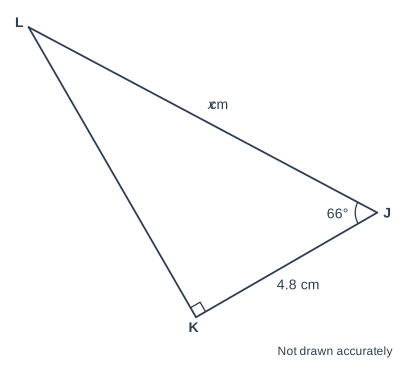
The diagram shows a right-angled triangle JKL.
Calculate the length of the hypotenuse, JL. Give your answer correct to 1 decimal place.
From the \(66^\circ\) angle, 4.8 cm is the adjacent side and \(x\) is the hypotenuse, so use CAH: \(\cos 66^\circ = \dfrac{4.8}{x}\). Because \(x\) is on the bottom, rearrange to \(x = \dfrac{4.8}{\cos 66^\circ}\). A common mistake is to work out \(4.8\cos 66^\circ = 2.0\), but the hypotenuse must be longer than 4.8 cm.
Mark scheme
1 mark
\(\cos 66^\circ = \dfrac{4.8}{x}\); or the correct answer 11.8 with no working
Choosing cosine: 4.8 cm is adjacent to the \(66^\circ\) angle and \(x\) is the hypotenuse. Max 2 if the answer is not given correct to 1 decimal place.
1 mark
\(x = \dfrac{4.8}{\cos 66^\circ}\) or \(4.8 \div 0.4067...\)
Rearranging correctly: dividing by \(\cos 66^\circ\).
1 mark
11.8 (cm)
Accept [11.75, 11.85] given to 1 decimal place, i.e. 11.8. The unrounded value 11.801... scores the first two marks only. Do not accept 2.0 (from \(4.8\cos 66^\circ\)) or 10.8 (from \(4.8\tan 66^\circ\), the opposite side). A correct answer with no working scores full marks.
Question 4
4 marks
You may use a calculator.
Jamal has a ladder that is 6.5 m long. He wants to reach a gutter that is 6.4 m above the ground.
The foot of the ladder stands on level ground and the top leans against the vertical wall of the house. For safety, the ladder must make an angle of \(75^\circ\) with the ground.
Will the top of the ladder reach the gutter? Show how you decide, giving any heights correct to 2 decimal places.
Model answer
The ladder, the wall and the ground make a right-angled triangle with the ladder as the hypotenuse. \(\sin 75^\circ = \dfrac{h}{6.5}\) \(h = 6.5\sin 75^\circ = 6.2785...\) The ladder reaches 6.28 m up the wall (2 d.p.). 6.28 m is less than 6.4 m, so no, the ladder will not reach the gutter. It is about 12 cm short.
Explanation
Picture the ladder leaning on the wall: it is the hypotenuse, and the height it reaches is opposite the \(75^\circ\) angle at its foot, so use sine. The ladder reaches 6.28 m, which is less than 6.4 m. A common mistake is to think that a 6.5 m ladder must reach 6.4 m: a leaning ladder always reaches less high than its own length.
Mark scheme
1 mark
The ladder is the hypotenuse and the height up the wall is opposite the \(75^\circ\) angle, e.g. \(\sin 75^\circ = \dfrac{h}{6.5}\)
1 mark
\(h = 6.5\sin 75^\circ\) or \(6.5 \times 0.9659...\); or the length of ladder needed to reach 6.4 m, \(\dfrac{6.4}{\sin 75^\circ}\)
1 mark
6.28 (m); or 6.63 (m), the length of ladder needed
Accept [6.275, 6.285] given to 2 decimal places, i.e. 6.28. The unrounded value 6.2785..., or 6.27 from rounding \(\sin 75^\circ\) to 0.965 first, scores the first two marks only. For the length of ladder needed, accept [6.625, 6.635] given to 2 decimal places, i.e. 6.63.
1 mark
No, because their height is less than 6.4 m, e.g. 6.28 m is less than 6.4 m (the ladder is about 0.12 m short); or No, because the ladder needed (6.63 m) is longer than 6.5 m
Needs a height from a correct method (6.28, the unrounded 6.2785..., or 6.27 from early rounding) compared with 6.4 m, or a ladder length from a correct method (6.63 or the unrounded 6.6257...) compared with 6.5 m. 'No' with no working, or with a wrong height, scores 0 for this mark.
Ready to try the rest? Every answer you write is marked against the mark scheme, so you can see exactly where the marks are.
Ctrl + Enter to check
Study HelperHints first, answers after you try
Stuck on this one? Ask for a hint and I’ll point you in the right direction, without giving the answer away. Once you’ve checked your answer, I’ll show you how the marks are awarded.