Level:
Correct: 0
Incorrect: 0
Marks: 0/0
Practice
Course:
Topics:
Year 9 Maths Smart practice A mixed round aimed at your weak spots
Unit 1
Number: standard form, indices and accuracy
Unit 2
Percentages and money
Unit 3
Algebraic expressions and proof
Unit 4
Equations and inequalities
Unit 5
Graphs and sequences
Unit 6
Ratio, proportion and rates
Unit 7
Congruence, similarity and transformations
Unit 8
Pythagoras' theorem and trigonometry
Unit 9
3D shapes and measures
Unit 10
Probability
Unit 11
Statistics
Avg
score:
–
Topics
done:
0/46

Cylinders

Practise 28 questions on Cylinders for Year 9 Maths. Write your answer and get it marked in seconds against the mark scheme, point by point, with the Study Helper on hand if you get stuck.

  • 28 questions
  • 1–5 marks each
  • Instant marking
  • No sign-up needed
20 questions, marked as you go

Sample questions with model answers

Here are 4 of the questions in this topic, each with a model answer, an explanation of why it earns the marks and the mark scheme.

Question 1

1 mark

A cylinder and a cuboid stand on a table. They are both 10 cm tall. The area of the base of the cylinder is the same as the area of the base of the cuboid.

Which solid has the bigger volume?

Choose your answer.

  • the cylinder
  • the cuboid
  • they have the same volume
  • you cannot tell

Model answer

They have the same volume.
Volume of each solid = area of the base \(\times\) 10 cm, and the two areas are equal.

Explanation

Cylinders and cuboids are both prisms. The volume of any prism is the area of its cross-section times its length (here, the area of the base times the height). The bases have equal areas and the heights are equal, so the volumes are equal: the shape of the base does not matter, only its area. A common mistake is to think that a round shape must hold more.

Mark scheme
  1. 1 mark

    They have the same volume

    Accept 'the same', 'equal' or the third option clearly chosen. Both solids are prisms, so each volume is the area of the base times the height: the same area times 10 cm gives the same volume.

Question 2

2 marks

You may use a calculator.

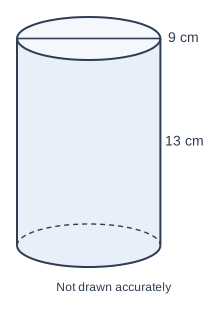
Ruby's pencil pot is a cylinder, as shown in the diagram.

Work out the volume of the pencil pot. Give your answer correct to the nearest cm³.

A cylinder drawn in 3D (hidden edges dashed). The diameter is labelled 9 cm (on a line across the flat top face through its centre). The height is labelled 13 cm (beside the vertical side of the cylinder). The diagram is labelled "Not drawn accurately".

Model answer

Radius \(= 9 \div 2 = 4.5\) cm
\(V = \pi \times 4.5^2 \times 13 = 263.25\pi = 827.02...\)
\(V = 827\) cm³ (to the nearest cm³)

Explanation

The diagram gives the diameter, so halve it to get the radius, 4.5 cm. Then use \(V = \pi r^2 h\). A common mistake is to use the diameter as the radius, which makes the answer 4 times too big.

Mark scheme
  1. 1 mark

    Radius \(9 \div 2 = 4.5\) used in \(\pi \times 4.5^2 \times 13\), or \(263.25\pi\) seen; or the correct answer 827 cm³ with no working

    Max 1 if the answer is not given to the nearest cm³.

  2. 1 mark

    827 (cm³)

    Accept [826.5, 827.5] rounded to the nearest whole number, which is 827 (using \(\pi = 3.14\) gives 826.6, also 827). The unrounded value 827.02... scores the first mark only. Do not accept 3,308 (using 9 cm as the radius) or 1,654 (from \(\pi \times 9 \times 4.5 \times 13\)). A correct answer with no working scores full marks.

Question 3

3 marks

Cylinder A has radius 2 cm and height 10 cm.
Cylinder B has radius 4 cm and height 3 cm.

Ali says,

"Cylinder A is taller, so it has the bigger volume."

Is Ali right? Show how you decide.

Model answer

A: \(\pi \times 2^2 \times 10 = 40\pi\) cm³
B: \(\pi \times 4^2 \times 3 = 48\pi\) cm³
\(48\pi\) is more than \(40\pi\), so Ali is wrong: B has the bigger volume.

Explanation

Work out both volumes before deciding. Height matters, but the radius is squared, so a wider cylinder can hold more even when it is shorter. Leaving both answers in terms of \(\pi\) makes the comparison easy: \(48\pi > 40\pi\). A common mistake is to forget to square the radius: that gives \(20\pi\) for A and \(12\pi\) for B, and the wrong decision.

Mark scheme
  1. 1 mark

    Volume of A: \(\pi \times 2^2 \times 10 = 40\pi\) (cm³)

    Volumes may be left in terms of \(\pi\) or worked out as decimals (125.66...).

  2. 1 mark

    Volume of B: \(\pi \times 4^2 \times 3 = 48\pi\) (cm³)

    Accept 150.79... or 150.8.

  3. 1 mark

    No, cylinder B has the bigger volume, e.g. \(48\pi\) is more than \(40\pi\)

    Needs both volumes worked out and compared (follow through from their volumes if one has a slip). 'No' with no working scores 0.

Question 4

4 marks

A shop sells baked beans in two sizes of tin. Both tins are cylinders.

Tin A has radius 4 cm and height 10 cm. It costs £1.20.
Tin B has radius 5 cm and height 12 cm. It costs £2.00.

Which tin is better value for money? Show how you decide.

Model answer

A: \(\pi \times 4^2 \times 10 = 160\pi\) cm³ for £1.20
B: \(\pi \times 5^2 \times 12 = 300\pi\) cm³ for £2.00
B gives \(300\pi \div 2 = 150\pi\) cm³ for each £1, so £1.20 buys \(1.2 \times 150\pi = 180\pi\) cm³ of B.
\(180\pi\) is more than \(160\pi\), so tin B is better value.

Explanation

To compare value, compare how much you get for the same money, or what the same amount costs. Leaving the volumes in terms of \(\pi\) keeps the numbers easy, and because \(\pi\) is in both it does not change which is bigger. A common mistake is to choose tin A because it is cheaper, without thinking about how much it holds.

Mark scheme
  1. 1 mark

    Volume of A: \(\pi \times 4^2 \times 10 = 160\pi\) (cm³)

    Volumes may be left in terms of \(\pi\) or worked out as decimals (502.65...).

  2. 1 mark

    Volume of B: \(\pi \times 5^2 \times 12 = 300\pi\) (cm³)

    Accept 942.47... or 942.5.

  3. 1 mark

    A correct comparison of value using their volumes and the prices, e.g. A gives \(160\pi \div 1.2 = 133.3\pi\) cm³ for each £1 and B gives \(300\pi \div 2 = 150\pi\) cm³ for each £1; or £1.20 buys \(180\pi\) cm³ of B but only \(160\pi\) cm³ of A; or A costs 0.75p and B costs 0.67p for each \(\pi\) cm³

    Any method that compares the volume for the same money, or the cost of the same volume. Follow through from their volumes.

  4. 1 mark

    Tin B, with correct figures that show it

    'Tin B' with no working, or from comparing only the prices or only the volumes, scores 0 for this mark.

Ready to try the rest? Every answer you write is marked against the mark scheme, so you can see exactly where the marks are.

Topic notes

Cylinders

The big idea

A cylinder is a prism with a circular cross-section: slice across it anywhere and you get the same circle. Tins, candles and water pipes are cylinders. Its volume is the area of the circle times the height, and its surface is two circles and a curved surface that unrolls into a rectangle.

Reminder from Year 8: a circle with radius \(r\) has area \(\pi r^2\) and circumference \(2\pi r\). The diameter is twice the radius.

Volume of a cylinder

A cylinder drawn in 3D (hidden edges dashed). The radius is labelled r (on a line from the centre of the flat top face to its edge). The height is labelled h (beside the vertical side of the cylinder). The diagram is labelled "Diagram NOT accurately drawn".
The radius r is measured on a circular end, and the height h is the distance between the two ends.

Multiply the area of the circle by the height:

\[ V = \pi r^2 h \]

Halve a diameter first, then square the radius. Questions ask for the answer in one of two ways:

  • In terms of \(\pi\): keep \(\pi\) as a symbol, like a letter in algebra. This answer is exact and needs no calculator.
  • Rounded: use the \(\pi\) key on a calculator, write down the full display, then round as asked.

A candle is a cylinder with radius 4 cm and height 15 cm. Work out its volume (a) in terms of \(\pi\) (b) correct to 1 decimal place.

(a) \(V = \pi \times 4^2 \times 15 = \pi \times 16 \times 15 = 240\pi\) cm³

(b) With a calculator, key 240 × π = to get 753.982...

To 1 decimal place the volume is 754.0 cm³. Keep the 0: it shows the accuracy.

Surface area

Take the ends off a closed cylinder, cut down its side and flatten it: you get two circles and a rectangle. The rectangle is \(h\) wide, and its length is the circumference, \(2\pi r\), because it wrapped once round each circle.

The net of a cylinder: a rectangle with a circle of radius r touching its top edge near the left end and another circle touching its bottom edge near the right end. The top edge of the rectangle is labelled 2πr and its right-hand side is labelled h. Inside the rectangle is written: curved surface, area 2πrh.
The net of a closed cylinder: two circles, each with area πr², and a rectangle 2πr long and h wide.
  • Curved surface area \(= 2\pi r h\)
  • Total surface area of a closed cylinder \(= 2\pi r^2 + 2\pi r h\)

Check which surfaces are really there. A cylinder with no lid, such as a bucket, has one circle: \(\pi r^2 + 2\pi r h\). A tube open at both ends has no circles: just \(2\pi r h\).

A tin of tomatoes is 7 cm across and 10 cm tall. A paper label covers its curved surface. Work out the area of the label, and the total area of metal in the closed tin, in terms of \(\pi\).

7 cm across is the diameter, so \(r = 7 \div 2 = 3.5\) cm.

Label: \(2 \times \pi \times 3.5 \times 10 = 70\pi\) cm²

Two ends: \(2 \times \pi \times 3.5^2 = 24.5\pi\) cm²

Metal (ends and curved side): \(24.5\pi + 70\pi = 94.5\pi\) cm². To see its size, key 94.5 × π = to get 296.88..., about 296.9 cm².

Capacity

Capacity is how much a container holds. 1 cm³ holds 1 ml, so 1000 cm³ = 1 litre. Use the inside measurements of the container.

A jug is a cylinder with inside radius 7 cm. The lemonade in it is 16 cm deep. How many 250 ml cups can it fill?

Use a calculator. Volume: \(\pi \times 7^2 \times 16 = 784\pi\) cm³. Key 784 × π = to get 2463.0..., so there is 2463 ml (2.463 litres) of lemonade.

\(2463.0 \div 250 = 9.85...\)

There is not quite enough for a 10th cup, so round down: 9 cups.

Stretch: finding the height or the radius

Work backwards from \(V = \pi r^2 h\). The height is \(h = V \div (\pi r^2)\). For the radius, find \(r^2 = V \div (\pi h)\), then take the square root.

A cube of modelling clay has edges of 6 cm. It is reshaped into a cylinder with radius 3 cm. How tall is the cylinder, correct to 1 decimal place?

Volume of clay: \(6 \times 6 \times 6 = 216\) cm³. Reshaping does not change the volume.

\(\pi \times 3^2 \times h = 216\), so \(h = 216 \div (9\pi)\)

On a calculator key 216 ÷ ( 9 × π ) = to get 7.639..., so the cylinder is 7.6 cm tall.

Remember

  • Volume: \(V = \pi r^2 h\)
  • Curved surface: \(2\pi r h\). Closed cylinder: \(2\pi r^2 + 2\pi r h\)
  • 1 ml = 1 cm³ and 1 litre = 1000 cm³

Common mistakes

  • Using the diameter as the radius. The volume comes out 4 times too big.
  • Not squaring the radius. With radius 5 cm and height 2 cm, the volume is \(\pi \times 5^2 \times 2 = 50\pi\) cm³, not \(10\pi\) cm³.
  • Using \(\pi r^2\) for the length of the rectangle in the net. It is the circumference, \(2\pi r\).
  • Counting two circles for a bucket, or only one for a closed tin.
  • Giving a decimal when the question asks for an answer in terms of \(\pi\).

Top tip

Write \(r = \) ... and \(h = \) ... next to the diagram before you start, with every length in the same unit: a pipe 2 m long with a radius of 3 cm is 200 cm long.

Study Helper Hints first, answers after you try

Stuck on this one? Ask for a hint and I’ll point you in the right direction, without giving the answer away. Once you’ve checked your answer, I’ll show you how the marks are awarded.