Practise 27 questions on Pythagoras' theorem: shorter sides and problems for Year 9 Maths. Write your answer and get it marked in seconds against the mark scheme, point by point, with the Study Helper on hand if you get stuck.
27 questions
1–5 marks each
Instant marking
No sign-up needed
20 questions, marked as you go
Sample questions with model answers
Here are 4 of the questions in this topic, each with a model answer, an explanation of why it earns the marks and the mark scheme.
Question 1
1 mark
A rectangle has a diagonal of 10 cm. The rectangle is 6 cm wide.
How long is the rectangle?
Model answer
The diagonal is the hypotenuse. \(l^2 = 10^2 - 6^2 = 100 - 36 = 64\) \(l = \sqrt{64} = 8\) The rectangle is 8 cm long.
Explanation
A diagonal cuts a rectangle into two right-angled triangles. The diagonal is the hypotenuse, and the width and the length are the two shorter sides. You know the hypotenuse, so subtract the squares. The lengths 6, 8 and 10 are double the Pythagorean triple 3, 4, 5. A common mistake is to work out \(10 - 6 = 4\).
Mark scheme
1 mark
8 (cm)
From \(10^2 - 6^2 = 100 - 36 = 64\) and \(\sqrt{64} = 8\). Do not accept 4 (\(10 - 6\)) or 11.7 (from adding the squares). A correct answer with no working scores full marks.
Question 2
2 marks
You may use a calculator.
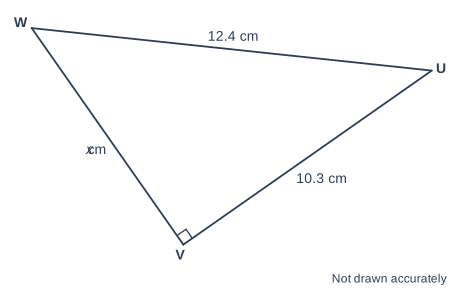
The diagram shows a right-angled triangle UVW.
Work out the value of \(x\). Give your answer correct to 1 decimal place.
UW, 12.4 cm, is opposite the right angle, so it is the hypotenuse and \(x\) is a shorter side. Subtract the squares, then take the square root. Check: your answer must be shorter than 12.4 cm. If you get 16.1, you have added the squares instead of subtracting them.
Mark scheme
1 mark
\(12.4^2 - 10.3^2\) or \(153.76 - 106.09\) or 47.67; or the correct answer 6.9 with no working
Max 1 if the answer is not given correct to 1 decimal place.
1 mark
6.9
Accept [6.85, 6.95] given correct to 1 decimal place, i.e. 6.9. Accept \(x = 6.9\) or 6.9 cm. The unrounded value 6.904... scores the first mark only. Do not accept 16.1 (from adding the squares) or 2.1 (\(12.4 - 10.3\)). A correct answer with no working scores full marks.
Question 3
3 marks
You may use a calculator.
On a coordinate grid, P is the point \((-4, 7)\) and Q is the point \((3, -2)\).
Work out the distance from P to Q. Give your answer correct to 1 decimal place.
Sketch the two points: PQ is the hypotenuse of a right-angled triangle with a horizontal side and a vertical side. Find each one by subtracting coordinates, taking care with the negatives: \(3 - (-4) = 7\). Squares are never negative, so it does not matter which way round you subtract. A common mistake is to work out \(3 - 4 = -1\) instead of \(3 - (-4) = 7\).
Mark scheme
1 mark
Horizontal distance 7 and vertical distance 9 (or \(-9\)); or the correct answer 11.4 with no working
Max 2 if the answer is not given correct to 1 decimal place.
1 mark
\(7^2 + 9^2\) or \(49 + 81\) or 130
Follow through their two distances.
1 mark
11.4 (units)
Accept [11.35, 11.45] given correct to 1 decimal place, i.e. 11.4. The unrounded value 11.401... scores the first two marks only. Do not accept 16 (adding 7 and 9) or 5.1 (from distances of 1 and 5, sign errors). A correct answer with no working scores full marks.
Question 4
4 marks
You may use a calculator.
Bilal's vegetable patch is a rectangle. A diagonal of the patch is 9.7 m long. One side of the patch is 6.5 m long.
Bilal wants a fence along the whole edge of the patch. He can only buy fencing in a whole number of metres.
How many metres of fencing must he buy?
Model answer
The diagonal is the hypotenuse. \(s^2 = 9.7^2 - 6.5^2 = 94.09 - 42.25 = 51.84\) \(s = \sqrt{51.84} = 7.2\) m Perimeter \(= 2 \times (6.5 + 7.2) = 27.4\) m Bilal must buy 28 m of fencing.
Explanation
First find the missing side with Pythagoras' theorem: the diagonal is the hypotenuse, so subtract the squares. The perimeter is then twice the sum of the two sides, 27.4 m. Fencing comes in whole metres, so Bilal must round up to 28 m. A common mistake is to round 27.4 down to 27 m, which would leave a gap.
Mark scheme
1 mark
\(9.7^2 - 6.5^2\) or \(94.09 - 42.25\) or 51.84; or the correct answer 28 m with no working
Finding the other side of the rectangle.
1 mark
Other side \(= \sqrt{51.84} = 7.2\) (m)
1 mark
Perimeter \(= 2 \times (6.5 + 7.2) = 27.4\) (m)
Follow through their other side.
1 mark
28 (m)
Follow through their perimeter rounded up to the next whole metre. 27 m (rounding down) does not score this mark: it is not enough fencing. Do not accept 33 (from using the diagonal as a side, 32.4 m). A correct answer with no working scores full marks.
Ready to try the rest? Every answer you write is marked against the mark scheme, so you can see exactly where the marks are.
Ctrl + Enter to check
Study HelperHints first, answers after you try
Stuck on this one? Ask for a hint and I’ll point you in the right direction, without giving the answer away. Once you’ve checked your answer, I’ll show you how the marks are awarded.