Practise 22 questions on Combining and describing transformations for Year 9 Maths. Write your answer and get it marked in seconds against the mark scheme, point by point, with the Study Helper on hand if you get stuck.
22 questions
1–5 marks each
Instant marking
No sign-up needed
20 questions, marked as you go
Sample questions with model answers
Here are 4 of the questions in this topic, each with a model answer, an explanation of why it earns the marks and the mark scheme.
Question 1
1 mark
A shape is reflected in the line \(x = 3\). One vertex of the shape is at the point \((3, 5)\).
Write down the coordinates of the image of this vertex.
Model answer
The point \((3, 5)\) is on the line \(x = 3\), so it does not move. The image is \((3, 5)\).
Explanation
A reflection sends each point to the same distance on the other side of the mirror line. This vertex has x-coordinate 3, so it is on the mirror line itself: its distance from the line is 0 and it stays where it is. Points that do not move in a transformation are called invariant points. A common mistake is to reflect in the y-axis instead and give \((-3, 5)\).
Mark scheme
1 mark
\((3, 5)\)
Accept 3, 5 without brackets, or 'it stays at (3, 5)'. Do not accept (-3, 5) (reflected in the y-axis) or (3, 1) (reflected in the line y = 3).
Question 2
2 marks
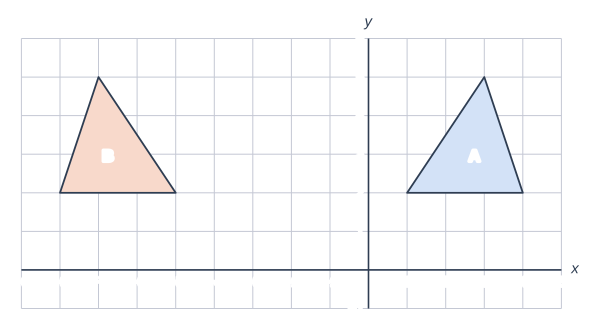
Triangles A and B are drawn on the grid. One transformation maps A onto B.
Describe this transformation fully.
Model answer
B is a mirror image of A (flipped over), so this is a reflection. The corner \((1, 2)\) goes to \((-5, 2)\): only the x-coordinate changes, so the mirror line is vertical. Halfway between 1 and \(-5\) is \(-2\). Reflection in the line \(x = -2\).
Explanation
B is flipped over compared with A, so the transformation is a reflection. Each corner and its image are the same distance from the mirror line, so the line is halfway between them: halfway between 1 and \(-5\) is \(-2\). Every point on a vertical line has the same x-coordinate, so the line is \(x = -2\). A common mistake is to call a vertical line \(y = -2\).
Mark scheme
1 mark
Reflection
'Describe fully' for a reflection needs the word reflection and the equation of the mirror line. Naming more than one transformation scores 0 in total.
1 mark
in the line \(x = -2\)
Do not accept y = -2 (the wrong letter) or x = 2, or a description of the line without its equation (e.g. 'a vertical line'). A correct description with no working scores full marks.
Question 3
3 marks
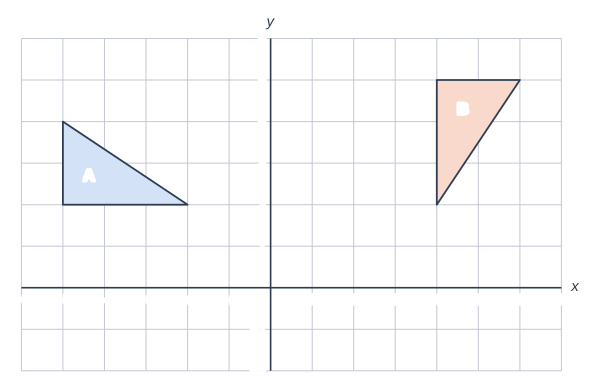
The grid shows two triangles, A and B.
Which single transformation maps A onto B? Describe it fully.
Model answer
B is A turned round (not flipped), so this is a rotation. The side from \((-5, 2)\) to \((-2, 2)\) points right; its image, from \((4, 5)\) to \((4, 2)\), points down. Right to down is a quarter turn clockwise. The corner \((-5, 2)\) is 6 left and 3 up from \((1, -1)\). Its image \((4, 5)\) is 3 right and 6 up from \((1, -1)\): the same move turned a quarter turn clockwise. Rotation \(90^\circ\) clockwise about \((1, -1)\).
Explanation
B is A turned round, not flipped over, so it is a rotation. Compare a side of A with the matching side of B to find the angle and direction: a side pointing right now points down, which is a quarter turn clockwise. To find the centre, try points (tracing paper helps) until turning A about that point lands on B; the centre is the same distance from each corner as from its image. A common mistake is to give the angle without a direction.
Mark scheme
1 mark
Rotation
'Describe fully' for a rotation needs three things: the word rotation, the angle with its direction, and the centre. Naming more than one transformation scores 0 in total.
1 mark
\(90^\circ\) clockwise
Accept '270° anticlockwise' or 'a quarter turn clockwise'. Do not accept 90° with no direction, or 90° anticlockwise.
1 mark
about the centre \((1, -1)\)
The centre must be given as coordinates. A correct description with no working scores full marks.
Question 4
4 marks
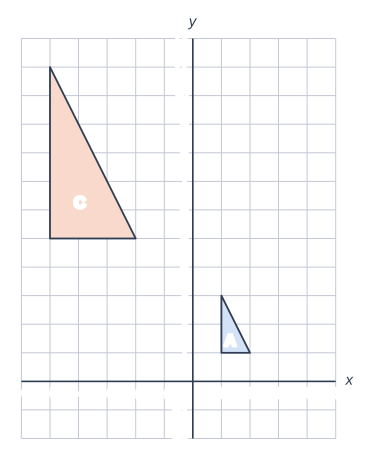
Triangle A is enlarged by scale factor 3, with centre the origin, to give triangle B. Triangle B is then translated by the vector \(\begin{pmatrix} -8 \\ 2 \end{pmatrix}\) to give triangle C. The diagram shows triangles A and C. Triangle B is not shown.
Describe fully the single transformation that maps triangle A onto triangle C.
Model answer
C is 3 times the size of A and faces the same way, so A to C is an enlargement with scale factor 3. Corner \((1, 1)\) of A goes to \((-5, 5)\) on C: 6 left and 4 up. C's corner is 3 times as far from the centre as A's corner, so this move is twice the distance from the centre to A's corner. Half of the move is 3 left and 2 up, so the centre is 3 right and 2 down from \((1, 1)\): \((4, -1)\). Check: \((2, 1)\) goes to \((-2, 5)\), 4 left and 4 up; half is 2 left and 2 up, so the centre is \((2 + 2, 1 - 2) = (4, -1)\). Enlargement, scale factor 3, centre \((4, -1)\).
Explanation
The translation moves the enlarged triangle without changing its size, so C is still 3 times the size of A: the single transformation is an enlargement with scale factor 3, but its centre is no longer the origin. Find the new centre from A and C, using lines through matching corners. Check it: \((4, -1)\) goes to \((12, -3)\) in the enlargement and then back to \((4, -1)\) in the translation, so it is the invariant point. A common mistake is to keep the centre at the origin.
Mark scheme
1 mark
Enlargement
'Describe fully' for an enlargement needs the word enlargement, the scale factor and the centre. Naming two transformations scores 0 in total.
1 mark
scale factor 3
Do not accept 1/3.
1 mark
A correct method for the centre, e.g. lines through matching corners of A and C extended to meet, or half of the move from a corner of A to its image on C, taken the other way from A; or one coordinate of the centre correct, \(x = 4\) or \(y = -1\)
May be implied by a correct centre. Centre (0, 0) scores 0 for this mark and the next.
1 mark
centre \((4, -1)\)
The centre must be given as coordinates. A correct description with no working scores full marks.
Ready to try the rest? Every answer you write is marked against the mark scheme, so you can see exactly where the marks are.
Ctrl + Enter to check
Study HelperHints first, answers after you try
Stuck on this one? Ask for a hint and I’ll point you in the right direction, without giving the answer away. Once you’ve checked your answer, I’ll show you how the marks are awarded.