Level:
Correct: 0
Incorrect: 0
Marks: 0/0
Practice
Course:
Topics:
Year 9 Maths Smart practice A mixed round aimed at your weak spots
Unit 1
Number: standard form, indices and accuracy
Unit 2
Percentages and money
Unit 3
Algebraic expressions and proof
Unit 4
Equations and inequalities
Unit 5
Graphs and sequences
Unit 6
Ratio, proportion and rates
Unit 7
Congruence, similarity and transformations
Unit 8
Pythagoras' theorem and trigonometry
Unit 9
3D shapes and measures
Unit 10
Probability
Unit 11
Statistics
Avg
score:
–
Topics
done:
0/46

Direct and inverse proportion

Practise 28 questions on Direct and inverse proportion for Year 9 Maths. Write your answer and get it marked in seconds against the mark scheme, point by point, with the Study Helper on hand if you get stuck.

  • 28 questions
  • 1–5 marks each
  • Instant marking
  • No sign-up needed
20 questions, marked as you go

Sample questions with model answers

Here are 4 of the questions in this topic, each with a model answer, an explanation of why it earns the marks and the mark scheme.

Question 1

1 mark

3 friends take 8 hours to deliver leaflets to every house in a village.
Each friend delivers leaflets at the same rate.

How long would it take 1 friend to deliver all the leaflets on their own?

Model answer

The job is \(3 \times 8 = 24\) hours of work for one person.
1 friend takes 24 hours.

Explanation

The whole job is \(3 \times 8 = 24\) hours of work for one person. With fewer people the job takes longer, so you multiply, not divide. A common mistake is to work out \(8 \div 3\), but one friend on their own must take longer than three friends together.

Mark scheme
  1. 1 mark

    24 hours

    Accept 24. Do not accept 2.67 hours or \(2\dfrac{2}{3}\) hours (from \(8 \div 3\)) or 5 hours (from \(8 - 3\)). A correct answer with no working scores full marks.

Question 2

2 marks

\(y\) is inversely proportional to \(x\).
When \(x = 8\), \(y = 4.5\).

Work out the value of \(y\) when \(x = 12\).

Model answer

\(y = \dfrac{k}{x}\)
\(k = xy = 8 \times 4.5 = 36\)
\(y = \dfrac{36}{12} = 3\)

Explanation

Find \(k\) first: in inverse proportion \(k = x \times y\), so \(k = 8 \times 4.5 = 36\). Then \(y = \dfrac{36}{x}\), and when \(x = 12\), \(y = 36 \div 12 = 3\). Check: \(x\) went up, so \(y\) should go down, and 3 is less than 4.5.

Mark scheme
  1. 1 mark

    \(k = 8 \times 4.5 = 36\) or \(y = \dfrac{36}{x}\); or the correct answer 3 with no working

    Or a multiplier method: \(x\) is multiplied by 1.5, so \(4.5 \div 1.5\).

  2. 1 mark

    3

    Accept \(y = 3\). Do not accept 6.75 (from \(4.5 \times 1.5\), direct proportion). A correct answer with no working scores full marks.

Question 3

3 marks

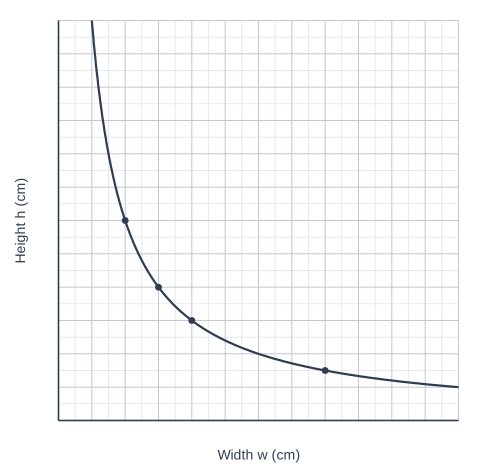
Ali is designing rectangular labels. All of the labels have the same area.
The graph shows the width, \(w\) cm, and the height, \(h\) cm, of these labels. Four points on the curve are marked with dots.

Write a formula for \(h\) in terms of \(w\).
One of these labels is 16 cm wide. Find its height.

A graph of Height h (cm) (vertical axis, 0 to 24, marked every 2) against Width w (cm) (horizontal axis, 0 to 12, marked every 1), on a grid with 2 small squares to each large square. The curve is a curve: it gets closer and closer to the line y = 0 (the x-axis) as x goes further right without reaching it. A dot is marked at (2, 12). A dot is marked at (3, 8). A dot is marked at (4, 6). A dot is marked at (8, 3).

Model answer

From the graph, when \(w = 4\), \(h = 6\).
Area \(= 4 \times 6 = 24\), so \(hw = 24\).
\(h = \dfrac{24}{w}\)
When \(w = 16\): \(h = \dfrac{24}{16} = 1.5\) cm

Explanation

The graph is a curve that falls more and more slowly, which is the shape of inverse proportion. Every label has the same area, so width × height is the same for every point on the curve: \(4 \times 6 = 24\) and \(3 \times 8 = 24\). That gives \(h = \dfrac{24}{w}\). The width 16 cm is off the graph, which is why the formula is useful. A common mistake is to treat the curve as a straight line and carry it on down to the axis.

Mark scheme
  1. 1 mark

    Reads a pair of values from the graph and multiplies them, e.g. \(4 \times 6 = 24\) or \(2 \times 12 = 24\); or the correct formula with no working

    Any correct pair from the curve: (1, 24), (2, 12), (3, 8), (4, 6), (6, 4), (8, 3), (12, 2). Each value is read within half a small square: a width within 0.25 cm and a height within 0.5 cm of a point on the curve (e.g. any height in [5.5, 6.5] at \(w = 4\)).

  2. 1 mark

    \(h = \dfrac{24}{w}\)

    Accept \(h = 24 \div w\) or \(hw = 24\). Follow through: a formula \(h = \dfrac{k}{w}\) with \(k\) worked out correctly from their own reading within these ranges scores this mark.

  3. 1 mark

    1.5 (cm)

    Follow through their constant \(\div 16\). A correct height with no working scores this mark; a correct formula and a correct height with no working scores full marks.

Question 4

4 marks

Asha cycles to her grandparents' house. She always takes the same route.
The time the journey takes is inversely proportional to her average speed.

At an average speed of 12 km/h, the journey takes 40 minutes.

Asha says, "If I cycle at 18 km/h, that is 50% faster, so the journey will take 50% less time. It will take 20 minutes."

Is Asha right?
Work out the actual percentage decrease in the time.

Model answer

\(12 \times 40 = 480\), so speed × time is always 480.
At 18 km/h: \(480 \div 18 = 26\dfrac{2}{3}\) minutes (26 minutes 40 seconds).
Asha is not right: it takes \(26\dfrac{2}{3}\) minutes, not 20 minutes.
Decrease: \(40 - 26\dfrac{2}{3} = 13\dfrac{1}{3}\) minutes.
\(\dfrac{13\frac{1}{3}}{40} = \dfrac{1}{3}\), so the time goes down by \(33\dfrac{1}{3}\%\).

Explanation

In inverse proportion, speed × time stays the same: \(12 \times 40 = 480\). At 18 km/h the time is \(480 \div 18 = 26\dfrac{2}{3}\) minutes. The speed is multiplied by 1.5, so the time is divided by 1.5, which is the same as multiplying by \(\dfrac{2}{3}\). That is a decrease of a third, \(33\dfrac{1}{3}\%\), not 50%. Asha's mistake is to expect the same percentage change in both quantities: that only happens in direct proportion, where a 50% rise in one gives a 50% rise in the other.

Mark scheme
  1. 1 mark

    A correct method for the time at 18 km/h, e.g. \(12 \times 40 = 480\) then \(480 \div 18\), or \(40 \times \dfrac{12}{18}\), or the distance \(12 \times \dfrac{40}{60} = 8\) km then \(8 \div 18\) hours; or the correct time \(26\dfrac{2}{3}\) minutes (26 minutes 40 seconds) with no working

  2. 1 mark

    \(26\dfrac{2}{3}\) minutes

    Accept 26 minutes 40 seconds, 26.7 minutes, 26.67 minutes or \(\dfrac{4}{9}\) of an hour.

  3. 1 mark

    No, with a correct comparison: the journey takes \(26\dfrac{2}{3}\) minutes, not 20 minutes

    'No' on its own scores 0. Accept 'No, the time goes down by a third, not by a half' with correct working.

  4. 1 mark

    \(33\dfrac{1}{3}\%\)

    From \(40 - 26\dfrac{2}{3} = 13\dfrac{1}{3}\) and \(\dfrac{13\frac{1}{3}}{40} \times 100\), or from \(1 - \dfrac{2}{3} = \dfrac{1}{3}\). Accept 33.3% or 33%, or 'a third'. Do not accept 50% or 13.3%.

Ready to try the rest? Every answer you write is marked against the mark scheme, so you can see exactly where the marks are.

Topic notes

Direct and inverse proportion

The big idea

In direct proportion two quantities change together: double one and the other doubles. In inverse proportion they work against each other: double one and the other halves. Twice as many workers finish a job in half the time.

Reminder from Year 8: if \(y\) is directly proportional to \(x\), then \(y \div x\) is the same for every pair and \(y = kx\). The number \(k\) is the constant of proportionality. The graph is a straight line through the origin.

Inverse proportion

If \(y\) is inversely proportional to \(x\), then \(x \times y\) is the same for every pair. Multiply \(x\) by 3 and \(y\) is divided by 3. Everyday examples:

  • the number of workers and the time a job takes;
  • the speed and the time for the same journey;
  • the number of people sharing a fixed amount and how much each one gets.

For workers, first find the total amount of work: number of workers × time. It stays the same however many workers there are.

8 pickers take 6 hours to pick a field of strawberries. The farmer wants the field picked in 5 hours. How many pickers does she need?

Total work: \(8 \times 6 = 48\) hours for one picker.

In 5 hours: \(48 \div 5 = 9.6\) pickers.

You cannot have part of a picker, and 9 pickers would take \(48 \div 9 = 5.33...\) hours, which is too long. She needs 10 pickers.

Check: less time needs more pickers, and 10 is more than 8.

The formulae \(y = kx\) and \(y = \dfrac{k}{x}\)

Direct proportionInverse proportion
Formula\(y = kx\)\(y = \dfrac{k}{x}\)
Finding \(k\) from one pair\(k = y \div x\)\(k = x \times y\)
  1. Write the formula with \(k\) in it.
  2. Put in the pair of values you know and find \(k\).
  3. Write the formula again with the number in place of \(k\).
  4. Use it to find other values.

At a steady temperature, the pressure, \(P\) kilopascals (kPa), of some air sealed in a syringe is inversely proportional to its volume, \(V\) cm³. When \(V = 40\), \(P = 150\). Write a formula for \(P\) in terms of \(V\). Find \(P\) when \(V = 25\), and \(V\) when \(P = 200\).

\(P = \dfrac{k}{V}\), so \(k = 40 \times 150 = 6000\)

\(P = \dfrac{6000}{V}\)

When \(V = 25\): \(P = 6000 \div 25 = 240\) kPa. The air is squashed into less space, so the pressure goes up.

When \(P = 200\): \(200 = \dfrac{6000}{V}\), so \(V = 6000 \div 200 = 30\) cm³.

Which kind of proportion?

  • In a table: if \(y \div x\) is the same for every pair, it is direct proportion. If \(x \times y\) is the same for every pair, it is inverse proportion. Otherwise it is neither.
  • On a graph: direct proportion is a straight line through the origin. Inverse proportion is a curve that gets closer and closer to both axes but never touches them.
  • In words: ask "if one doubles, what happens to the other?" One going down as the other goes up is not enough: a candle gets shorter as it burns, but time × height does not stay the same.
A coordinate grid with x from 0 to 8 and y from 0 to 12; each grid square is 1 unit across, and the axes cross at the origin O. The line labelled "y = 2x (direct)" is a straight line sloping upwards from left to right passing through the origin and (2, 4). The curve labelled "y = 24/x (inverse)" is a curve: it gets closer and closer to the line y = 0 (the x-axis) as x goes further right without reaching it. The line labelled "y = 2x (direct)" and the curve labelled "y = 24/x (inverse)" cross at about (3.5, 6.9). A dot at (2, 4) is labelled "(2, 4)". A dot at (4, 8) is labelled "(4, 8)". A dot at (4, 6) is labelled "(4, 6)". A dot at (8, 3) is labelled "(8, 3)".
Direct proportion: when x doubles from 2 to 4, y = 2x doubles from 4 to 8. Inverse proportion: when x doubles from 4 to 8, y = 24/x halves from 6 to 3.

The table shows the length, \(L\) cm, of a vibrating string and the frequency, \(f\) hertz (Hz), of the note it makes. Which kind of proportion is this? Find the frequency when \(L = 55\).

Length, \(L\) (cm)604030
Frequency, \(f\) (Hz)220330440

Direct? \(220 \div 60 = 3.666...\) but \(330 \div 40 = 8.25\), so no.

Inverse? \(60 \times 220 = 13{,}200\), \(40 \times 330 = 13{,}200\) and \(30 \times 440 = 13{,}200\). Length × frequency is always the same, so \(f\) is inversely proportional to \(L\): a shorter string makes a higher note.

\(f = \dfrac{13{,}200}{L}\), so when \(L = 55\), \(f = 13{,}200 \div 55 = 240\) Hz.

Remember

  • Direct: \(y = kx\), \(k = y \div x\), a straight line through the origin.
  • Inverse: \(y = \dfrac{k}{x}\), \(k = x \times y\), a curve that never touches the axes.
  • In inverse proportion, multiplying one quantity by a number divides the other by the same number.
  • Workers × time is the total work, and it stays the same.

Common mistakes

  • Treating inverse proportion as direct: if 8 pickers take 6 hours, 1 picker takes \(8 \times 6 = 48\) hours, not \(6 \div 8\).
  • Calling it inverse proportion just because one quantity goes up as the other goes down.
  • Dividing to find \(k\) in inverse proportion: for \(y = \dfrac{k}{x}\), \(k = x \times y\).
  • Stopping at \(k = 6000\) when the question asks for a formula: write \(P = \dfrac{6000}{V}\).
  • Rounding down a number of workers: 9.6 pickers means 10.

Top tip

Check an inverse proportion answer by multiplying: the new pair must give the same \(k\). In the syringe example, \(25 \times 240 = 6000\) and \(30 \times 200 = 6000\).

Study Helper Hints first, answers after you try

Stuck on this one? Ask for a hint and I’ll point you in the right direction, without giving the answer away. Once you’ve checked your answer, I’ll show you how the marks are awarded.