Practise 27 questions on Equations of straight lines for Year 9 Maths. Write your answer and get it marked in seconds against the mark scheme, point by point, with the Study Helper on hand if you get stuck.
27 questions
1–5 marks each
Instant marking
No sign-up needed
20 questions, marked as you go
Sample questions with model answers
Here are 4 of the questions in this topic, each with a model answer, an explanation of why it earns the marks and the mark scheme.
Question 1
1 mark
A straight line goes through the origin. It is parallel to the line \(y = 7x - 2\).
What is the equation of the line?
Model answer
Parallel lines have the same gradient, so \(m = 7\). The line goes through \((0, 0)\), so \(c = 0\). \(y = 7x\)
Explanation
Parallel lines have the same gradient, so the new line also has gradient 7. The origin, \((0, 0)\), is on the \(y\)-axis, so the \(y\)-intercept is 0. That gives \(y = 7x + 0\), which is just \(y = 7x\). A common mistake is to keep the \(-2\) as well, but \(y = 7x - 2\) does not go through the origin.
Mark scheme
1 mark
\(y = 7x\)
Accept \(y = 7x + 0\). Do not accept \(y = 7x - 2\) (the given line, which does not go through the origin) or \(y = -7x\) (a different gradient). A correct answer with no working scores full marks.
Question 2
2 marks
Where does the line \(3x + 4y = 24\) cross each axis?
Write the coordinates of both points.
Model answer
On the \(x\)-axis \(y = 0\): \(3x = 24\), so \(x = 8\). The point is \((8, 0)\). On the \(y\)-axis \(x = 0\): \(4y = 24\), so \(y = 6\). The point is \((0, 6)\).
Explanation
Every point on the \(x\)-axis has \(y = 0\), and every point on the \(y\)-axis has \(x = 0\). Put each of these into the equation and solve. This is a quick way to find two points on a line written as \(ax + by = c\). A common mistake is to mix up the two points and write \((6, 0)\) and \((0, 8)\).
Mark scheme
1 mark
\((8, 0)\) (on the \(x\)-axis)
From \(3x = 24\) when \(y = 0\).
1 mark
\((0, 6)\) (on the \(y\)-axis)
From \(4y = 24\) when \(x = 0\). The two points may be given in either order. If the points are swapped, \((6, 0)\) and \((0, 8)\), award 0. A correct answer with no working scores full marks.
Question 3
3 marks
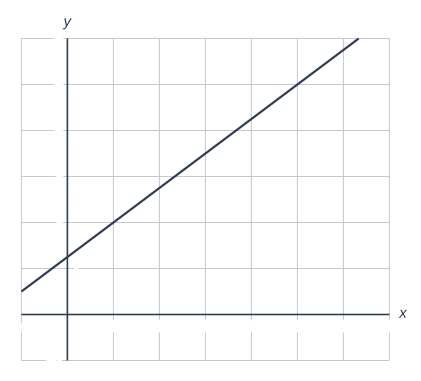
The grid shows line L. The line crosses the \(y\)-axis between two grid lines, so its \(y\)-intercept cannot be read exactly from the grid.
Work out the equation of line L.
Model answer
The line passes through \((1, 2)\) and \((5, 5)\). Gradient \(= \dfrac{5 - 2}{5 - 1} = \dfrac{3}{4}\) \(y = \dfrac{3}{4}x + c\) At \((1, 2)\): \(2 = \dfrac{3}{4} + c\), so \(c = \dfrac{5}{4} = 1.25\) \(y = \dfrac{3}{4}x + 1.25\)
Explanation
Find two points where the line passes exactly through grid corners, here \((1, 2)\) and \((5, 5)\), and use them to work out the gradient. The \(y\)-intercept is not on a grid line, so work it out instead: substitute one of your points into \(y = \dfrac{3}{4}x + c\) and solve for \(c\). A common mistake is to guess the \(y\)-intercept from the grid, as 1 or 1.5.
Mark scheme
1 mark
Gradient \(\dfrac{3}{4}\), e.g. from \((1, 2)\) and \((5, 5)\); or the correct answer \(y = \dfrac{3}{4}x + \dfrac{5}{4}\) with no working
Accept 0.75. A gradient of \(\dfrac{4}{3}\) (run over rise) does not score. The points used must be on the line: \((1, 2)\) and \((5, 5)\) are the only grid corners on it.
1 mark
Substitutes a point on the line into \(y = \dfrac{3}{4}x + c\), e.g. \(2 = \dfrac{3}{4} \times 1 + c\), and works out \(c = \dfrac{5}{4}\) (1.25)
Follow through from their gradient. The question says the intercept cannot be read exactly, so \(c\) must be worked out: a value of \(c\) read or estimated from the grid (such as 1 or 1.5) does not score this mark.
1 mark
\(y = \dfrac{3}{4}x + \dfrac{5}{4}\)
Accept any equivalent form, e.g. \(y = 0.75x + 1.25\), \(4y = 3x + 5\) or \(3x - 4y = -5\); typed forms such as y = 3/4x + 5/4 are fine. Follow through from their gradient and their worked-out \(c\). \(y = \dfrac{3}{4}x + 1\) or \(y = \dfrac{3}{4}x + 1.5\) (the intercept guessed from the grid) scores the first mark only. A correct answer with no working scores full marks.
Question 4
4 marks
M is the midpoint of the line segment from \((-4, 1)\) to \((8, 5)\).
Line L passes through M and through the point \((0, -5)\).
Work out the equation of line L.
Model answer
M \(= \left(\dfrac{-4 + 8}{2}, \dfrac{1 + 5}{2}\right) = (2, 3)\) Gradient of L \(= \dfrac{3 - (-5)}{2 - 0} = \dfrac{8}{2} = 4\) L passes through \((0, -5)\), so \(c = -5\). \(y = 4x - 5\)
Explanation
First find M by halving the totals of the coordinates of the two end points. Now you have two points on L: M and \((0, -5)\). The point \((0, -5)\) is on the \(y\)-axis, so it gives \(c = -5\) straight away. A common mistake is to use the two end points to find the gradient, but L is a different line from the segment.
Mark scheme
1 mark
M \(= (2, 3)\); or the correct answer \(y = 4x - 5\) with no working
1 mark
\(\dfrac{3 - (-5)}{2 - 0}\) or \(\dfrac{8}{2}\)
Follow through from their M.
1 mark
Gradient 4
Follow through from their M. A gradient of \(\dfrac{1}{3}\) (the gradient of the line segment) does not score.
1 mark
\(y = 4x - 5\)
Accept any equivalent form, e.g. \(y = -5 + 4x\) or \(4x - y = 5\). Follow through from their gradient with \(c = -5\). A correct answer with no working scores full marks.
Ready to try the rest? Every answer you write is marked against the mark scheme, so you can see exactly where the marks are.
Ctrl + Enter to check
Study HelperHints first, answers after you try
Stuck on this one? Ask for a hint and I’ll point you in the right direction, without giving the answer away. Once you’ve checked your answer, I’ll show you how the marks are awarded.